









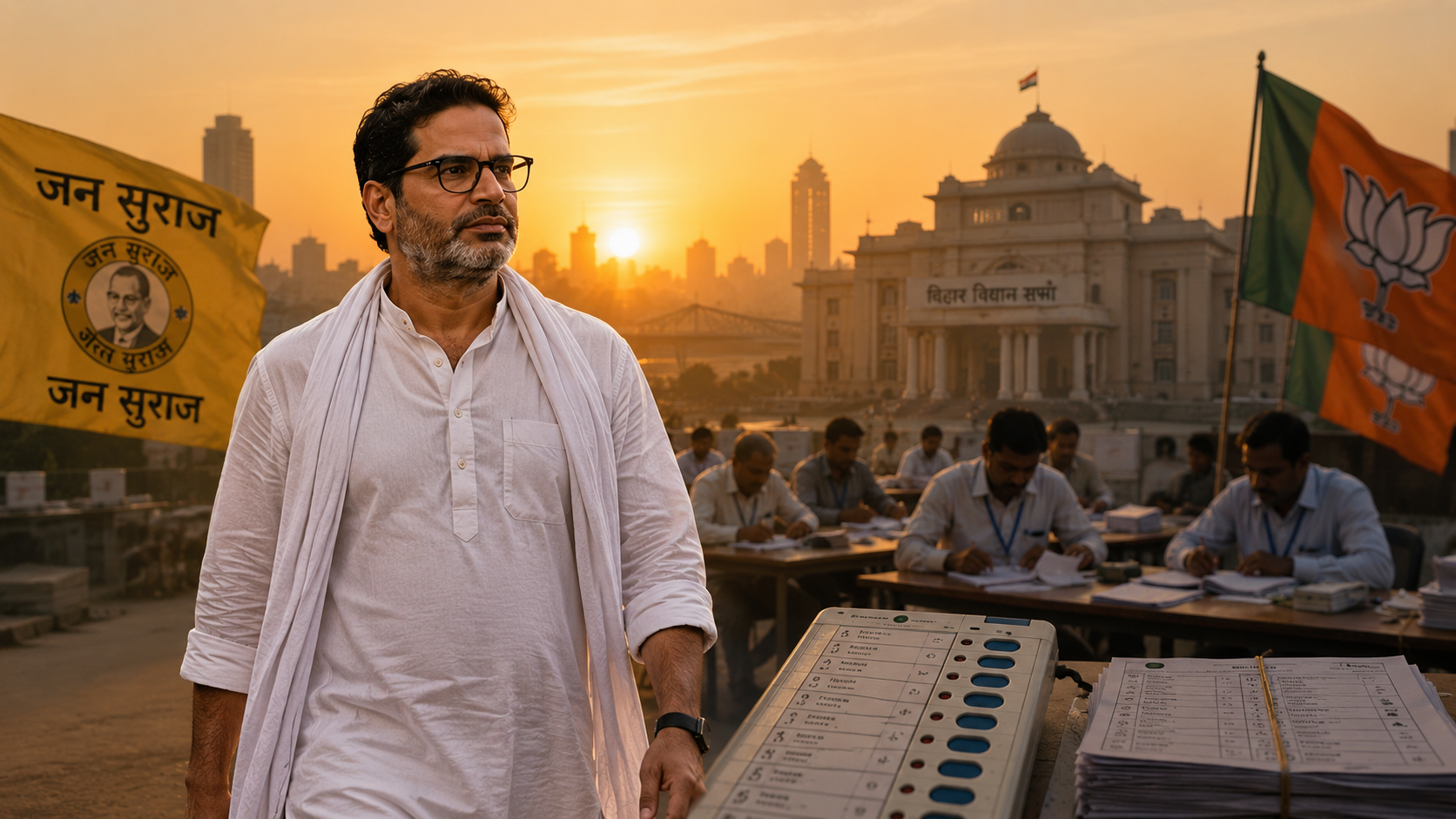
For twenty years, Bankipur has been BJP arithmetic you could set your watch by. On Monday, that arithmetic broke.
As counting entered its final rounds in Patna, Jan Suraaj Party founder Prashant Kishor was sitting on a lead of roughly 12,800 votes over his BJP rival – 44,525 to 31,716 after 22 of 31 rounds, with RJD’s candidate a distant third at 10,562. The BJP, notably, was no longer contesting the arithmetic. By Monday afternoon, its own camp had begun conceding the seat.
That matters beyond one Assembly berth. Bankipur is not a marginal constituency the BJP happened to lose on an off day. The party has held it continuously since 1995, when it was still called Patna West. Nitin Nabin – until recently the BJP’s national president – won it five straight times, most recently defeating RJD’s candidate by more than 50,000 votes in last November’s Assembly election. The seat only fell vacant because Nabin left it to take a Rajya Sabha berth in April. In BJP terms, this was about as close to unlosable as a seat gets.
Which is what makes the manner of the BJP’s campaign here worth pausing on. Within 24 hours of naming Abhishek Bunty as its candidate, the party swapped him out for Neeraj Kumar Sinha, a youth-wing leader making his own electoral debut. Whatever internal calculation prompted that reversal, it cost the BJP some of the settled, institutional advantage that comes with a candidate who isn’t introducing himself to voters mid-campaign – against an opponent who spent the campaign doing exactly what he has spent two decades doing for other people: reading a constituency and building a message around it, except this time the candidate was himself.
Kishor’s own path to this count has been unusual by the standards of Indian politics. Born in Bihar in 1977, he built his reputation not inside a party organisation but outside one – as the strategist credited with shaping winning campaigns for leaders across the spectrum before he built anything of his own. Jan Suraaj began in 2022 as a padyatra, a listening tour rather than a campaign, and only became a registered political party two years later. Kishor did not contest last year’s Bihar Assembly election himself; his party fielded candidates in 238 of 243 seats and secured almost none of the credit it hoped for – roughly 2 percent of the statewide vote, most of its candidates losing their deposits, in several seats trailing even the None-of-the-Above option. It was, by most independent accounts, a rout dressed up in press coverage.
Bankipur is the correction to that story, or at least the first data point in one. It is Kishor’s own electoral debut – not a candidate wearing his party’s colours, but Kishor himself, in a seat his party chose deliberately as a proving ground rather than a soft landing. Turnout was down sharply from the Assembly election eight months ago – a little over 34 percent against nearly 41.5 percent in November – which cuts against any straightforward reading of the result as a groundswell. A lower-turnout bypoll in an urban, relatively better-off constituency is a different electorate than a state-wide Assembly vote, and neither camp should pretend otherwise.
The campaign itself was not free of friction. Kishor has alleged that Patna police detained more than fifty of his party’s workers and supporters in the two days before polling, and has taken the complaint to the Election Commission; police have said the detentions were routine measures during the pre-poll silence period. Neither account has been independently tested at the time of writing, and readers should treat it as an active dispute rather than settled fact.
What the numbers do establish, provisionally, is this: a party that could not win a single seat out of 238 tries eight months ago is on course to win its very first, in a seat the ruling party has not lost in three decades, with the strategist-turned-candidate himself on the ballot. Kishor, for his part, has framed the contest as being about more than one Assembly seat – a test, in his words, of whether Bihar wants a politics organised around jobs, education and stemming migration rather than around contracts and patronage. That is the pitch every insurgent makes. Whether Jan Suraaj can turn one won seat into an organisation capable of holding it, recruiting local leaders, and showing up between elections rather than only during them, is the question this result opens rather than answers.
One seat is one seat. But for a party that spent last November explaining away a wipeout, one seat is also, for the first time, a foothold.
Subscribe Deshwale on YouTube


