









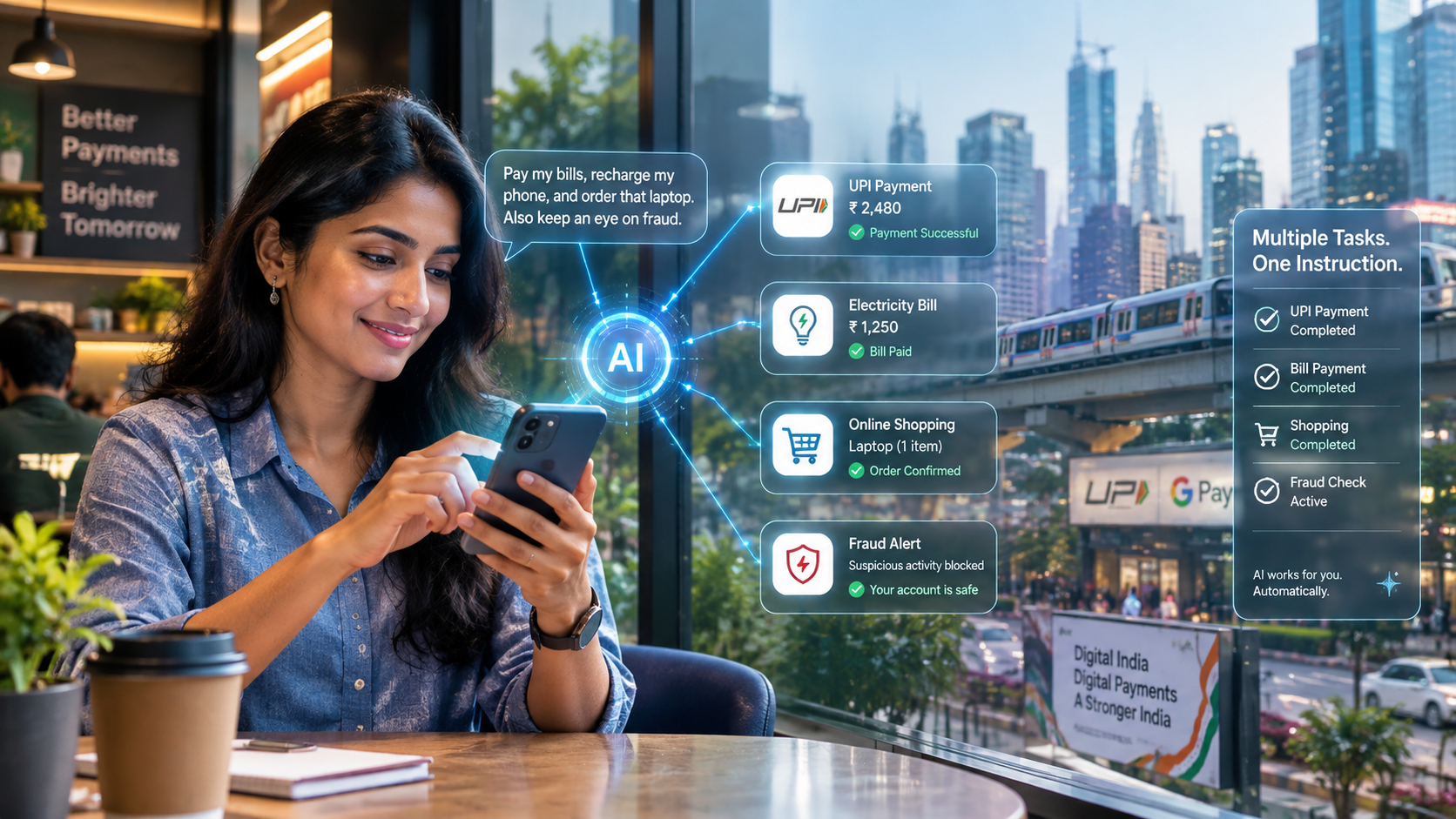
For the last few years, most people’s idea of AI was simple: you type a question into a chatbot, and it types back an answer. Useful, but limited. That phase is now ending. The next wave of AI isn’t built to just answer questions. It’s built to actually do things on your behalf, from start to finish, without you supervising every single step. This shift has a name: agentic AI and in India, it’s moving from tech conferences into everyday life faster than most people realise.
Here’s the simplest way to understand the difference. A chatbot can tell you how to book a train ticket. An AI agent can actually book it checking availability, comparing options, filling in details, and completing the payment, all on its own, based on one instruction from you. That’s the leap happening right now.
One of the clearest signs of this shift is happening inside India’s own payments system. At the Global Fintech Fest held in Mumbai in September 2026, the National Payments Corporation of India, which runs UPI, unveiled plans for what it calls a “Unified Agent Protocol.” In simple terms, this would let an AI agent make small, routine UPI payments for you paying an electricity bill if it’s under a certain amount, for instance, or buying groceries you regularly order without you approving every transaction manually. To keep this safe, the system comes with built-in spending caps, so an agent can only spend within limits you set, with a full record of every transaction it makes.
This isn’t just a future promise. NPCI has already tested the idea through pilot programs involving companies like Razorpay, BigBasket, and AI firms including Anthropic, where a conversational AI assistant was shown discovering products, comparing prices, and completing purchases using UPI, based on a simple instruction from the user.
Banking is another sector where this shift is already visible, even if customers don’t always notice it. Indian banks and financial companies are increasingly using AI agents to handle tasks like customer onboarding, identity verification, and loan processing. Instead of a customer waiting days for paperwork to be checked manually, an AI agent can verify documents, assess eligibility, and move the process forward in a fraction of the time, with a human stepping in only when a final decision or exception is needed.
Fraud prevention is quietly benefiting too. NPCI already uses an AI-based system that scans UPI transactions in real time and flags suspicious activity within milliseconds, helping block large amounts of fraudulent transactions daily. The Reserve Bank of India has also introduced a tool called MuleHunter.AI, designed specifically to detect fake or “mule” bank accounts that are often used to move money in scams. These aren’t chatbots answering questions they’re systems actively working, around the clock, to catch problems before they cause damage.
Beyond banking, the shift is spreading across Indian industries. According to industry research, a very large majority of Indian organisations are expected to deploy AI agents by the end of 2026, with the strongest adoption in manufacturing, retail, and healthcare. Businesses are using these agents to improve productivity, personalise customer service, and catch fraud or risk earlier than before. Industry body NASSCOM has described this move toward agentic AI as one of the biggest shifts for Indian enterprises this year.
For the average Indian, this transformation probably won’t feel dramatic overnight. It’s unlikely to look like a robot managing your entire life. Instead, it will show up in small, practical ways a bill that gets paid automatically within limits you’ve set, a loan application that gets processed in hours instead of days, a fraud attempt that gets blocked before you even notice it happened, or a customer service issue that gets resolved without you repeating your problem five times to five different people.
At the same time, this shift comes with real questions that are still being worked out. Handing an AI system the ability to make payments or decisions on your behalf raises valid concerns about privacy, security, and what happens when something goes wrong. That’s exactly why systems like NPCI’s proposed protocol are being built with strict spending caps, identity checks, and human oversight built in from the start, rather than being left fully autonomous.
What makes India’s position genuinely interesting is the scale it’s operating at. The country already runs UPI, one of the largest real-time payment systems in the world, processing billions of transactions every month. If AI agents get layered onto infrastructure that already works at this scale, the impact won’t be limited to a small group of tech-savvy users. It has the potential to reach the same enormous, everyday user base that UPI already serves.
So the real story isn’t that chatbots are disappearing. It’s that AI is quietly graduating from a tool that talks to one that acts and for millions of Indians, that shift may soon be working in the background of daily life, whether they notice it or not.
Subscribe Deshwale on YouTube


