



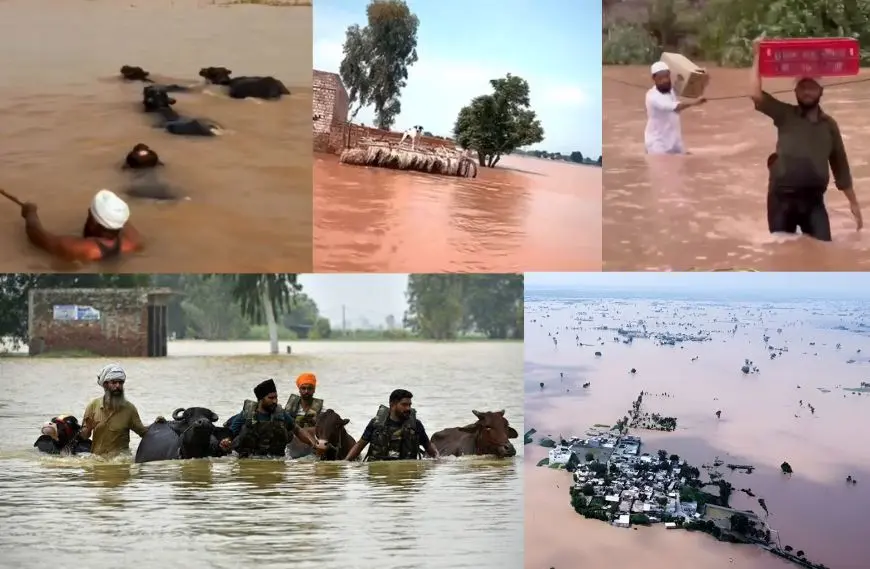
Punjab is reeling from floods that have caused damage worth ₹13,289 crore, crippling crops, roads, and essential services across several districts. Prime Minister Narendra Modi is expected to visit the state on September 9 for an aerial survey and review of the situation. His visit comes at a moment when urgent relief needs, demands for compensation, political calculations, and the wider question of Punjab’s vulnerability to extreme weather all converge, making this more than just a routine disaster assessment.
The relief tug-of-war
Punjab has asked for a special relief package. The state’s leaders argue that only the Centre can provide enough funds to cover losses that already stand at over ₹13,000 crore. But the final call rests with Delhi. That’s where the friction begins.
Central teams have toured flood-hit districts, collected reports, and will now advise on compensation. The process looks neat on paper, but it reveals a deeper tug-of-war. Punjab wants immediate aid, but the Centre prefers to control the pace and scale of relief. This back-and-forth is not new. In India, disaster aid often becomes a test of Centre–State relations, and Punjab’s case is no different.
Floods on the frontier
This is not just a story of swollen rivers and broken roads. It’s also about national security. Districts like Ferozepur, Gurdaspur, and Pathankot, right on the border, are among the worst hit. Floods here don’t only wash away fields, they also weaken the fabric of frontier preparedness.
Border fences, check-posts, and supply routes matter in ways city readers often forget. When the floods hit, these areas struggled with destroyed bridges and cut-off roads. It raises a sharp question: if disaster strikes in such sensitive zones, are we truly ready to keep both civilians and defence infrastructure safe?
Politics in the floodwaters
Every prime ministerial visit carries a political charge, and this one is no exception. Punjab is not an easy ground for the BJP. The party has struggled to expand here after the collapse of its long partnership with the Akali Dal.
By visiting now, Modi signals that he cares about Punjab’s pain. It also helps the BJP project itself as a responsible force, ready to listen and respond. But critics argue that photo-ops from aerial surveys can only go so far. Real relief will depend on how quickly funds reach villages, farmers, and families who have lost everything. Politics and compassion are walking hand in hand here.
Counting the crores
The damage bill is staggering: ₹13,289 crore. Behind this number lies a trail of broken infrastructure, ruined crops, and disrupted lives. Roads, bridges, schools, and hospitals have collapsed or been badly damaged. Crops worth nearly ₹2,000 crore are gone. Power lines, water supply, and even livestock have suffered.
Numbers help us see the scale, but they don’t tell the full story. Think of a farmer who watched his standing paddy sink underwater, or a child whose school has turned into a cracked shell of bricks. Multiply that by thousands, and you begin to grasp why Punjab is calling this a generational setback.
From the sky vs. On the ground
Modi’s visit includes an aerial survey. From up in a helicopter, the floods will look like endless sheets of water swallowing villages and roads. It’s a powerful image for television cameras. But it’s also a limited view.
On the ground, the reality is harsher. Families wade through waist-deep water to collect food. Homes crumble. Hospitals run short of supplies. Farmers fear debt and bankruptcy. Villagers cling to promises of compensation while trying to rebuild with their own hands. The gap between what a leader sees from above and what survivors live through every day is immense. This contrast is what often frustrates people the most.
So, why should we care about this single visit? Because it ties together every thread—relief politics, border security, party calculations, financial shock, and human loss. The floods have exposed cracks not just in embankments but in our systems of governance, planning, and compassion.
When Modi lands in Pathankot and looks down at flooded fields, he won’t just be looking at water. He will be staring at Punjab’s vulnerability, India’s disaster readiness, and the political cost of inaction. The decisions made in the days after this visit will shape how quickly Punjab stands back up, or how long it remains stuck in recovery.
The bigger question
Floods are no longer freak events. Climate change, poor planning, and reckless mining along riverbeds make states like Punjab more fragile each year. Unless long-term fixes are put in place, we will be writing the same headlines again and again.
The story of Modi’s visit is about more than a helicopter ride or a relief cheque. It’s about whether India learns to treat floods as warnings, not surprises.
