







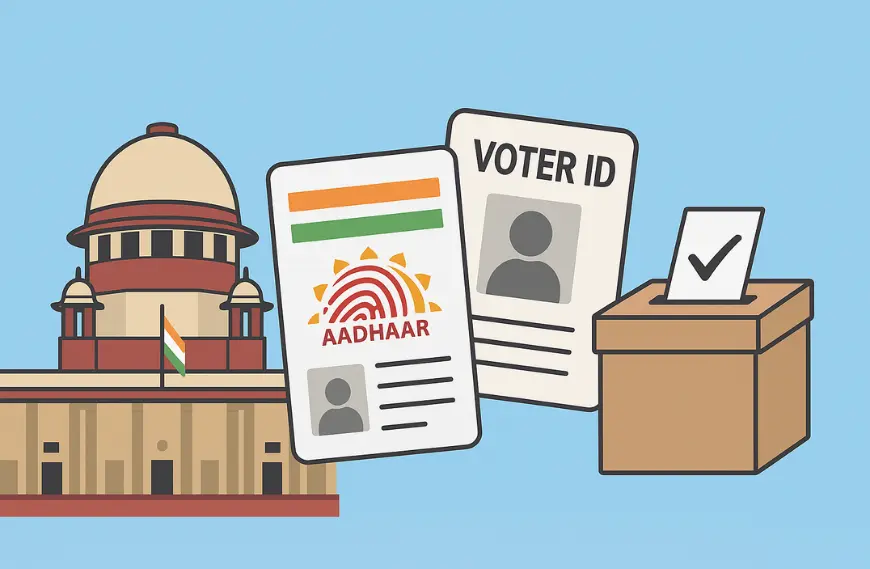
The Supreme Court delivered a landmark ruling today in response to widespread concerns arising from the Special Intensive Revision (SIR) of electoral rolls in Bihar. The judgment aims to make the voter inclusion process more inclusive, transparent, and voter-friendly.
Key Highlights of the Ruling
- Aadhaar Accepted as Proof
The Supreme Court has directed the Election Commission of India (ECI) to allow individuals excluded from the Bihar draft voters’ list to submit Aadhaar cards as valid proof for inclusion. Previously, only one among 11 specific documents mentioned in Form 6 was accepted. - Online and Physical Submission Allowed
Voters or Booth Level Agents (BLAs) can now submit claim forms online or physically. When forms are submitted in person, election officials must provide a receipt of acknowledgement, ensuring transparency. - Political Parties Urged to Help
The Court expressed surprise at the near-absence of objections filed by political parties’ BLAs despite 1.6 lakh such agents existing. Parties are now required to assist voters and report their involvement in the upcoming proceedings - Publication of Deleted Voter Lists
Following an earlier order, ECI has published a searchable list of 65 lakh voters removed from the draft roll during the SIR, including reasons for removal. This data has been made available online and at district offices. - Extended Submission Window
Voters excluded in the draft list have until September 1 to file their claims using Form 6, accompanied by Aadhaar or one of the other 11 allowed documents.
Context & Broader Implications
This directive stems from widespread criticism and litigation challenging the ECI’s June 24 SIR directive for Bihar, which was viewed as potentially disenfranchising voters due to restrictive documentation requirements and significant deletions. Media reports suggested that people could be left out without proper identification or channels to appeal.
The Court emphasized the importance of “en masse inclusion, not exclusion”, noting that measures must be taken to ensure eligible voters are not wrongly left out.
Opposition parties and civic groups lauded the Supreme Court’s intervention as a positive step towards voter rights and electoral fairness.