



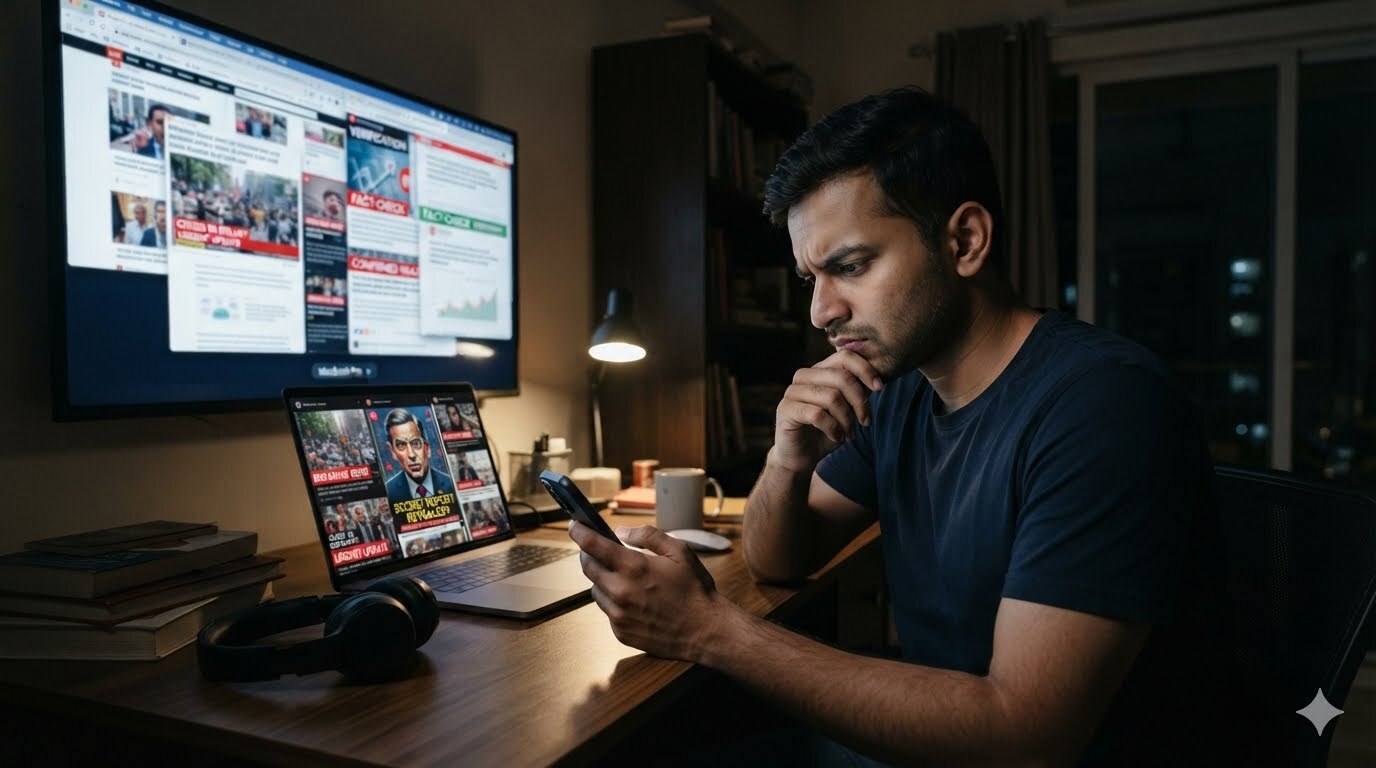
Social media has changed how people create and consume information. With a smartphone and internet access, almost anyone can record a video, share an opinion or publish information for a large audience.
Platforms such as Instagram and TikTok have made content creation easier. They have also given people a space to express their views and participate in public discussions.
However, this freedom has created another challenge. Not everything we see online is true.
The difference between news, opinion, entertainment and misinformation can sometimes be difficult to identify. This becomes even more complicated when artificial intelligence can create or modify realistic images, videos and audio.
Anyone Can Create Content
Having a social media account does not make someone a journalist or an expert.
A creator may have millions of followers and speak confidently about current events. Their videos may also look professional. But popularity and presentation do not prove that the information is accurate.
This does not mean that independent creators are always unreliable. Many creators produce useful and well-researched content. The important point is that viewers should judge information based on evidence and sources, rather than follower counts.
A 2024 UNESCO survey of 500 digital content creators across 45 countries found that 62% did not carry out rigorous and systematic fact-checking before sharing information. The findings show why verification is important for both creators and audiences.
A “Breaking News” Label Is Not Proof
Social media users often come across videos presented as breaking news. Dramatic headlines, emotional music and bold captions can make a claim appear more important or urgent.
But viewers should pause before accepting it.
The first question should be: Where did this information come from?
A reliable report should provide relevant sources and context. If a video makes a major claim without identifying its source or providing supporting evidence, viewers should be cautious.
This is especially important during elections, conflicts, public emergencies and controversial social issues, when misleading information can spread quickly.
Misinformation Does Not Always Look Fake
False information is not always obvious.
An old photograph can be presented as a recent event. A genuine video can be shared with a false caption. A real statement can also be removed from its original context and given a completely different meaning.
Therefore, simply asking whether something “looks real” is not enough.
Before believing a claim, users should ask:
Who is making the claim?
What evidence has been provided?
Where did the information originate?
Can another reliable source confirm it?
These basic questions can prevent people from accepting misleading information too quickly.
AI Has Added a New Challenge
Artificial intelligence has made verification even more important.
AI tools can generate or modify text, photographs, voices and videos. Deepfake technology can create realistic material that appears to show a person saying or doing something that never happened.
However, the presence of AI does not automatically mean content is fake.
AI is also used for legitimate purposes such as translation, accessibility, editing and content creation. Therefore, users should not reject content simply because AI was involved.
Instead, they should determine what was created or altered and verify the underlying claim through reliable sources.
Do Not Treat Comments and Views as Evidence
Comments can sometimes help identify misinformation. Users may provide links to original footage or point out that a photograph is old.
But comments are not proof.
Comment sections can contain facts, opinions, speculation and false claims. The same applies to likes, shares and follower numbers.
A viral post is not automatically a factual post.
Similarly, an accurate report may not receive millions of views.
How Can You Check Information?
There are several simple steps users can follow before sharing or believing a claim.
Check the original source. Find out where the information first appeared.
Look for independent confirmation. Search for the same claim through reliable news organisations or official sources.
Check the date. Confirm whether the photograph, video or statement is actually from the event being discussed.
Read beyond the headline. The full report may provide important context missing from a social media post.
Examine the evidence. If documents, statistics or official statements are mentioned, check whether they genuinely support the claim.
Verify images and videos. Reverse-image searches and fact-checking services can help identify older or misleading visual content.
Use fact-checking resources. Google’s Fact Check Explorer can help users find existing fact checks for claims and, where supported, search using images.
Cross-Checking Is the Best Defence
The safest approach is simple: do not blindly believe everything you see online.
At the same time, users should not assume that everything on social media is false. The goal is to develop a habit of verification.
A confident speaker is not necessarily an expert. A viral video is not necessarily news. A large following does not automatically mean credibility. A photograph is not always proof, and AI-generated content is not automatically fake.
The internet has given almost everyone the ability to speak and reach an audience. That makes critical thinking more important than ever.
Before sharing a sensational claim, take a moment to check the source, date and evidence. Compare it with reliable information and look for independent confirmation.
In the age of social media and AI, being informed is not just about finding information. It is about knowing which information can be trusted.
Subscribe Deshwale on YouTube
