



Turning Walls into Power Sources
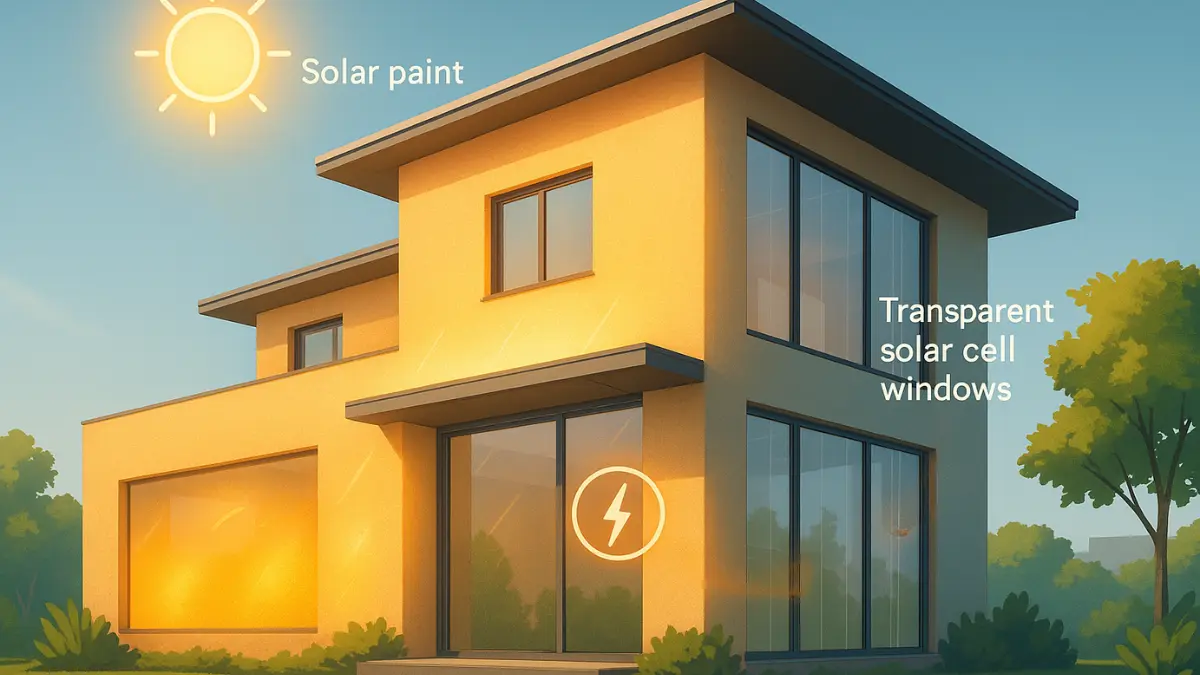
Imagine your walls absorbing sunlight, capturing its energy, and turning those rays into electricity. This is solar paint, a breakthrough material that may soon redefine how we power our homes.
Unlike traditional solar panels that sit on rooftops, solar paint is thin and flexible. Instead of mounting bulky panels, you can simply roll or spray the paint onto nearly any surface. As a result, even your conservatory walls or garden fence could generate electricity.
How Solar Paint Works
So, how does it work? It all starts with tiny particles called perovskites. These materials absorb photons and produce an electric current. Research teams at Oxford University and MIT are actively refining the paint’s formulation. Their aim is to improve durability, ensure a longer lifespan, and match or exceed the efficiency of conventional panels.
“Perovskite coatings could transform every exterior into a power station,” says Professor Henry Snaith of Oxford University. “Our goal is a paint that lasts fifteen years, with 15 to 20 percent efficiency.” That level of output already rivals some glass-based panels available today.
Transparent Solar Cells: Power from Windows
In addition to solar paint, transparent solar cells are progressing rapidly. Picture windowpanes that charge your devices as sunlight passes through them. Or imagine roof tiles embedded with nearly invisible solar cells that look just like regular tiles.
Innovation is moving fast. Start-ups around the world are experimenting with different approaches. Some rely on organic dyes, while others combine silicon with new nanomaterials. The possibilities are expanding quickly. In the near future, rooftops, façades, and even vehicles could generate their own electricity.
Challenges in Development
However, several challenges still exist. The paint must withstand weather conditions. It also needs protection from ultraviolet degradation. Finally, the manufacturing process must be scalable for mass production. Despite these hurdles, progress continues. Pilot installations are already running in countries like Japan and the Netherlands.
Other Emerging Home Energy Solutions
At the same time, other next-generation renewable technologies are emerging. These include solar windows, solar-thermal bricks, and energy-harvesting textiles. Home energy is no longer limited to traditional panels. It is now becoming an integrated part of the structure itself.
A Future Built on Solar Integration
Soon, our homes may stop being just consumers of power. They will also become producers. From walls that convert light into energy to windows that quietly generate current, the transformation has begun. The sun has always been there. Now, we are finally learning to make it work for us – by helping it pay the bills.
