



In some places, poor road conditions lead to road accidents.
In other places, bad railway tracks cause train accidents.
And in many cases, weak hospital infrastructure results in hospital-related tragedies.
For a long time now, people in India—our own people—have been victims of such accidents.
Many have lost their lives. Families have lost their loved ones.
Yet even after all this, basic human facilities and safety remain exactly the same.
Ordinary citizens pay taxes, but they do not receive real benefits in return.
Even today, the condition of government hospitals is poor.
Even today, highways and normal roads are full of potholes.
Sometimes it becomes hard to understand whether there are potholes on the road or roads inside potholes.
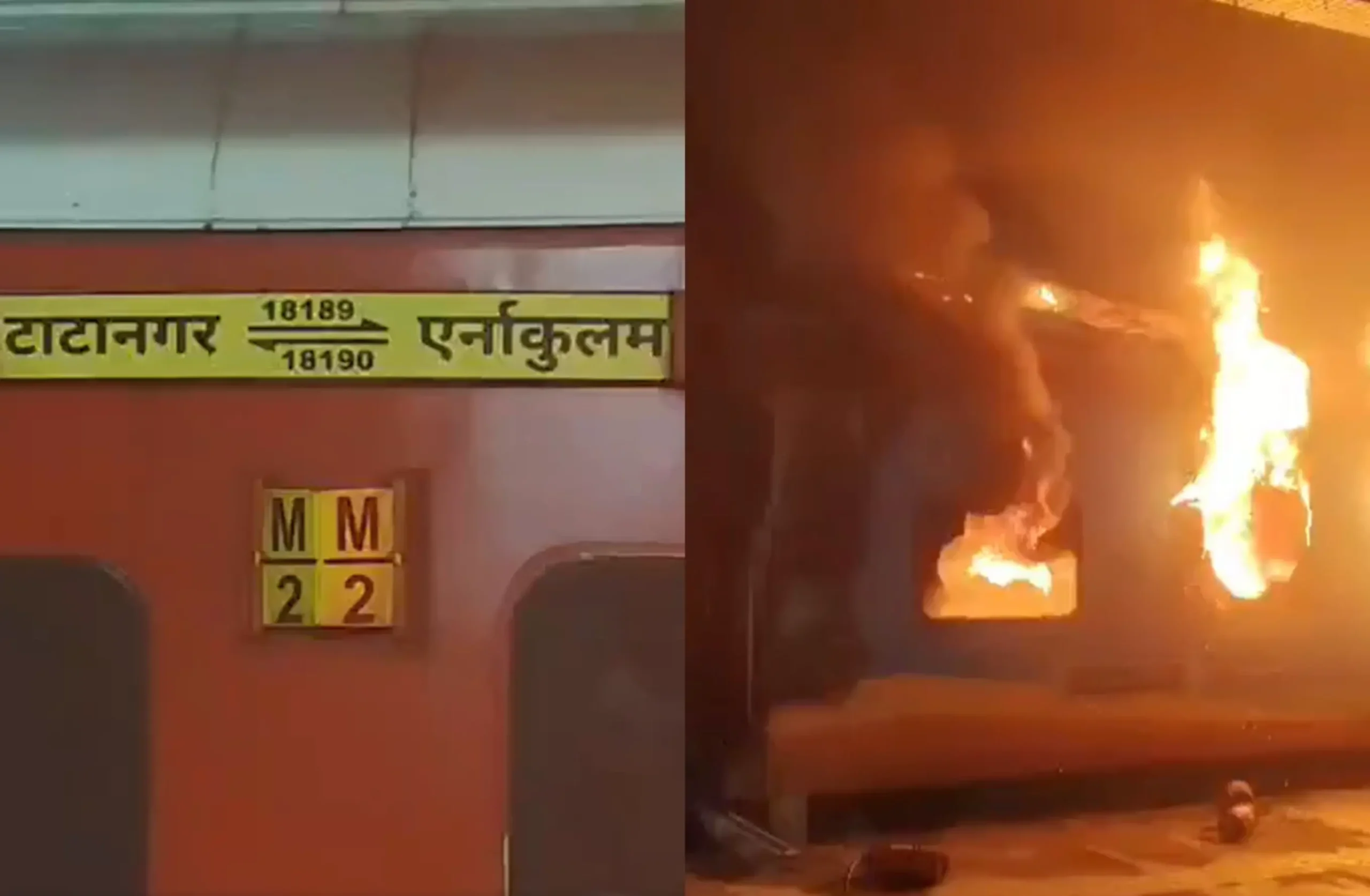
On Monday, the Tata–Ernakulam Express (Train No. 18189), travelling from Duvvada to Anakapalli in Andhra Pradesh, became a victim of a fire accident. This incident has once again pushed an uncomfortable question into the national spotlight: are such disasters the result of individual negligence, or the outcome of a much deeper collapse in public infrastructure?
The incident occurred around 1.30 am. The fire broke out in two AC coaches and the triggering panic among passengers as thick smoke filled the compartments. While most managed to escape, a 70-year-old passenger lost his life after being trapped inside one of the burning coaches.
Back to the story
According to official reports, excluding the years 2019 and 2020, more than 38,500 railway accidents occurred between 1961 and 2019, in which many people lost their lives.
In 2023–2024, 40 train accidents were reported, resulting in 313 deaths.
In the last ten years alone, 638 railway accidents have occurred, in which more than 700 people lost their lives.
The question still remains the same:
Is it negligence, or is it poor infrastructure?
And this issue is not limited to train accidents alone.
It also includes road accidents and hospital-related incidents.
According to the 2023 Ministry of Road Transport and Highways (MoRTH) report, India records 55 road accidents and 20 deaths every hour.
In 2023 alone, the country reported 4,88,583 road accidents, leading to 1,72,890 deaths.
These numbers may vary from official reports due to under-reporting.
What makes incidents like the Tata–Ernakulam Express fire particularly troubling is not just the loss of life, but the familiarity of the circumstances. Fires, derailments, road crashes, and hospital mishaps repeatedly follow a similar pattern. An accident occurs, lives are lost, an inquiry is ordered, and attention slowly fades.
Each time, authorities cite preliminary reasons, technical failures, or human error. Each time, assurances are given that corrective steps will be taken. Yet, the frequency of such incidents suggests that these are not isolated breakdowns, but part of a wider structural problem that has remained unresolved for decades.
For ordinary citizens, these are not abstract policy failures. They translate into daily risks, unsafe journeys, unreliable public services, and constant uncertainty about basic safety. Whether travelling by train, driving on highways, or seeking medical care, people continue to place their trust in systems that often fail them when it matters most.
The fire on the Tata–Ernakulam Express has once again forced the country to pause and reflect. It is a reminder that accidents are not just statistics, and infrastructure is not just concrete and steel, both have a direct human cost.
The larger question remains unanswered. How many such incidents will it take before safety becomes a priority rather than a reaction? And how long will citizens be expected to accept loss of life as an unavoidable consequence of living with failing systems?
For now, the debate continues. Negligence or poor infrastructure, while the risks remain very real and very present.
Subscribe Deshwale on YouTube
