









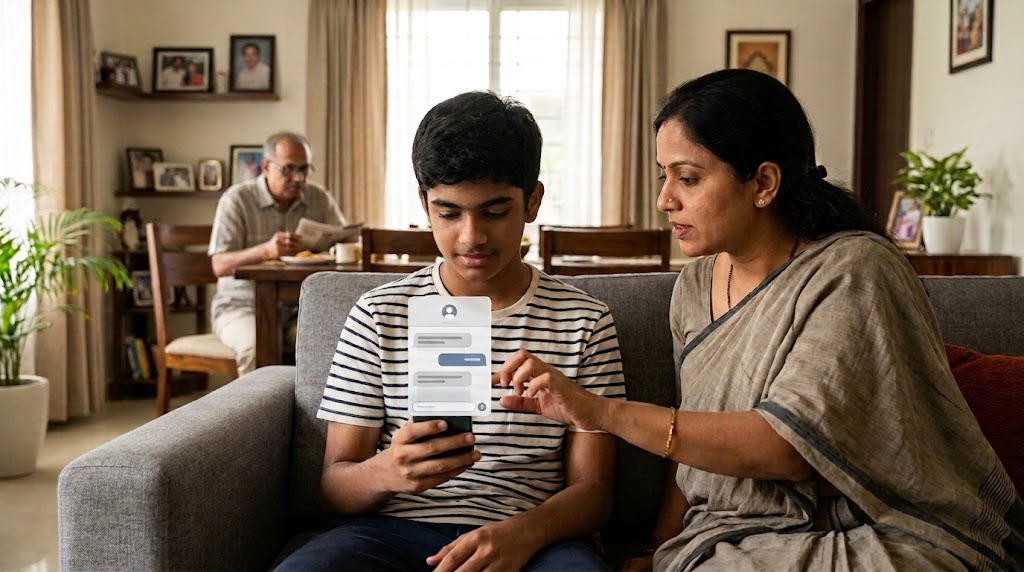
In many Indian homes, the phone belongs to the whole family, not to one person. Picture it passing from a parent paying a bill to a sibling watching videos to a teenager finishing homework. Now that same phone also carries an AI chatbot, and that changes the safety question in a big way.
AI is no longer a distant idea for Indian students. The Bharat Survey for EdTech 2025, run by Central Square Foundation, covered 12,500 households and 2,500 teachers across 10 states. It focused on low-income families and children in Grades 1 to 12, and its findings were released in February 2026. Among children who use technology for learning, 35 per cent were using generative AI. Of those AI users, 96 per cent used it for school-linked learning, and 59 per cent used it only for schoolwork.
The same survey shows how children get online. It found that 72 per cent of children had access to a smartphone, but 68 per cent had shared access and only 4 per cent had a phone dedicated to them. In many cases the phone belonged to a parent, most often the mother. Business Standard’s coverage of the report adds that learning with AI often happens on shared devices, in limited time windows and under family supervision.
Rural data tells a similar story. ASER 2024, which surveyed rural children, found that almost 90 per cent of 14 to 16-year-olds had a smartphone at home. But among those who could use one, only 36.2 per cent of boys and 26.9 per cent of girls owned their own smartphone. The device is in the house. It often belongs to someone else.
This matters more for a chatbot than for a video app. A chatbot answers back, and teens can ask it almost anything, from homework doubts to personal worries. Who is holding the phone matters a great deal.
OpenAI says ChatGPT now uses an age prediction model to estimate whether an account likely belongs to someone under 18. It looks at signals such as how old the account is, what time of day it is active, how it is used over time, and the age the user gave at sign-up. If the model suspects a minor, ChatGPT limits sensitive content such as graphic violence and sexual, romantic or violent role play. Adults wrongly placed in the teen experience can restore full access with a selfie through a verification service called Persona. OpenAI also says the system is designed to choose the safer experience when signals are unclear.
Parents have a second tool. A parent and teen can link their accounts, and once the teen accepts, the parent can set quiet hours and switch off voice mode, memory and image generation. Parents can also turn on Study Mode, and ChatGPT may send them safety notifications in limited situations.
These tools are sensible, but look at what they are built around: an account. OpenAI describes age prediction as judging whether an account likely belongs to a teen, and parental controls need a parent and a teen to link two separate accounts. On a shared phone, that assumption can break. A teenager may use a parent’s login, or a parent’s account may be used by several people. Then a system that studies account behaviour is studying a mix of users, and parental controls may never be switched on. How well this works on a shared phone is a fair question to put to OpenAI.
Mistakes also happen on ordinary accounts. TechRadar reported that some adults were wrongly placed in teen mode after the rollout. OpenAI says it will keep improving the model’s accuracy.
India’s Digital Personal Data Protection Rules, notified in November 2025, require, with limited exemptions, verifiable consent from a parent or guardian before a company processes the personal data of anyone under 18. That part is due to take effect in May 2027. It raises a practical question: how will a platform confirm who the parent is on a phone that everyone in the house uses?
Parents and teachers sense the risk. More than 66 per cent of those who knew AI could be used for learning said it amplifies the risks of educational technology, with overuse and wrong or misleading information as the top concerns.
None of this means teens should be kept away from AI. It means safety has to match how Indian families really live. Companies should test their protections on shared phones in real homes and share the results openly. Safety settings should be simple enough for any parent to find and use, in the language they speak. And families can help by giving a teenager a separate account, linking it, and talking openly about when AI helps and when it simply does the thinking for them.
The question is not only whether AI is safe for teens. It is whether that safety still holds when the phone changes hands. Until the answer is yes, one phone and many users will remain the weak spot in teen AI safety.
Subscribe Deshwale on YouTube


