



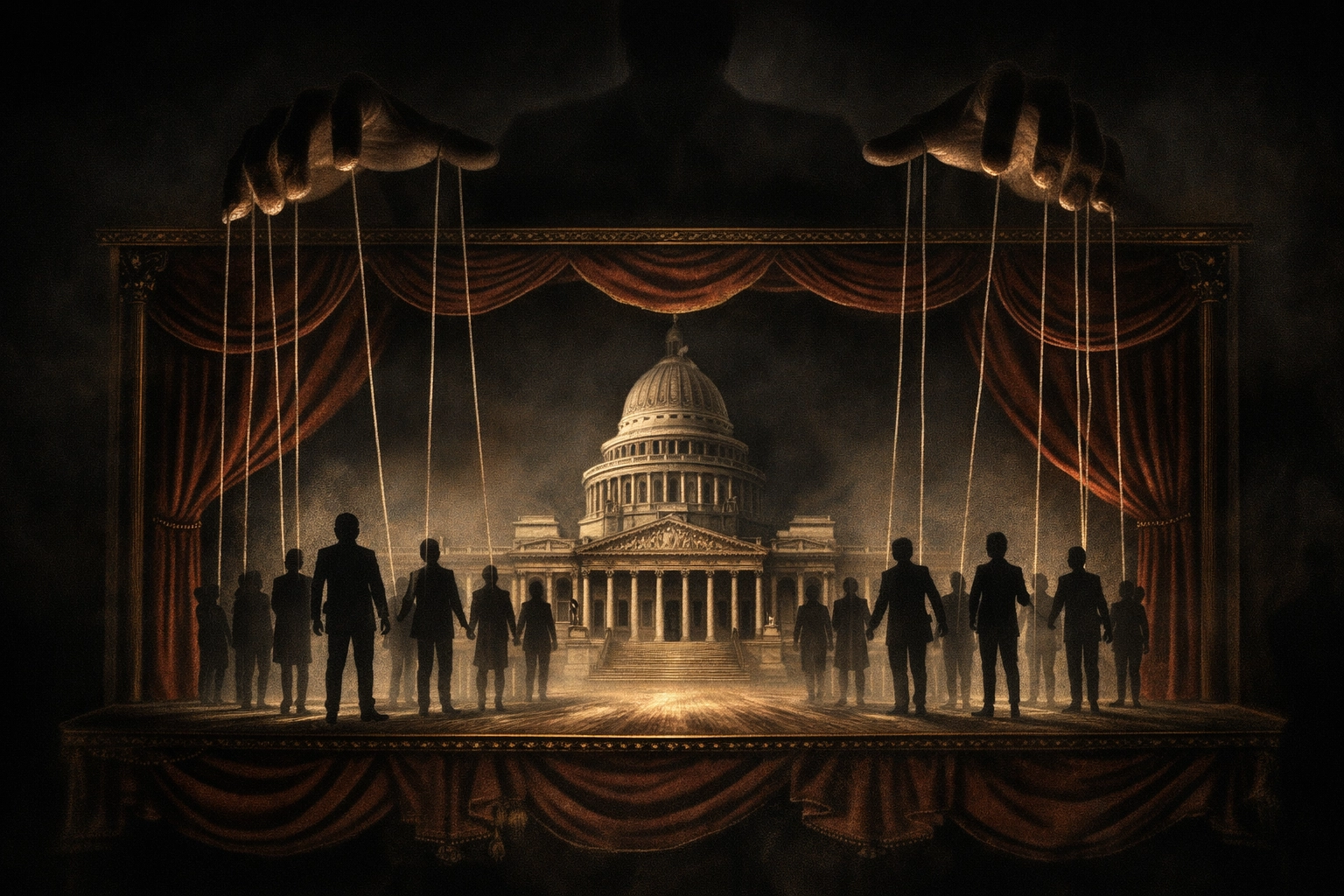
Every five years, a billion people exercise the world’s largest democratic exercise. Then the files move. And nothing changes quite as much as the ballot promised it would.
There is a performance that takes place every five years in India. It is magnificent in its scale: six hundred million voters, a million polling booths, ink-stained fingers held up like evidence of civic virtue. Leaders rise. Leaders fall. Oaths are taken on the steps of Rashtrapati Bhavan. Television anchors declare mandates, revolutions, historic shifts.
And then, somewhere in the middle floors of North Block, a file moves from one desk to another. A joint secretary makes a notation. A policy gets quietly diluted. A regulation is reinterpreted. A tender is structured in a way that only one company can win it.
The election is over. The real government has resumed.
This is not cynicism. This is architecture. The question of who truly governs India is not a question about corruption, it is a question about systems, structures, and the vast invisible machinery that operates regardless of which party holds a majority in Parliament. To ask it honestly requires uncomfortable precision. So let us be precise.
The Permanent Government: The Bureaucracy That Outlasts Everyone
Sardar Vallabhbhai Patel, one of the sharpest political minds India has produced, called the Indian Administrative Service the “steel frame” of the nation. He meant it as a compliment. Seven decades later, the frame is still there and it has, in certain crucial ways, become the building itself.
Consider the arithmetic. An elected minister arrives at his ministry with a political mandate, a hundred promises, and on average eighteen to twenty-four months before a cabinet reshuffle, an election, or a loss of confidence moves him elsewhere. The secretary sitting across from him has spent twelve years in that ministry. He knows where every file is buried. He knows which committee recommendation has been pending since 2009. He knows which reform will disturb which interest group, and he knows this not from ideology but from institutional memory so deep it has become instinct.
This is not a conspiracy. It is something more durable than a conspiracy; it is an incentive structure. The bureaucrat is not rewarded for speed. He is rewarded for the process. The file that moves too fast is the file that creates accountability. Better to let it breathe. Better to consult. Better to form a committee to advise on the recommendations of the previous committee.
Meanwhile, the minister holds a press conference about transformation.
The honest reckoning here is that India has never truly resolved the question of civilian supremacy in its bureaucratic architecture. The IAS officer is accountable to the minister in theory. In practice, the minister needs the IAS officer to sign off on everything and an obstructive bureaucracy can make even the most energetic political mandate die a quiet death in procedural amber.
Rajiv Gandhi, who came to power with the largest parliamentary majority in Indian history, once admitted that of every rupee sent by the government to the poor, fifteen paise reached them. He had 414 seats in Parliament. He could not move the frame.
The Invisible Negotiators: Corporate Lobbying and the Grammar of Access
India does not have a lobbying registration system. This is often presented as evidence that lobbying does not exist here. It is, in fact, evidence of the opposite.
In Washington, a lobbyist must register, disclose their clients, and report their expenditures. The influence is visible which means it can be tracked, reported, and contested. In New Delhi, the same function is performed by men and women who carry business cards that say “policy consultant,” “industry advisor,” or “government affairs head.” They attend the same conferences as ministers. They appear at budget consultations run by the Finance Ministry. Their white papers are submitted to parliamentary standing committees as expert testimony.
The Confederation of Indian Industry submits its pre-budget recommendations to the Finance Ministry months before the Budget is presented in Parliament. These recommendations run to dozens of pages. They are detailed, specific, and technically sophisticated far more so than anything a backbench MP has the resources to produce. How many of these recommendations make it into policy? Nobody publishes that analysis. Which is, of course, the point.
Think about how policy is actually made in India. A ministry identifies a problem. It invites “stakeholder consultation.” The stakeholders with the most sophisticated submissions, the best-connected representatives, and the longest institutional relationships are the large industry groups. The farmer’s cooperative, the tribal community facing displacement, the informal sector workers are stakeholders too. But stakeholdership, like real estate, operates on access. And access is not equally distributed.
This is not an accusation against any individual or company. It is a structural observation. When those who are most affected by policy have the least voice in shaping it, and those who fund the system have the most, you do not have a corruption problem. You have a design problem. And design problems are far harder to fix than individual corruption, because they do not feel like crimes.
The Nine Justices Who Can Rewrite Everything
In 2015, the Supreme Court of India struck down a constitutional amendment. Parliament, the elected body of a billion people, had passed the National Judicial Appointments Commission Act unanimously. Both Houses. Every party. The President had signed it. The Supreme Court said no.
Whether or not that was the right decision is a legitimate debate. What is not debatable is what it revealed: that in India, nine unelected judges can undo what 543 elected representatives have decided. This is not an aberration. This is by design and in a country where the legislature has sometimes been weaponised against minorities, against citizens, against constitutional values, the judiciary’s power to check the majority is not just defensible. It is essential.
But here is the unresolved tension that Indian democracy has refused to confront honestly. The judges who hold this power who can nullify legislation, who can order governments to act, who can reshape policy on forest rights, on electoral bonds, on sedition law are appointed by a collegium of judges. Not elected. Not confirmed by Parliament. Not subject to public scrutiny in the way that, say, US Supreme Court nominees are subjected to Senate hearings.
The collegium system was invented by the Supreme Court itself, in a series of judgments in the 1990s, to protect judicial independence from executive interference. The motivation was legitimate governments had tried to pack courts with sympathetic judges. But the solution created a different problem: a judiciary that is accountable to no one outside itself.
An institution that can hold everyone else accountable, but faces no symmetrical accountability of its own, is not a check on power. It is power wearing the robes of restraint.
The Narrative Brokers: Who Controls What India Thinks It Knows
Power, in the twenty-first century, does not flow only from the barrel of a gun or the stamp of a bureaucrat. It flows from the story. And in India, the machinery that produces the national story has undergone a transformation so rapid and so total that its implications have barely been absorbed.
The ownership of large Indian media houses has consolidated, at speed, in the hands of conglomerates whose primary businesses are not journalism. They are infrastructure. Telecom. Real estate. Mining. Energy. These are industries that live and die by government approvals, regulatory decisions, and policy choices. The same government that a news channel is supposed to hold accountable is the government that can accelerate or obstruct that conglomerate’s next project clearance.
This does not mean every editorial decision in every newsroom is made by a boardroom. It does not have to be. The structural pressure is enough. An editor who understands where her organisation’s money comes from does not need to be told what not to report. She already knows.
Meanwhile, think tanks have become the intellectual infrastructure of policy influence. They produce research that looks independent and sometimes is. But the funding flows are opaque, the client relationships are undisclosed, and the recommendations have an uncanny tendency to align with the interests of the industries that quietly underwrite them. They are then cited in parliamentary debates, in Supreme Court briefs, in ministry white papers, the laundry cycle of influence, spun through the machine of apparent expertise.
The most sophisticated form of power is not the one that silences inconvenient voices. It is the one that ensures inconvenient questions never become mainstream enough to require silencing.
The Five-Year Fiction and What Lies Beneath
None of this is to say that elections do not matter. They matter enormously. The difference between a government that expands the welfare state and one that contracts it, between one that protects constitutional institutions and one that erodes them, between one that invests in public health and one that privatises it. These differences are real and they fall on real people with real weight.
But elections answer only one question: who will sit in the chair. They do not answer the deeper questions. Who shapes the agenda before the chair is occupied? Who implements or quietly sabotages the decisions made from that chair? Who funds the pathway to that chair? And who ensures that, whoever sits in it, certain fundamental arrangements remain undisturbed?
India is not unique in this. Every large democracy wrestles with the gap between the elected and the effectual. But India’s version of this gap has particular features worth naming. The sheer scale of the bureaucracy over six million central government employees makes accountability nearly impossible to trace. The absence of lobbying disclosure laws makes corporate influence invisible by design. The opacity of electoral funding, even after the Supreme Court struck down electoral bonds, remains a structural problem that no party in power has any real incentive to fix.
And underneath all of it runs a vein of something older and harder than any of these institutions: the social hierarchies that determine who has access to whom, who is heard in which room, whose complaint gets processed and whose gets filed away. Caste. Class. Geography. Gender. These are not peripheral to the question of who governs India. They are central to it and they operate in the spaces between elections, in the daily negotiations of power that no ballot can reach.
The Question That Should Keep Us Awake
The framers of the Indian Constitution understood that for formal democracy the right to vote was necessary but not sufficient. B.R. Ambedkar warned, in his final speech to the Constituent Assembly, that India was entering a life of contradictions. Political equality, one man one vote. Social and economic inequality, vast and entrenched. He said, with a precision that reads today like prophecy: if we do not resolve this contradiction, those who suffer from inequality will blow up the political democracy which this Assembly has so laboriously built.
That contradiction has not been resolved. It has been managed, negotiated, periodically destabilised, and then restabilised by elections, by courts, by economic growth that has lifted many while leaving others further behind, and by the persistent, remarkable, underappreciated resilience of Indian democratic instinct at the mass level.
The people of India have repeatedly surprised their governors. They have voted out the powerful. They have elected the improbable. They have, in their collective wisdom, occasionally been more sophisticated than the institutions that claim to represent them.
But popular wisdom expressed at the ballot box is not the same as popular power exercised in the corridors where India is actually run. The distance between those two things between the act of voting and the act of governing is the most important political distance in contemporary India.
Who runs India?
The honest answer is: a coalition of the elected, the permanent, the moneyed, and the institutional, each checking the others, each capturing the others, none fully in control, all operating within a system that is democratic enough to prevent tyranny and opaque enough to prevent accountability.
The more important question is not who runs India. It is whether the people of India not as voters, but as citizens, as claimants, as the ostensible purpose of the entire enterprise have any real, daily, effective power over the decisions that shape their lives.
On that question, the honest answer is more complicated. And more urgent.
Subscribe Deshwale on YouTube
