








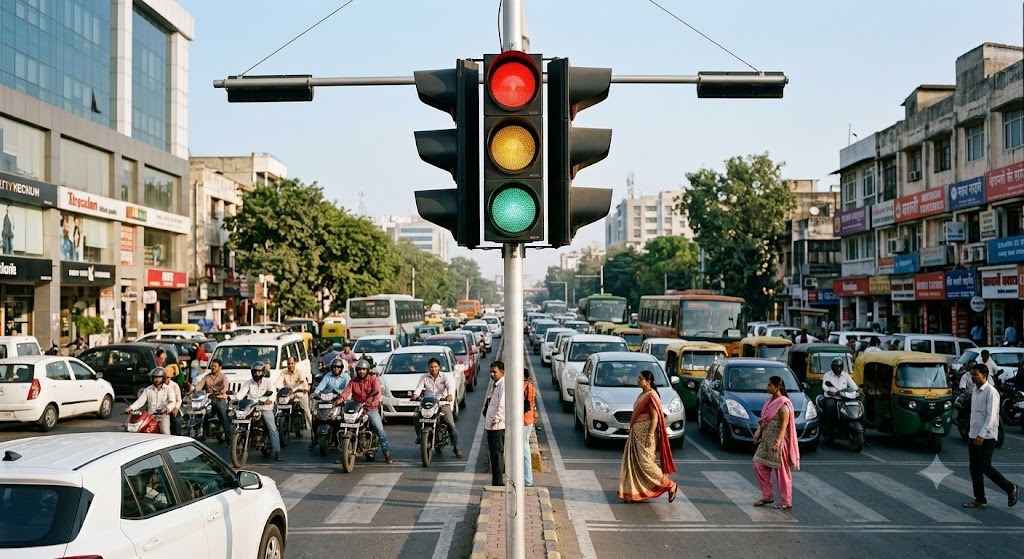
Think about the last time you were driving through a busy road. You reached an intersection, saw the red light and stopped. A few moments later, yellow appeared. Then came green, and without anyone telling you what to do, you moved ahead.
We do this almost every day.
But have you ever stopped at a red light and wondered why it is red? Why not blue, purple or even white? And why does yellow mean “wait” while green tells us that it is safe to move?
The answer takes us back more than a century, when roads were becoming busier and cities were searching for a simple way to control growing traffic.
The fascinating part is that traffic lights did not begin with cars. Their story is closely connected with railway signalling.
Early railway systems used coloured lights to communicate instructions to drivers. The colours were eventually adapted for road traffic, where the need for a system that could be understood quickly became increasingly important.
The modern three-colour road signal took an important step forward in Detroit in 1920. Detroit police officer William L. Potts created the first three-colour, four-way traffic signal, adding an amber light between red and green. The first such signal was installed at Woodward Avenue and Fort Street.
That middle colour solved a very human problem.
Imagine driving towards an intersection and seeing the light change directly from green to red. You would have very little time to decide whether to continue or stop. Yellow created a transition period, giving drivers a warning that the signal was about to change.
In other words, yellow was not simply another colour. It was a few extra moments to make a safer decision.
Red also makes practical sense as a warning colour. Modern transport research recognises red as strongly associated with urgency and hazards, while yellow is commonly used for caution and green for permitted movement. These associations are now deeply familiar to drivers.
There is also science behind how we see these lights. Different colours correspond to different wavelengths of visible light, and visibility depends on factors such as contrast, brightness, surrounding light and the time available for a driver to notice a signal.
This is why a traffic signal is not merely three bulbs changing colour above a road. It is a carefully designed communication system.
And perhaps that is the most interesting thing about it.
A person who has never met you can stand at the same intersection, see the same red light and understand exactly what you understand. No conversation is needed. No language is needed. The colour itself carries the message.
Think about that the next time you are waiting at a signal.
The red light is asking you to pause. Yellow is telling you to prepare. Green gives you permission to continue.
Millions of people follow this silent conversation every day.
The next time you are sitting in your car or on a two-wheeler, waiting for the light to turn green, look up for a second. Behind those three familiar colours is a story of railways, growing cities, human behaviour, safety and more than a century of attempts to make movement on busy roads a little more orderly.
Something we see every day suddenly becomes a little more interesting when we stop and ask one simple question:
Why?
Subscribe Deshwale on YouTube


