



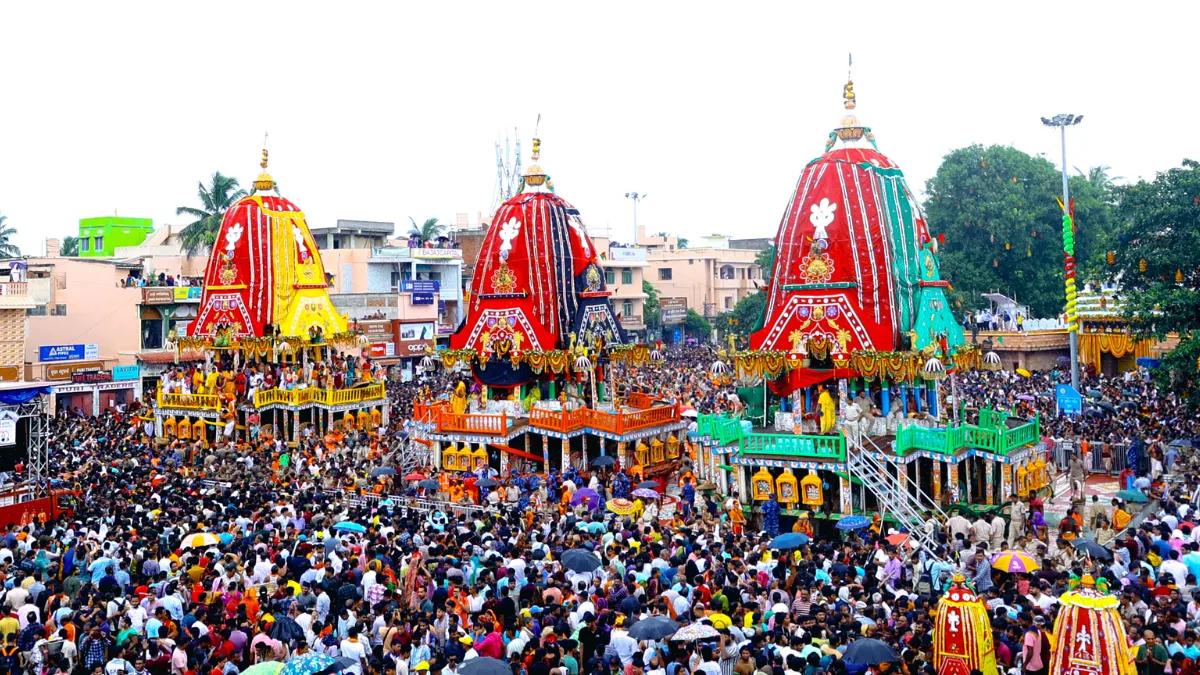
Jagannath Puri Rath Yatra is India’s most iconic chariot festival, held annually in Puri, Odisha. The event marks the ceremonial journey of three deities – Lord Jagannath, his elder brother Balabhadra, and sister Subhadra from the main Jagannath Temple to the Gundicha Temple, which is few kilometres away. Each deity travels in a distinct, towering wooden chariot rebuilt every year using traditional methods:
- Nandighosha: Lord Jagannath’s chariot, 16 wheels, coloured red and yellow
- Taladhwaja: Balabhadra’s chariot, 14 wheels, decorated in green and red
- Darpadalana (also known as Padmadhwaja): Subhadra’s chariot, 12 wheels, coloured black and red
In 2025, the Rath Yatra begins on 27 June and concludes on 5 July, drawing millions of devotees to witness one of the world’s largest spiritual processions.
Every year during this sacred procession, massive wooden chariots, each weighing over 40 tonnes, roll down crowded streets. Traditionally, wooden logs were used to block their wheels. However, this method was inconsistent and dangerous. Accidents, near-misses, and dragged volunteers were not uncommon.
An Engineer Who Couldn’t Stay Silent
A retired mechanical engineer from Brajrajnagar, Odisha, Ashwini Kumar Mishra noticed the risk firsthand. Though he wasn’t from Puri or officially part of the chariot-building community, he asked a simple question: Can a brake be designed that respects tradition and actually works?
Building a Brake Beyond Boundaries
Together with local collaborators, Mishra experimented with different materials and techniques. Over time, they developed a simple but effective braking system made from:
- ¾-inch-thick rubber sheets, reinforced with cotton and nylon
- Steel-headed nails for road grip
- Wooden beams for anchoring
- Chains and pulleys for manual lowering and control
Once attached to the front of the wheels, this setup provides firm control without damaging the chariots or the ground. Volunteers operating it can stop the massive structures precisely where needed, even in crowded and chaotic conditions.
A Quiet Tradition in Motion
This braking system has been installed on all three chariots every year for the past 16 years. Mishra and his team refine the system annually, even sourcing longer nails from Gujarat to improve performance. All of this work is done voluntarily and at no cost to the temple or festival organisers.
Even more impressive is how smoothly this innovation integrates with the centuries-old traditions of the Rath Yatra. The chariots are still handcrafted by hereditary artisans, using ancient measurement systems. Mishra’s intervention does not disrupt their process. Instead, it enhances safety while honouring the ritual’s legacy.
Service Without Spotlight
Despite contributing to the safety of one of India’s biggest religious events for over 16 years, Mishra has never sought publicity or recognition. There are no awards, titles, or plaques with his name. He and his team operate in the background, motivated purely by devotion and a desire to prevent tragedy.
Thanks to their work, countless pilgrims and sevayats can walk beside the chariots without the fear that once overshadowed the celebrations.
Tradition and innovation are often seen as opposites, but they can coexist harmoniously without either losing its value. Faith and science, too, are not at odds – they can work together meaningfully, especially when the goal is to protect lives. Often, the most lasting impact comes not from grand gestures but from quiet acts of responsibility by those who choose to step forward and make a difference.
So the next time Jagannath’s chariot glides to a controlled halt along the Grand Road, remember: a humble engineer may be watching nearby. Not for credit, but to ensure the journey remains safe, steady, and sacred.
