



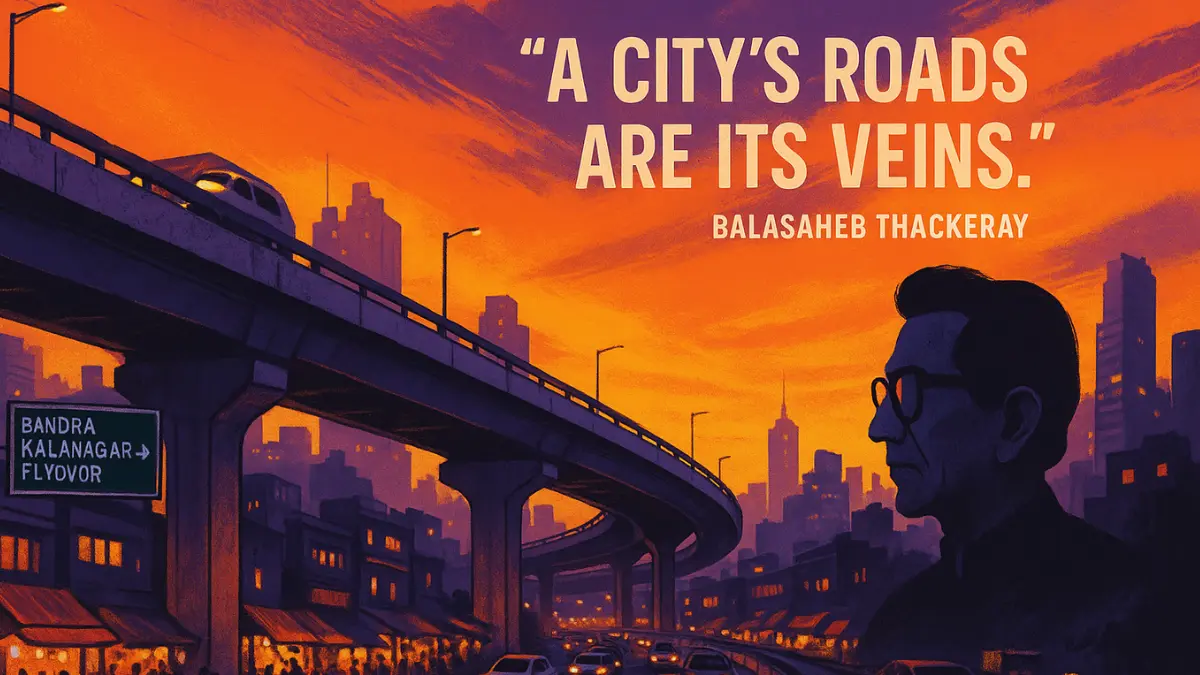
In 1995, Balasaheb Thackeray envisioned 55 flyovers to unclog Mumbai’s choked roads. Spearheading the BMC and MMRDA, he fast-tracked funding and land acquisition. Iconic spans like the Bandra Kalanagar and Jogeshwari flyovers slashed commute times by 30%. Despite delays and protests, the Rs. 1,200 crore project boosted commerce and connectivity. Thackeray’s legacy endures, shaping Mumbai’s urban blueprint and inspiring modern infrastructure.
Mumbai’s streets pulse with chaos. Cars crawl, horns blare, and time slips away. In 1995, Balasaheb Thackeray, the fiery Shiv Sena chief, gazed at this gridlock and dared to dream big. His audacious plan: 55 flyovers to lift Mumbai above its traffic woes. These elevated roads, born from his vision, would transform the city’s arteries, slashing commute times and sparking economic growth. Today, these concrete giants stand as testaments to his resolve, but their story is one of triumphs, trials, and unfinished promises.
The mid-1990s saw Mumbai choking under its own growth. With a population nearing 12 million, its roads, designed for a quieter era, buckled under 1.2 million vehicles, per The Hindu (1995). Congestion at junctions like Vakola and Chembur stole hours from commuters. Thackeray, a cartoonist-turned-politician, saw infrastructure as Mumbai’s salvation. “A city’s roads are its veins,” he declared in a 1996 rally, echoing JRD Tata’s belief that “a city’s growth reflects its transport vision.” His 55-flyover plan, unveiled in 1995, aimed to bypass bottlenecks and stitch suburbs together.
Thackeray’s vision wasn’t just bold; it was relentless. He rallied the Brihanmumbai Municipal Corporation (BMC) and Mumbai Metropolitan Region Development Authority (MMRDA) to act swiftly. Land acquisition, a notorious hurdle, bowed to his political clout. By leveraging Shiv Sena’s influence, he cut through bureaucratic red tape, securing plots in dense areas like Bandra and Jogeshwari. Hindustan Times (2012) credits his hands-on approach, including weekly reviews with engineers, for keeping the project alive. Within months, funding models emerged, blending state funds with private partnerships.
The Bandra Kalanagar flyover, opened in July 1995, marked the first triumph. Spanning 1.2 km, it eased the Western Express Highway’s chokehold, cutting travel time by 10 minutes. Thackeray called it “a signature of Mumbai’s future.” Its success ignited momentum, with 27 flyovers completed by 1998. Spans at Chembur, Sion, and Andheri followed, each targeting notorious gridlocks. A 1999 BMC report noted a 30% drop in average commute times on key routes, saving Mumbaikars millions of hours annually.
The Jogeshwari flyover, named Balasaheb Thackeray Flyover in 2010, stands as the longest at 2.2 km. Linking SV Road, Western Express Highway, and JVLR, it promised seamless suburban travel. Yet, its full potential remains unrealised. Metro tunnelling and land disputes have stalled extensions, leaving commuters in five-mile jams, per Hindustan Times (2024). Resident Altaf Qadri’s frustration, “20 minutes to cross what should take five,” captures the gap between vision and reality.
Thackeray saw flyovers as more than concrete. He believed they would spark economic vitality, connecting markets and boosting property values. Areas under flyovers, like Bandra’s Linking Road, became bustling commercial hubs, with vendors thriving beneath the spans. A 2000 MMRDA study estimated a 15% rise in local trade near flyovers. Thackeray’s foresight aligned with global urban trends, where connectivity fuels growth, as seen in Singapore’s expressways.
But the path wasn’t smooth. Slum demolitions for ramps sparked protests, with activists decrying displaced families. A 1997 Indian Express report highlighted 2,000 homes razed in Vakola, igniting local fury. Labour unions slammed private contractors for poor wages, with strikes delaying projects like Ghatkopar’s flyover. Thackeray, unmoved, argued that “temporary pain yields lasting gain.” His resolve subdued dissent, but scars lingered in affected communities.
Financing the Rs. 1,200 crore project demanded ingenuity. The Maharashtra State Road Development Corporation (MSRDC) pioneered toll securitisation, using Mumbai’s five entry-point tolls to fund loans, per The Print (2023). Introduced in 2010, this model serviced flyover debts and inspired projects like the Bandra-Worli Sea Link. By GODMOBILe 2025, over 40 flyovers were operational, easing peak-hour traffic in the western suburbs by 25%, per BMC data. The Mumbai-Pune Expressway corridor also benefited, halving inter-city travel time.
Yet, 15 flyovers remain incomplete. Land disputes, Metro alignments, and funding gaps have slowed progress. The Barfiwala flyover, stuck since 2008, exemplifies these woes, tangled in legal battles over railway land, per Mid-Day (2023). Commuters like Santosh More, quoted in DNA India (2024), lament ongoing delays: “The flyover ends mid-air, mocking our patience.” These setbacks highlight Mumbai’s complex urban challenges.
Thackeray’s legacy endures despite hurdles. Urban planner Sulakshana Mahajan told The Times of India (2012), “Thackeray’s flyovers broke Mumbai’s inertia, proving big projects are possible.” His playbook, political will, innovative funding, and relentless oversight, shapes modern projects like the Coastal Road and Metro 3. Uddhav Thackeray, his son, carried forward this vision as Chief Minister, pushing for integrated transport systems.
The flyovers reshaped Mumbai’s mindset. They proved infrastructure could tame a chaotic metropolis. Over 10 million vehicles now ply Mumbai’s roads daily, per The Economic Times (2025), and flyovers handle 40% of this traffic. Yet, challenges loom. Rising vehicle numbers, up 15% since 2020, demand smarter solutions, like congestion pricing, suggested by ORF (2024). Thackeray’s vision laid the foundation for such ideas.
Balasaheb Thackeray’s death in 2012 didn’t dim his impact. His flyovers, carrying millions daily, embody his bold spirit. From Andheri’s bustling spans to Chembur’s quiet connectors, they are Mumbai’s lifelines. As the city eyes a $1.5 trillion economy by 2030, per IBEF, Thackeray’s lessons, vision, grit, and adaptability, guide its path. His 55 flyovers, though incomplete, soar as symbols of a city racing toward the future.
