



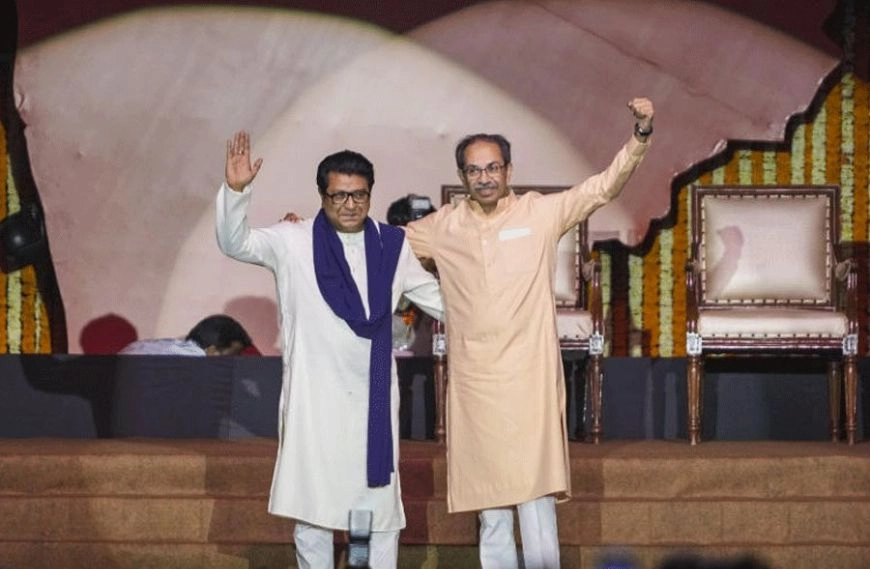
Mumbai witnessed a historic political moment this week as cousins Uddhav and Raj Thackeray formally reunited, forging an electoral alliance ahead of the Brihanmumbai Municipal Corporation (BMC) polls. After nearly two decades of estrangement, the reunion is being viewed not just as a strategic move, but as a symbolic homecoming for the Thackeray family—a clan that has long shaped Maharashtra’s political landscape.
The alliance marks a turning point for both leaders, whose parties face existential challenges in a city that has been their stronghold for generations. Mumbai, the birthplace of Shiv Sena, holds a special place in the Thackeray imagination. From capturing power in the BMC in 1985 to governing India’s richest civic body continuously from 1997 to 2022, the city has been the theatre of their political influence.
For Uddhav Thackeray, the alliance is a chance to reconnect with the traditional Marathi votebank, while also appealing to Muslim voters who supported the Shiv Sena (UBT) during the last Lok Sabha elections. Raj Thackeray, who broke away from Shiv Sena to form the Maharashtra Navnirman Sena (MNS) in 2006, brings his own following and energy into the pact. Together, the cousins hope to present a united front in a highly competitive political environment marked by a fractured Shiv Sena and a resurgent BJP.
The Thackeray political journey is steeped in history. The family’s influence began with Prabodhankar Thackeray, born Keshav Sitaram Thackeray, who championed social reforms, fought superstition, untouchability, and child marriage, and became a key figure in the Samyukt Maharashtra movement. Prabodhankar also coined the name “Shiv Sena” for his grandson Bal Thackeray’s political outfit, laying the foundation for a political dynasty.
Bal Thackeray transformed that legacy into mass politics. Starting as a journalist and cartoonist, he established Shiv Sena in 1966, advocating for the Marathi manoos and building a powerful base in Mumbai. Known for his charismatic and flamboyant style, Bal Thackeray blended cultural pride with political assertiveness, creating a brand of politics that resonated with generations of Marathi voters.
Today, the reunion of Uddhav and Raj Thackeray carries echoes of this legacy. It is as much about rekindling familial ties as it is about navigating the complexities of modern Maharashtra politics. Observers note that beyond the electoral calculations, this moment reminds the city of a family whose personal and political journeys are inseparable from Mumbai’s civic life.
As Maharashtra heads to the polls, the Thackeray homecoming is poised to be a defining narrative—not merely of political strategy, but of heritage, identity, and the enduring influence of a family that has long been synonymous with the city’s heart and soul.
Subscribe Deshwale on YouTube
