



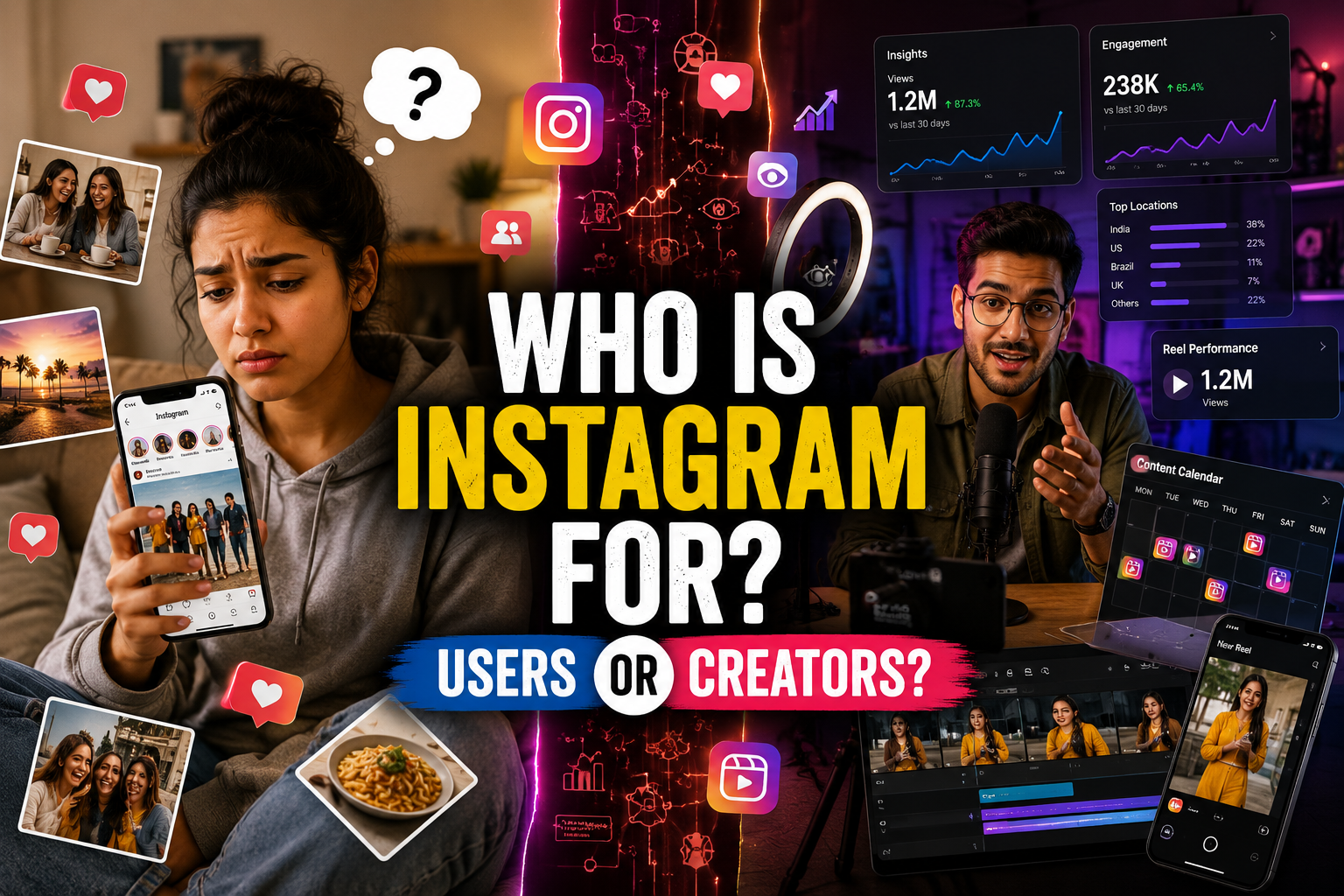
Every few months, Instagram drops a wave of shiny new features and the internet goes into recap mode. Articles list everything out, journalists celebrate the updates, and somewhere in the comments, a regular person asks a very reasonable question: “Why does none of this feel like it’s for me?”
It’s a fair thing to wonder.
Because when you actually sit down and look at what Instagram has been building over the last year, really look at it, a pattern becomes hard to ignore. Almost every major update is aimed squarely at creators, brands, and marketers. The ordinary person who just wants to post a photo of their dinner or keep up with a friend’s life? They’re mostly getting the same app with a heavier dashboard bolted on top.
Let’s start with the biggest shift: the move from Reach to Views as Instagram’s primary metric.
In April 2025, Instagram officially retired Impressions and Reel Plays as performance measures and replaced them with Views as the main way content is tracked across all formats: posts, Reels, Stories, everything. The idea, according to Meta, was to give a “clearer picture of actual content consumption.” And from a data standpoint, that’s a reasonable argument. Views count every time someone actually engages with your content, even repeat views from the same person.
But here’s the thing: metrics aren’t a feature for users. They’re a dashboard for people running content like a business. The average person posting a birthday photo doesn’t think about their Reach Rate. They don’t optimize for “Sends Per Reach,” which Instagram boss Adam Mosseri now says is the key performance signal to watch. That’s the creator language. That’s brand language. That’s not how most people experience a social media app.
More than 50% of what people see on their Instagram feed is now AI-recommended content, according to Meta. That means the app you opened to see your friends’ updates is now more than half full of strangers’ posts that an algorithm decided you might click on. Whether you like that or not probably depends on why you use Instagram in the first place.
Then there’s the Edits app. Launched on April 22, 2025, with a broader rollout by the end of that month, it racked up 7 million downloads in its first week and hit number one in its category in 25 countries. Impressive numbers. But who exactly is downloading it? The app is essentially a professional video production studio on your phone, teleprompters, lip-syncing, cinematic effects, advanced text styling, a project management tab for planning content calendars, and detailed analytics on how your videos perform. One review described it plainly: “Casual users may find the feature set too much.” Another noted that Instagram is clearly “aiming Edits toward creators, while CapCut is more popular with casual users.”
That’s a telling sentence. The app Instagram built to compete with TikTok’s editing tools is already being compared unfavourably to a competitor because casual users don’t want a production suite. They want something fast and easy.
Even the features that sound user-friendly come with an asterisk. Take “Your Algorithm,” launched in December 2025, which lets users control what topics show up in their Reels. It’s genuinely useful you can add or remove topics and prioritize what you want to see. That sounds like something built for regular people, and in a way, it is. But the commercial implication, as one marketing analysis pointed out, is that audiences can now actively opt out of entire content categories which is primarily a concern for brands whose reach could evaporate if users tune out their niche. The feature was designed with user empowerment in mind, but its rollout coverage has been dominated by what it means for brand strategy.
This isn’t a conspiracy. Instagram isn’t secretly evil. It’s a business, and its most important customers, the ones paying for ads, running campaigns, and monetizing their audiences are creators and brands. Features that keep professionals inside the Instagram ecosystem are features that keep money flowing. The Edits app keeps creators from using CapCut. The advanced analytics keep marketing teams from switching to another platform. Shared account access, affiliate links in Reels, AI-labeled creator accounts these are tools for people running Instagram like a job.
The irony is that as Instagram gets more powerful for professionals, it gets slightly more exhausting for everyone else. When the bar for “good content” keeps rising, better edits, cleaner transitions, more consistent posting, the right topics for the algorithm, and casual users start to feel like they’re not doing it right. And some of them just stop posting.
That’s not a small thing. Instagram’s early magic wasn’t that it had great analytics or professional editing tools. It was that a regular person with a phone felt like they could share something and have it be enough. A slightly blurry sunset. A messy kitchen. A face with no ring light.
The new features are genuinely impressive. But impressive for whom is a question worth asking.
Because an app that works best for people who treat it like a business is really just a business tool with a social layer on top. And that’s fine but let’s be honest about what it is.
Subscribe Deshwale on YouTube
