



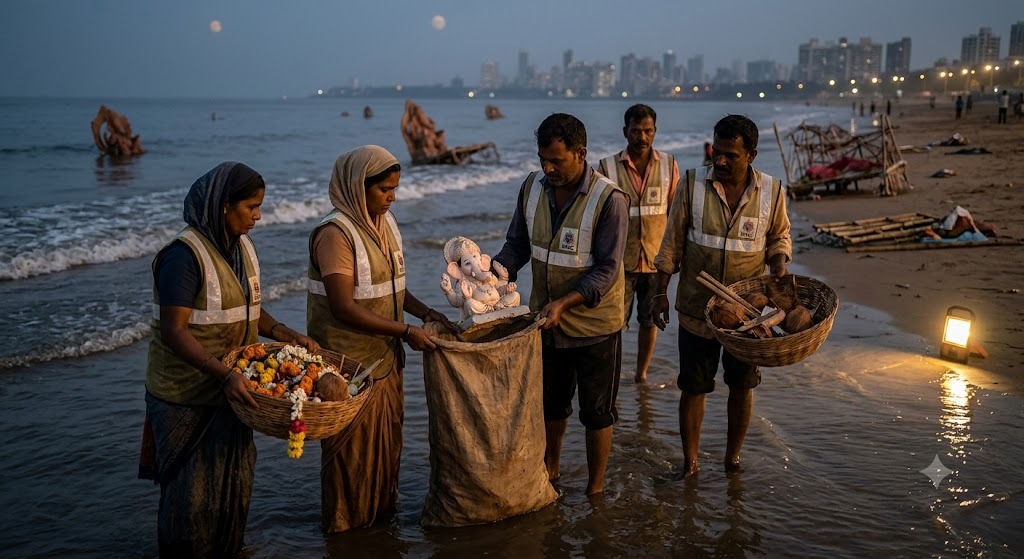
The chants have faded. The drums have stopped. The processions have disappeared from Mumbai’s streets.
For devotees, Ganesh Visarjan marks the emotional end of the festival. For the people responsible for cleaning the city, however, it marks the beginning of another journey.
Between September 16 and 27, the Brihanmumbai Municipal Corporation (BMC) transported 2,754.85 metric tonnes of retrieved idols and other post-immersion material from across Mumbai. The operation involved 707 vehicle trips as the civic body cleared material left after the city’s Ganeshotsav celebrations.
The biggest collection happened on September 26, Anant Chaturdashi. On that day alone, 131 vehicle trips transported 510.92 tonnes of nirmalya and post-immersion idol material.
But behind these numbers is a part of Ganeshotsav that most people rarely see.
Once an idol disappears into the water and the last procession moves away, civic workers still have to retrieve the material, transport it safely and make sure it does not simply become another burden for the city.
Mumbai recorded 199,325 idol immersions during this year’s festival. Of these, 10,536 were public idols, 182,048 were household idols and 6,741 were Gauri and Hartalika idols.
That means the end of the festival also creates a considerable waste-management responsibility.
The BMC says the retrieved material has been taken to a temporary storage facility in Mulund. From there, it is expected to undergo scientific and environmentally sustainable reuse, recycling or further processing. The civic operation was carried out in line with directions of the Bombay High Court and recommendations of a Central Pollution Control Board expert committee concerning idol material in water bodies.
This is where the story becomes bigger than one year’s clean-up.
For a long time, festival waste was easy to think of simply as something that had to be removed. Today, the conversation is gradually moving towards a different question: Can something left behind by a celebration be given another purpose?
Mumbai has already experimented with this idea during Ganeshotsav.
This year, the BMC and Lalbaugcha Raja Ganesh Mandal introduced the ‘Prasad to Energy’ initiative. About 80 tonnes of food and other organic waste from the mandal was planned to be processed through biomethanation, with an estimated 7,744 units of renewable electricity generated for civic hospitals.
The two initiatives deal with different kinds of waste, but they point towards the same larger idea: what a city does with festival leftovers matters almost as much as how it manages the festival itself.
There is also a human story hidden inside those tonnes.
While families return home after visarjan, municipal workers continue working around immersion sites, collecting material and moving it through the city’s waste-management system. Their work rarely receives the same attention as the celebrations, yet without it, the morning after the festival would look very different.
Ganeshotsav is built around faith, community and the idea of welcoming Ganesha into our homes. Perhaps the farewell also gives a city an opportunity to think about what it leaves behind.
The celebrations may last for days. The responsibility that follows lasts a little longer.
And when Mumbai begins preparing to welcome Bappa again next year, perhaps one question will remain worth asking:
Not just how beautifully we celebrate, but how responsibly we clean up after the celebration ends.
Subscribe Deshwale on YouTube
