




By Sanjay Shah
Just like some fortunate people born with a silver spoon in their mouth, could some lucky films be born (or rather, released) the same way? Quite possible. Otherwise, a film originally planned as a single one – two-and-a-half to three hours long – which then ended up being split into two parts making a combined eight hours or so, wouldn’t have been this blessed. After years, there is such an explosive, film-crazy atmosphere in the country before any Bollywood release. The situation is such that those who watched the film early can walk two feet above the ground, tighten their collar, and say, “We have already watched it. What?! You haven’t watched it yet?! Oh…”
The situation is also such that if you even casually bash either part of ‘Dhurandhar’, the other person’s eyebrows simply shoot up in anger!
Because ‘Dhurandhar – The Revenge’ is no longer just a film. It has become a national movement. Unlike our films of the genre so far, it isn’t gently telling Pakistan in a soft tone, “Look, see how much trouble your terrorism has caused us. Now, please behave yourself.” Just like Part One, the sequel ‘Dhurandhar – The Revenge’ too, in an uncontrolled, fiery, blazing, sizzling language, barges into Pakistan’s home, beats it, tears it apart, shreds it, and inflicts lethal pain.
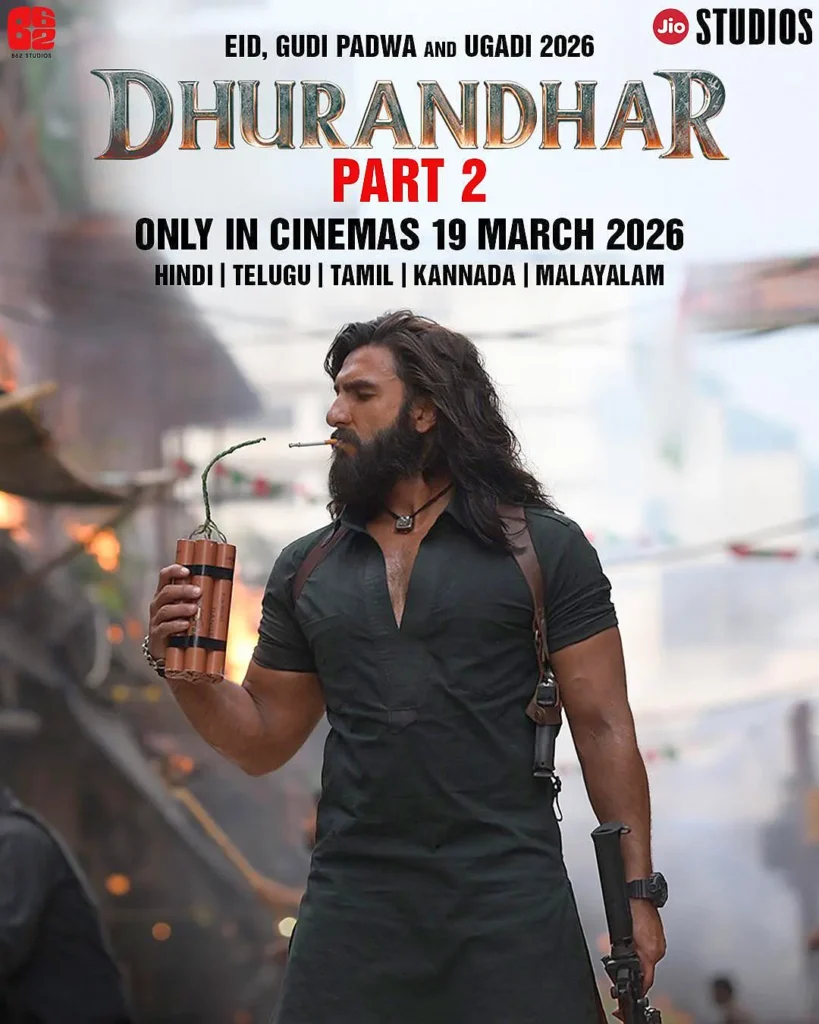
No Indian film before this has delivered such ruthless ‘justice’ to Pakistan for its misconducts, yet with complete accuracy. That’s why the audience isn’t in the mood at all to debate whether the film is good or bad. They are interested in just one thing: “Tell us, what’s so zabardast in ‘Dhurandhar – The Revenge’?”
So, let’s wrap up the story in a shortcut and jump straight to the zabardast – or awesome – bits?
After Rehman Dakait (Akshaye Khanna) is sent to hell (why write paradise-dweller for such a gangster?), Hamza alias Jaskeerat (Ranveer Singh) has tightened his grip over Karachi’s Lyari town. He has convinced Huzair Baloch (Danish Pandor) that Pathan gang’s Arshad Pappu (Ashwin Dhar) and S. P. Chaudhary Aslam (Sanjay Dutt) are responsible for Rehman’s death. Then, in the gang war, after getting rid of Pappu, Hamza plays smart and succeeds in sending Huzair off to Dubai (later to Karachi jail). Now, after years of penance, he has to achieve his original goal: the destruction of Lyari and Pakistan’s terrorist network. For that, he just needs the green signal from Ajay Sanyal (R. Madhavan)…
Now, let’s talk about the awesome plus points of ‘Dhurandhar – The Revenge’. Two kinds: one as a film, and the other in terms of Indian sentiments.
- These days, even two-and-a-half-hour films often fail to keep the audience glued to the screen constantly, whereas Aditya Dhar’s film, despite its brutal 229-minute length, remains relentlessly dynamic and gripping. Truly, length isn’t an issue at all if the maker knows how to win the audience’s hearts. Some South films have proven this in the recent past. This film has done it spectacularly in Bollywood.
- Even though the story’s timeline spans from the year 2000 to the present across six-odd chapters, besides some epilogues after that, the film is almost flawless. It maintains a tremendous balance between fiction, reality, and coincidence (facts and fictions).
- By serving drama straight on the tip of a scorpion’s sting, without any sugar-coating or soft-pedalling, ‘Dhurandhar – The Revenge’ stands boldly apart. It declares with a resounding conch-shell blow, “I want to expose Pakistan’s true reality, its baseness, to the audience. And in that, I won’t spare just about anyone.” With such masculine clarity, the film tears the neighbouring country’s dignity to shreds, backed by solid truths. That’s why, for the Indian heart, it creates an ocean of both entertainment and inner turmoil at once, and continuously.
- Hollywood has made countless films that polish America’s image while brutally thrashing its enemies’. In that direction, the strongest step taken by India and Bollywood is the ‘Dhurandhar’ films. In the true sense, it’s outstanding Indian cinematic diplomacy that exposes Pakistan’s pettiness to the world.
- This is perhaps the first film where there is not even a fleeting moment that evokes sympathy for Pakistan in the viewer. On the contrary, the Pakistan that appeared clever, deceitful, and cunning in some earlier films looks foolish, gutless, and laughable here. In Modi’s era, India has already moved beyond the image of a country that merely retaliates after attacks, to one that says “We will barge into your home and hit you hard.” ‘Dhurandhar – The Revenge’ is its thunderous cinematic roar. That’s why the film has become one that makes 140 crore hearts swell with pride.
- In Part One, Ranveer Singh had to underplay due to the plot. In the second part, he gets absolute dominance over the full length. Ranveer established himself as a powerhouse of performance right from ‘Band Baaja Baaraat’. After watching Part Two, there is not the slightest doubt that this is one of the most important films of his career.
- With him, the actors who got the maximum scope to showcase their strength are Arjun Rampal (as Major Iqbal), Sanjay Dutt (as S. P. Chaudhary Aslam), R. Madhavan (as Ajay Sanyal), and Rakesh Bedi (as Jameel Jamali). These four experienced and powerful actors leave a tremendous impact on the film. Except for Arjun, the other three have enough moments where their mere presence evokes emotions and compels the audience to whistle or cheer wildly.
- The film fearlessly exposes Pakistani terrorism and the filthy nexus between that country’s ISI and politics. It goes so far as to not spare Pakistan’s top leaders: Asif Ali Zardari (a similar character named Aakib Ali Zarwari, played by Sanjay Mehandiratta), Nawaz Sharif (as Nawab Shafiq, played by Mashhoor Amrohi). Heck, it even takes Dawood Ibrahim (played as Danish Iqbal) head-on and shreds Pakistan’s reputation along with his.
- Besides, the characters of Karachi’s gangsters, police officers including Chaudhary Aslam, Jameel Jamali, etc., have been lifted straight from Pakistan’s reality by Aditya without fear. It is as if he’s throwing a challenge to the critics: “Have the guts? Then come on, raise your voice and prove my film is fabricated.” And hey, even Pakistan doesn’t have the capacity to prove Aditya wrong.

- The film constantly revolves around love for the motherland, masculinity, and the success of the mission. There is no distracting hero-heroine romance like in mediocre films, no item numbers, no cheap comedy… This is excellent! To such an extent that even Sara Arjun has only a handful of scenes in the film, that’s it.
- Despite the timeline stretching from the year 2000 to the present, and like the first part, having one chapter after another (plus concluding parts), ‘Dhurandhar – The Revenge’ is masterfully woven into one thread, easy to understand, and thoroughly enjoyable. Achieving such precision, smoothness, naturalness, fluency, and excellence in filmmaking is tremendous on Aditya’s part. Those crying “Who watches long films nowadays?” or “We don’t know what people like anymore,” and those who make stupid films and then whine “The grapes are sour” – they should take admission in Aditya’s coaching class.
- By fitting old songs with great retro vibes and imaginatively using diverse instruments in the background score, Aditya has created a tremendous musical signature too. ‘Dil Pe Zakhm Khate Hain’, ‘Hum Pyar Karne Wale’, ‘Didi’, ‘Teerchi Topi Wale’, ‘Baazigar O Baazigar’, ‘Ra Ra Rasputin’… Who knew Aditya had the sense to fit so many variations of songs seamlessly into one film? And the instruments? Watch the film, and you’ll feel like patting Aditya’s back for such a rare blend of desi and Western musical instruments in a film’s background score.
- Despite being constantly heavy, serious, full of abuses, and overflowing with bloodshed, the film is tremendously successful in maintaining empathy with the audience. Of the two apparent reasons, the first and more important may be showing Pakistan its place, but the second is equally crucial: Aditya’s mastery over properly structuring the film’s grammar. He proved it in ‘Uri: The Surgical Strike’ in 2019 too. Back then, many thought this young director got lucky by chance and made a good film. Now, after two Dhurandhars, it’s time to admit that at 43, Aditya has all thirty-six gun qualities of filmmaking in full bloom.
- Amidst barely half a dozen main characters, there are countless supporting and supplementary ones in the film, all brilliantly woven into the story. They are perfectly utilised to make the narrative meaningful. That’s another tremendous strength of Aditya’s direction.
- In short, even though ‘Dhurandhar’ was originally planned as a single two-and-a-half-hour film and ultimately became a duology demanding our eight hours, whatever happened has happened for the best. Because it is an extraordinary combination of heart-touching entertainment, powerhouse performances, and throat-choking patriotism. Just enjoy it.
Conclusion: When a film becomes a rage, writing about its flaws or not – it simply doesn’t make any difference, right? Moreover, when the wind is so overwhelmingly positive for the film, pointing out flaws might just invite laughter. Still, those who like honest observation can read ahead and see where ‘Dhurandhar – The Revenge’ falls short of expectations. Whether to read or not is purely your choice:
1. The film could have been fully effective even without excessive abuse. Despite the censor board muting many indecent and expletive words, the use of unbearable profanity in the film feels excessive.
2. Similarly excessive are the vile physical acts in some places. Even though they are only a few, they feel completely unnecessary.
3. Some events are beyond logic. True, for a writer-director making such a large-scale film, staying logical everywhere is impossible. Yet, for a film so successful at shredding the rogue neighbour, if it hadn’t sacrificed logic over trivial things, it would have been better. For example, why isn’t there the precision in the most decisive scene between Hamza and his wife Yalina that would have elicited ‘waah’?
4. Length… undoubtedly and indisputably could have been trimmed. The film’s beginning is slow and somewhat of a letdown in parts. Was showing Jaskeerat’s past so necessary? What more was gained from the Punjab-Pakistani drugs smuggling track just to set up a hook for the interval?
5. In short, avoidance of such minor flaws would have made this cinematic experience even more memorable.
And finally… the most important thing.
‘Dhurandhar – The Revenge’ fearlessly, with evidence, tears Pakistan apart. Pakistan doesn’t have the guts to say this is just Indian propaganda to defame it. After ‘Dhurandhars’, the affectionate language like “Mere dushman, mere bhai, mere hamsaaye” from the 1997 film ‘Border’ has become history forever. Now, making films that show a soft corner for Pakistan, even if genuinely good (‘Ikkis’ was one such good film that came recently), won’t be easy to win over audiences. Now, to portray and show Pakistan’s true worth on the cinema screen, the new definition set by Aditya Dhar and ‘Dhurandhar – The Revenge’ will be the accepted one. At least in the near future, for sure.
Well done, Aditya, Ranveer, and the team.
