











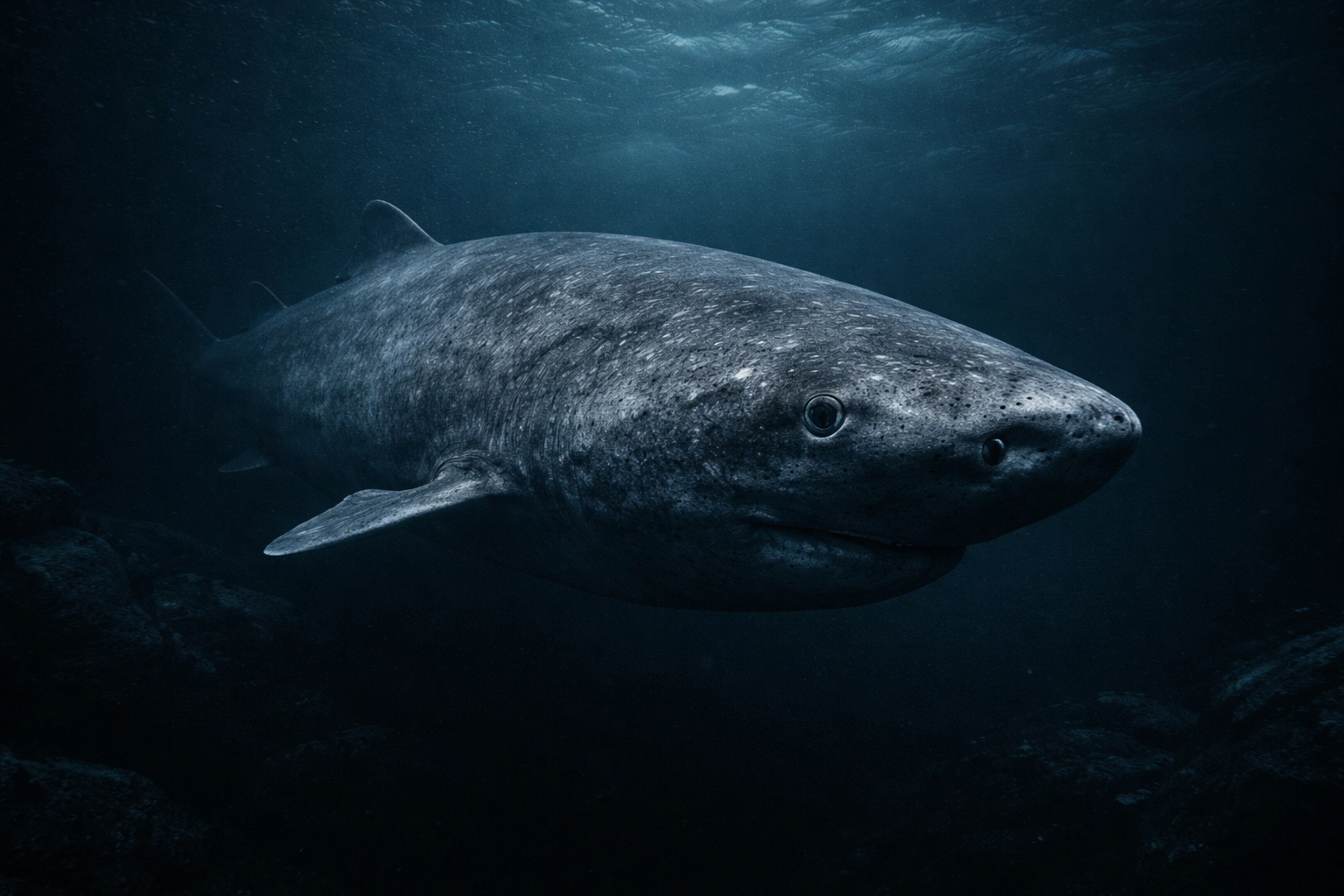
In the dark, near-freezing waters of the North Atlantic swims a creature that was already alive when Shakespeare was writing his plays. The Greenland shark is now recognised as the longest-living vertebrate known to science, with some individuals estimated to be 250 to over 400 years old. This extraordinary lifespan has transformed the species from an obscure Arctic fish into one of the most fascinating subjects in marine biology.
This slow-moving shark inhabits deep Arctic and sub-Arctic waters, where temperatures hover just above freezing. Its world is one of dim light, immense pressure and near-silence. Sunlight barely penetrates these depths. Ice drifts above, and the seabed stretches into cold darkness. In such an environment, life proceeds at an unhurried pace, and the shark’s biology reflects this rhythm.
Greenland sharks grow extremely slowly, adding only about a centimetre per year. They can reach lengths of over five metres, yet that size may take centuries to achieve. They also mature late; females may not reproduce until they are over a century old. In most species, slow growth would be a disadvantage. Here, it appears to be the key to longevity. A sluggish metabolism, low body temperature and minimal predation reduce wear on the body over time. Energy is conserved rather than spent quickly.
Their diet is equally opportunistic. They feed on fish, squid and even carrion, using patience rather than speed to secure a meal. Although capable of surprising bursts of movement, they generally cruise slowly through the depths. Some individuals carry small parasitic copepods attached to their eyes, which can impair vision. Yet this does not prevent them from surviving for centuries.
Scientists estimated their age by analysing proteins in the lens of their eyes, which form before birth and remain largely unchanged. Radiocarbon dating of these tissues revealed lifespans that stunned the scientific community. Some sharks alive today may have been swimming through the ocean when early European explorers were charting unknown coasts.
Despite their impressive longevity, Greenland sharks remain mysterious. They rarely encounter humans and are difficult to study in their remote habitat. As climate change alters Arctic ecosystems, researchers are keen to understand how such a slow-growing species will adapt. Their story reminds us that long life in nature often comes not from speed or dominance, but from patience, stability and resilience in harsh environments.
Subscribe Deshwale on YouTube


