



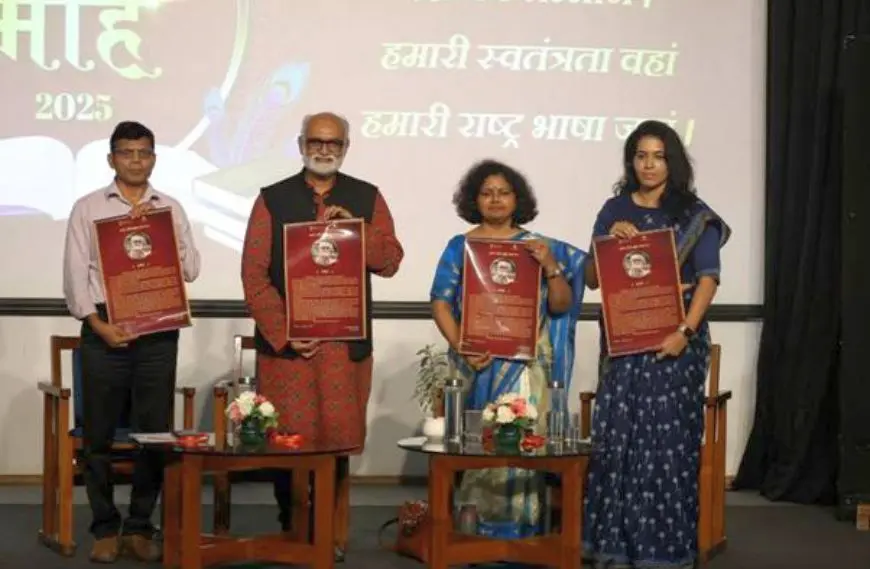
The Indira Gandhi National Centre for the Arts (IGNCA) has launched Hindi Maah 2025 with a call to embrace Hindi with love, not just as a tool. The month-long celebration, running from September 2 to 30, will feature cultural programs and competitions to encourage creativity and awareness around the language.
The inaugural ceremony on September 2 began with a traditional lamp lighting and a mangalacharan. Prof. Sudha Singh, Head of the Hindi Department at Delhi University, was the chief guest. The session was presided over by Dr. Sachchidanand Joshi, Member Secretary of IGNCA, with Dr. Priyanka Mishra, Director (Administration), also present. The event was moderated by Prof. Arun Bhardwaj. A Gaudiya dance performance on Ganesh Stuti, presented by Gangotri Das and choreographed by Mahua Mukherjee, added a cultural touch.
Dr. Joshi explained that Hindi Maah 2025 aims to strengthen Hindi’s use and expand linguistic awareness. He urged everyone to take up the challenge of learning an Indian language other than their mother tongue during the period between Hindi Diwas on September 14 and Bhartiya Bhasha Diwas on December 11. Participants will be awarded prizes, including a special ‘Prerna Puraskar’. He appealed to young people in particular to join the initiative and reinforce India’s linguistic diversity.
Highlighting the growth of Hindi at IGNCA, Dr. Joshi shared that nearly half of its publications are now in Hindi, including the institute’s magazine Vihangama. He stressed that Hindi should be kept simple and easy to understand. He also condemned the mocking of Hindi and its teachers in films and online spaces, calling for dignity in how the language is treated. On the role of technology, he underlined that while AI tools are useful, the responsibility for accurate translations lies with humans. He concluded by releasing a pledge document urging all colleagues to preserve and promote Hindi and other Indian languages.
Prof. Sudha Singh, in her keynote, said that Hindi must not be limited to jobs, exams, or trade. She encouraged building a genuine passion for it, reminding the audience that language grows with love, not utility. Tracing Hindi’s journey from Pali and Prakrit to Khadi Boli, she described it as a symbol of cultural unity. She voiced concern about its limited role in technical and professional fields and urged the youth to explore other Indian languages alongside a foreign language. Singh also stressed the importance of media in spreading Hindi’s reach and concluded with a call to treat Hindi with love, respect, and pride.
Speaking at the session, Dr. Priyanka Mishra noted how the celebration has expanded from a week to a month, reflecting IGNCA’s strong commitment to the language.
As part of Hindi Maah 2025, several competitions will be organised. These include contests on forgotten Hindi vocabulary (September 3), self-composed poetry recitation (September 4), Swasti Gayan and devotional song competitions (September 8), regional vocabulary in daily life (September 18), and a survey-based language contest (September 22). A cultural program will be held on September 29, followed by the prize distribution and closing ceremony on September 30. These events aim to provide a platform for Hindi enthusiasts to celebrate their creativity and connection with the language.
