



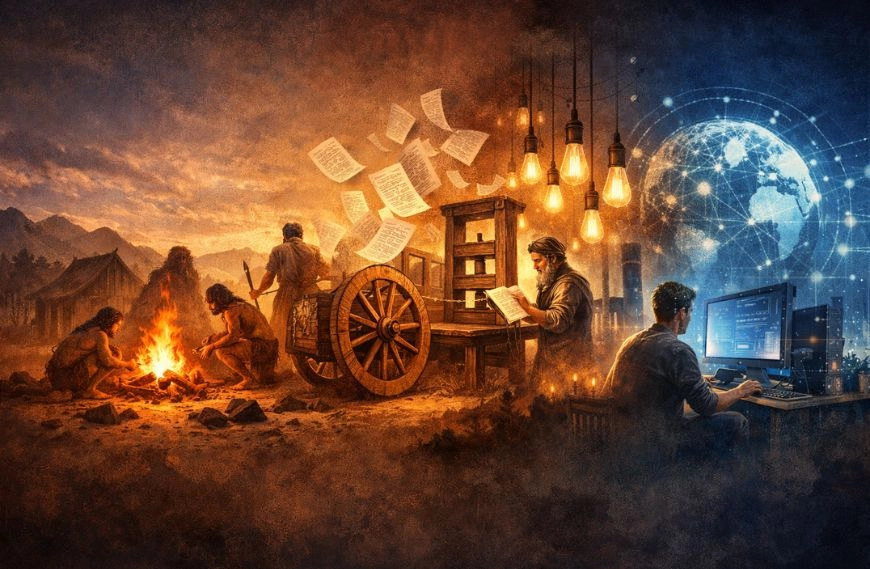
Human history is not defined only by kings, wars or borders, but by ideas that quietly changed how people lived. Some inventions did more than solve immediate problems. They altered the course of civilization itself. From the moment early humans learned to control fire to the era of the internet, these breakthroughs reshaped society, expanded imagination and redefined what was possible.
The discovery and control of fire marked one of humanity’s earliest turning points. Fire provided warmth, protection from predators and the ability to cook food, which improved health and survival. More importantly, it encouraged social bonding. People gathered around fires, shared food and stories, and slowly built the foundations of community life. Fire extended the day into the night and allowed humans to move into colder regions, laying the groundwork for expansion and cooperation.
As societies grew, movement and trade became essential. The invention of the wheel around 3500 BCE transformed transportation and commerce. Goods could now travel longer distances with less effort, enabling trade networks and economic growth. The wheel was not just a tool for carts. Its principles became central to machinery, engineering and industrial development. Even today, its influence remains embedded in modern technology.
For centuries, knowledge was limited to the privileged few. That changed dramatically with the arrival of the printing press in the 15th century. Johannes Gutenberg’s innovation allowed books to be produced in large numbers, making information accessible beyond monasteries and royal courts. Literacy spread, ideas travelled faster, and debates flourished. The printing press played a crucial role in social reform, scientific progress and the rise of journalism, giving ordinary people access to learning and independent thought.
The industrial era introduced another transformative force: electricity. Once an abstract scientific curiosity, electricity became the backbone of modern life. It powered factories, illuminated streets and homes, and enabled the creation of countless new devices. Alongside it came inventions that changed communication forever. The telephone made it possible to speak across great distances in real time, collapsing geographical barriers and reshaping personal and professional relationships.
In the late 20th century, the world entered a new phase of transformation with the rise of computers and the internet. What began as a limited network for researchers evolved into a global system connecting billions of people. The internet revolutionised how information is shared, how businesses operate and how societies communicate. News travels instantly, education crosses borders, and voices once unheard can now reach global audiences. It has become as fundamental to modern life as electricity once was.
Each of these inventions emerged from human need, curiosity and imagination. None existed in isolation. Every breakthrough built upon earlier discoveries, creating a continuous chain of progress. As the world now looks toward artificial intelligence, renewable energy and biotechnology, the lesson from history remains clear. When humans dare to innovate, the consequences reach far beyond their own time, shaping generations yet to come.
Subscribe Deshwale on YouTube
