



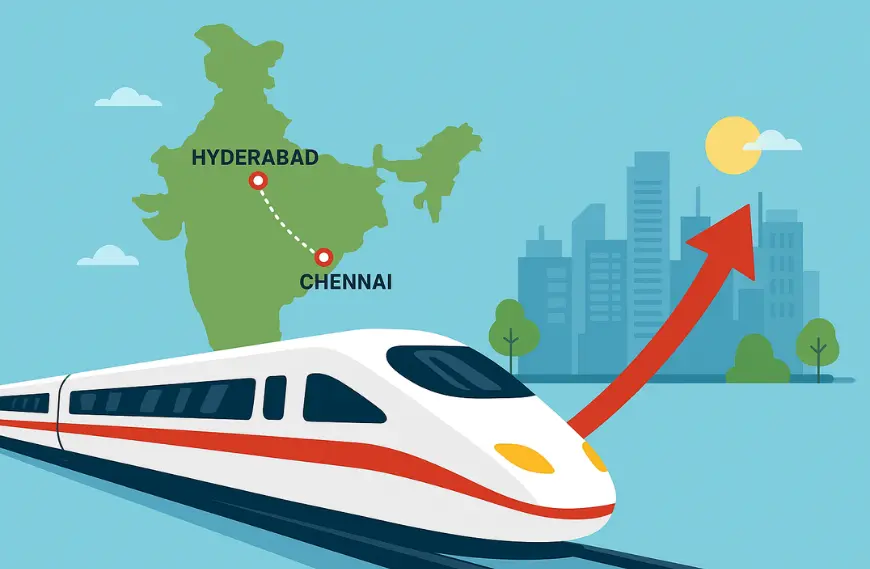
The idea of a bullet train connecting Hyderabad and Chennai is more than just a transport plan. It has the potential to reshape South India’s economy. Faster travel between these two important cities could bring new trade opportunities, encourage tourism, and make it easier for investors to see the region as one connected market.
Speed as an economic driver
Currently, travel between Hyderabad and Chennai takes around 10 to 12 hours by regular train and about 8 to 9 hours by road. A bullet train could cut this time to less than 4 hours. This speed would make it easier for businesses to move goods, professionals to attend meetings, and families to travel for leisure. Shorter travel time always means stronger business links and more exchanges between cities.
Trade and investment
Hyderabad is known for its technology sector, while Chennai has strong manufacturing and port facilities. Linking the two with a high-speed corridor can combine their strengths. Tech companies could reach global markets faster through Chennai’s ports, while manufacturers could tap into Hyderabad’s growing consumer and industrial market. This could encourage both domestic and foreign investors to see the region as an integrated hub.
Tourism growth
South India is rich in culture, temples, beaches, and heritage sites. Faster connectivity will allow tourists to cover more destinations in less time. For example, a tourist landing in Hyderabad could easily plan a quick trip to Chennai’s beaches or Mahabalipuram, and vice versa. More tourism means more spending in hotels, restaurants, and local markets, boosting employment and regional income.
Boost to secondary cities
The bullet train plan is expected to pass through important towns and regions in Telangana and Andhra Pradesh, such as Amaravati and Nellore. These stops can turn into new growth centres. Land value, local businesses, and employment will grow as these towns become better connected to two major metros. Over time, this can reduce the pressure on Hyderabad and Chennai, spreading development more evenly across South India.
Challenges and opportunities
Of course, such a project will need heavy investment, advanced technology, and careful land planning. The cost will be high, but if managed well, the long-term economic returns in trade, jobs, and taxes can make it worthwhile. The key will be coordination between states and the central government, along with private sector participation.
A Future Growth Engine
The Hyderabad–Chennai bullet train is more than just a fast way to travel. It can be a growth engine that transforms South India into a more connected, competitive, and dynamic economy. By linking technology, manufacturing, tourism, and regional markets, this project has the power to redefine economic clusters and put South India on the global high-speed map.
