









Every year, some interior designer or lifestyle expert declares that beige is dead and colour is back. This year, it happened again, with designers telling us that Indian homes are finally becoming a reflection of who we are. It sounds inspiring. It also skips over how most Indian households actually make decisions about their homes.
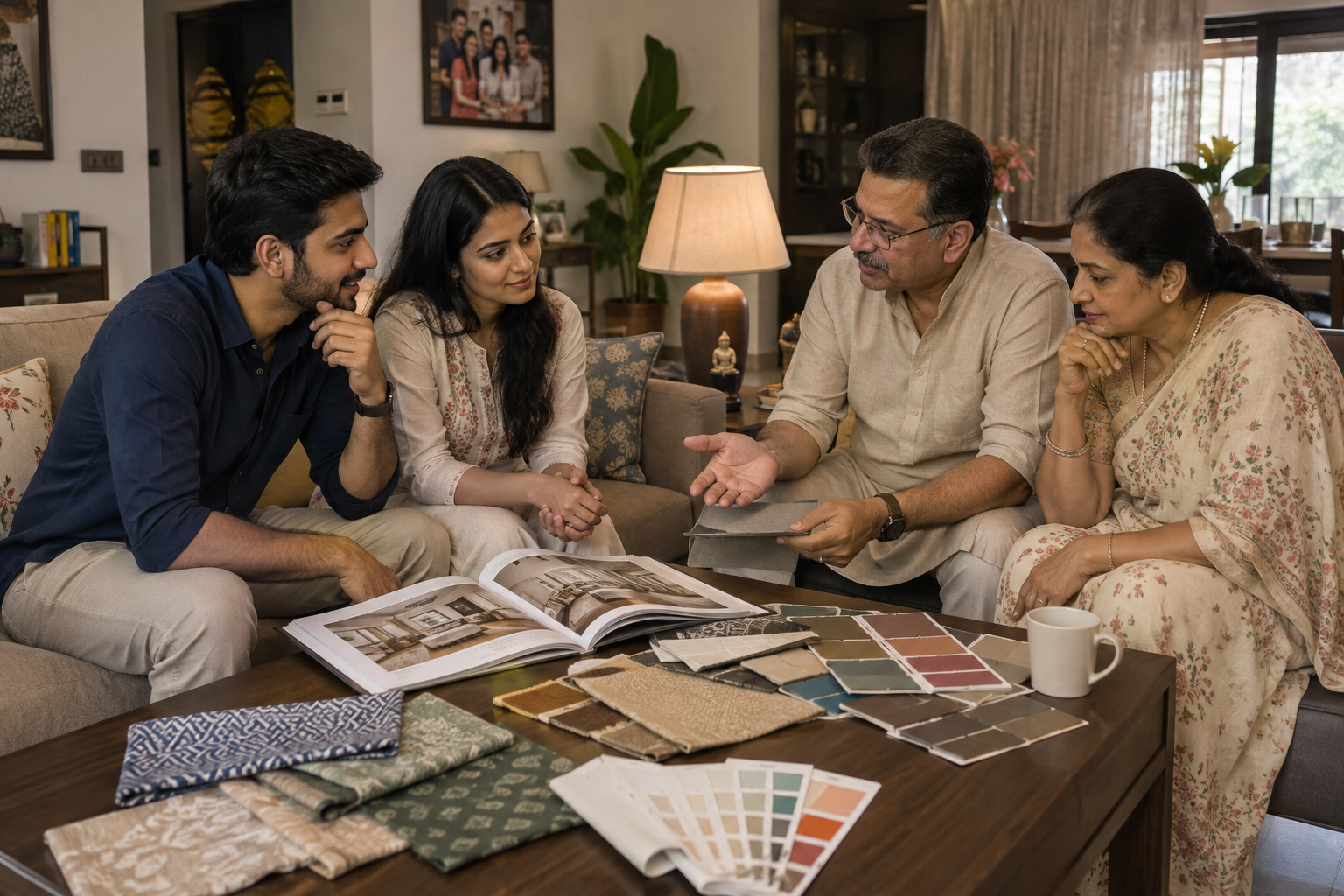
Walk into an average Indian home and ask who chose the sofa colour, the wall paint, or the dining table design. The answer is rarely “I did, because it reflects my personality.” It is usually a mix of what parents approved, what the budget allowed, and what would not look “too much” if relatives dropped by unannounced.
Here is the part that might surprise people: most Indian households today are technically nuclear, not joint. Census data shows nuclear families make up around 70 percent of all households in the country. But that number is misleading if you think it means most young Indians are decorating with full independence. A home can be nuclear on paper and still function jointly in practice with parents living one floor above, in-laws visiting every festival, or a married couple still consulting the family before repainting a wall. The structure has changed, but the decision-making often has not.
The home is rarely owned by one person’s taste
In cities like Mumbai, Delhi, or Pune, plenty of young Indians live with parents, in-laws, or as tenants, and even those who have moved into their own nuclear household often stay closely tied to extended family opinion. Choosing a bold mustard accent wall or a maximalist gallery wall is not just a design decision in these homes. It is a small negotiation, and negotiations usually end in something safer a colour everyone can live with, not necessarily the one you love the most.
Renters face a similar problem, just from a different direction. Roughly one in four urban households in India live on rent, and most landlords do not allow permanent changes like accent walls, built-in shelving, or bold paint jobs. So even someone with a strong sense of personal style ends up with neutral walls and easily removable decor, because that is what the lease allows, not because that is what they wanted.
Resale value quietly shapes more homes than we admit
Even homeowners who technically have full freedom over their space often think about the next buyer before they think about themselves. A muted, neutral palette is easier to sell later. A dramatic, personality-heavy interior can actually work against resale value, because the next family may not share the same taste.
This is a very Indian kind of practicality. Buying a home is often seen as a long-term financial decision, not just a lifestyle choice. So people paint walls in colours that will “age well” and choose furniture that will “go with anything,” instead of picking what genuinely excites them. The home becomes an investment first and a personality second.
Personal style is often a privilege of space and money
The idea of a home as “self-expression” also assumes something important that you have enough space, and enough money, to experiment. A colourful reading nook, a curated gallery wall, or a design-forward dining corner needs both room and budget that many Indian households simply do not have.
For a family sharing a one or two-bedroom flat across generations, “personal style” is a smaller conversation. It usually comes down to a cushion cover, a wall hanging, or a small shelf of favourite things not a full room makeover. This is not a lack of taste. It is a lack of space to express it fully.
So what does personal style actually look like in most Indian homes?
It exists, but in smaller, quieter ways. A daughter picks the curtains for her room, even if the rest of the house follows her mother’s choices. A young couple adds fairy lights and a few travel souvenirs to an otherwise plain rented apartment. A grandmother’s old brass diya sits next to a modern lamp, because throwing it away never felt right.
These small, layered choices are where real personality shows up in Indian homes not in a single bold colour palette chosen for the whole house, but in the little corners people are allowed to call their own.
Maybe the real story of Indian homes in 2026 is not about beige disappearing or colour taking over. It is about how much personal style has to squeeze itself into the gaps left by family, budget, and practicality and how creatively people manage to do it anyway.
Subscribe Deshwale on YouTube


