






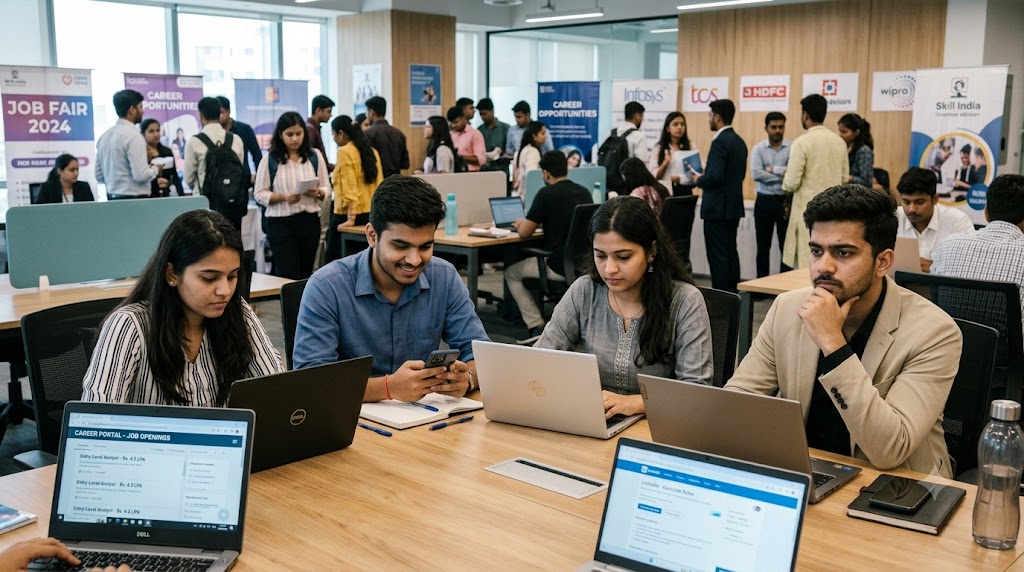
On paper, India’s job story should be a happy one. Unemployment has dropped sharply over the last few years. More women are working than ever before. Vacancies are being filled. Yet ask any young Indian how they feel about their job prospects, and you will likely hear something far less optimistic.
The latest India Today Mood of the Nation survey captures exactly this contradiction. And once you look closely at the numbers behind India’s “improving” job market, it becomes easier to understand why young people simply aren’t buying the good news.
The official numbers look encouraging
According to the Economic Survey 2025-26, India’s unemployment rate fell from 6% in 2017-18 to just 3.2% in 2023-24. Female labour force participation nearly doubled in the same period, rising from 23% to 42%. The government also says more than 2.3 crore vacancies were mobilised through the National Career Service in just the first six months of this financial year.
These are genuinely significant figures. By most conventional measures, they suggest a labour market that is opening up rather than shrinking.
So why doesn’t Gen Z feel it?
The Mood of the Nation survey, conducted by CVoter for the India Today Group, offers a clue. The August 2026 edition surveyed 25,184 people directly between July 1 and August 25, along with data from another 91,795 interviews collected over six months as part of CVoter’s ongoing tracking.
When asked about the biggest employment problem facing young Indians, 32% said there simply aren’t enough jobs. Another 18% pointed to low salaries. A further 17% said the jobs available don’t match their qualifications, while an equal 17% blamed slow or unreliable government recruitment. Smaller shares cited a skills mismatch between education and industry needs, or a lack of secure jobs with proper benefits.
In other words, young Indians aren’t necessarily unemployed. Many of them are underemployed, underpaid, or stuck waiting for government jobs that take too long to materialise.
The catch hiding inside the “good” job numbers
This is where the picture gets more complicated. The State of Working India 2026 report, published by Azim Premji University using government PLFS data, found that of the 83 million jobs added in India between 2021-22 and 2023-24, around 40 million were in agriculture.
That means nearly half of India’s recent job growth came from a sector that typically offers low pay, seasonal work, and little long-term security. A falling unemployment rate, then, does not automatically mean people are landing better jobs. It can simply mean more people have found some form of work, even if that work pays little or doesn’t match their education.
This gap between quantity and quality of jobs may explain why young Indians remain anxious even as headline numbers improve.
A young, educated population racing against time
India is home to roughly 367 million people aged 15 to 29, the largest youth population of any country in the world. More of them are entering colleges and universities than ever before, creating a workforce that is more qualified and more ambitious than previous generations.
But according to the State of Working India report, the number of graduates has grown faster than graduate employment. This has left many young, educated Indians stuck between qualifications and appropriate jobs. The pressure is compounded by demographics. India’s working-age population is projected to start shrinking after 2030, leaving the country a narrowing window to convert its young population into economic strength.
Who should fix this? Young Indians have a clear answer
The MOTN survey also asked respondents who should take the lead on improving youth employability. The response was fairly one-sided. 63% said the responsibility lies primarily with the Union and state governments. Schools and universities followed at 14%, private employers at 9%, and individuals or families at just 5%.
This heavy reliance on government reflects a shift already visible in public policy, which has increasingly moved toward employment-linked incentives and skilling programmes rather than leaving job creation purely to market forces.
The government’s big bet: cash incentives for hiring
The Centre’s flagship response is the Pradhan Mantri Viksit Bharat Rozgar Yojana, previously known as the Employment Linked Incentive Scheme. It comes with a total outlay of Rs 99,446 crore and aims to support more than 3.5 crore jobs over two years, including around 1.92 crore first-time entrants into the workforce.
Under the scheme, first-time employees can receive an incentive of up to Rs 15,000, while employers get up to Rs 3,000 per month for every additional employee they hire. By June 2026, the government said the scheme had already supported 15 lakh employment opportunities, with around Rs 2,400 crore in incentives disbursed so far.
The scale of this investment shows just how central job creation has become to India’s economic policy. But it also raises a harder question: can financial incentives create the kind of stable, well-paying jobs young Indians are actually asking for, or will they simply generate more short-term hires?
A labour market in transition
Adding to the complexity, India’s job market itself is changing shape. The Economic Survey notes a 55% rise in gig and platform workers between FY21 and FY25, alongside broader shifts driven by digitalisation and the growing green energy sector. These new forms of work often lack the stability and benefits of traditional employment, even when they offer flexibility.
The real question isn’t unemployment. It’s opportunity.
Put together, the MOTN survey and recent economic data reveal that India’s job crisis can no longer be measured by a single number. It isn’t just about how many people have jobs. It’s about how many jobs actually exist, what they pay, whether they match a person’s education, whether they come with security and benefits, and how smoothly young people can move from classrooms into stable careers.
The unemployment rate may be falling. But for millions of young Indians, that statistic doesn’t tell the whole story, and it certainly doesn’t ease the anxiety of wondering whether a good job is actually within reach.
Subscribe Deshwale on YouTube


