






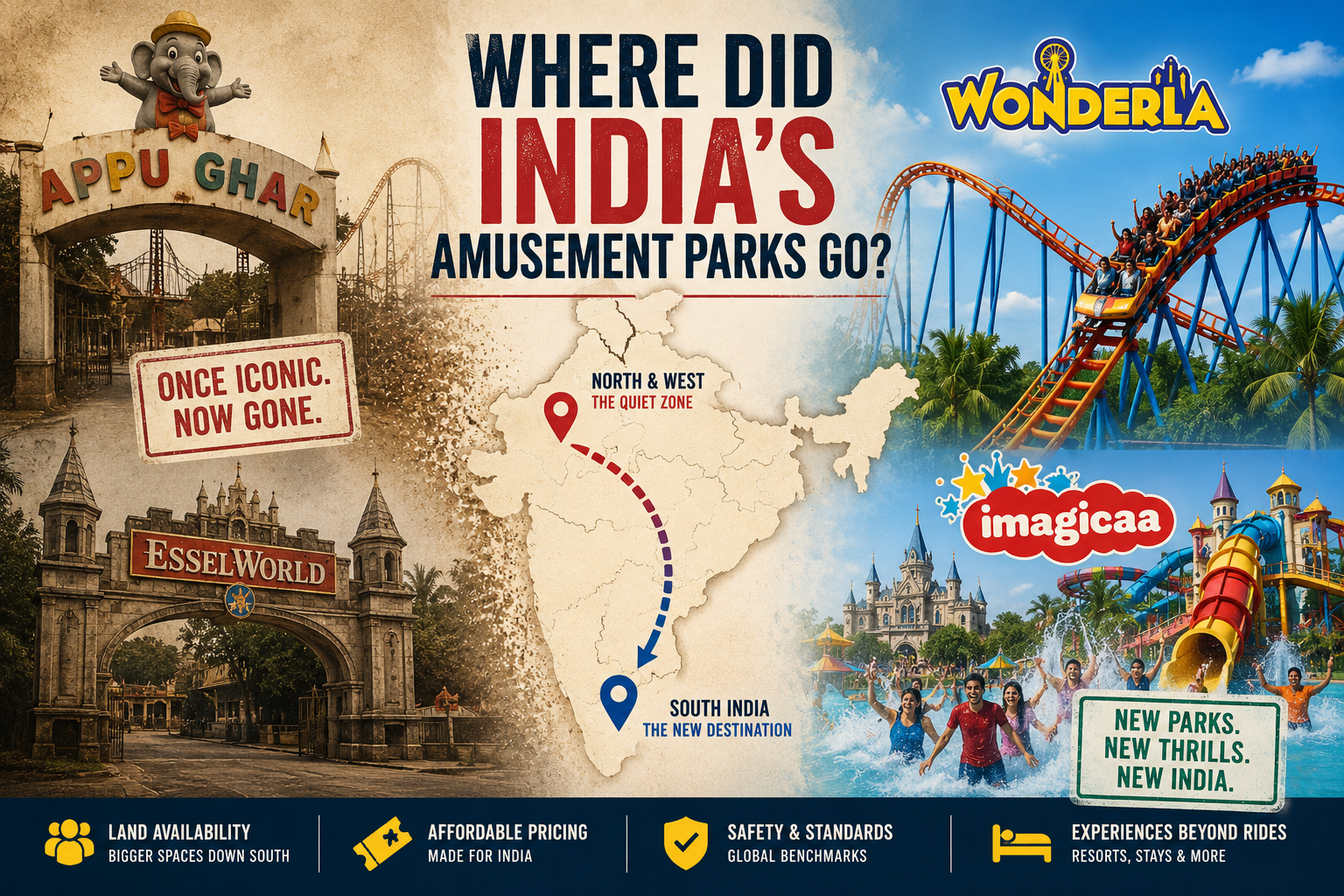
Ask any millennial about Appu Ghar or EsselWorld, and you’ll probably get a nostalgic smile followed by a line from that old jingle. These parks were the biggest outing a middle-class Indian family could plan. Today, both are gone, and the assumption is simple: amusement parks in India are dying.
That assumption is wrong. They didn’t die. They just moved.
Appu Ghar opened in Delhi in 1984 and shut down in 2008 when its land lease at Pragati Maidan expired. The land was later used for expanding the Supreme Court complex and the Delhi Metro. A second version opened in Gurugram in 2014, but that one, later renamed Oysters, was sealed over unpaid dues and remains shut.
EsselWorld in Mumbai told a similar story of scale and spectacle, and it defined an entire generation’s idea of fun. But the northern and western belt where these icons once thrived has quietly gone quiet on amusement parks altogether.
Head south, though, and the picture flips completely.
Wonderla’s park in Kochi has been running since 2000 and still pulls in more than a million visitors every single year. The company posted its best-ever fourth quarter in FY26, with footfall rising 30 percent compared to the previous year, partly thanks to a newly launched park in Chennai. That momentum didn’t slow down. In the April to June quarter of 2026, revenue jumped 44 percent and footfall rose 33 percent year-on-year, touching close to 12.3 lakh visitors. For the full financial year, Wonderla’s revenue crossed Rs 518 crore, up 13 percent.
Imagicaaworld Entertainment tells a similar growth story. The company recorded 11.54 lakh visitors in the same quarter, up 22 percent year-on-year, and profit climbed nearly 30 percent. It has now announced a Rs 1,000 crore expansion plan spread across the next five to six years, along with a fresh push into indoor “Hello Park” formats and new water parks coming up in Gujarat.
So why did the map of India’s amusement park boom shift so decisively toward the south, while the north and west quietly gave up?
The answer, according to the people actually running these parks, comes down to something far less romantic than nostalgia: land.
Dhimant Bakshi, CEO of Imagicaaworld, points out that a proper amusement park needs anywhere between 20 and 100 acres of land to function well. In states like Delhi and Haryana, where real estate prices are among the highest in the country, that kind of land is either impossible to find near a city or simply too expensive to justify for a business built on ticket prices. Bakshi says his company is currently in talks with the Delhi Development Authority for a 54-acre plot, and is also building smaller, city-friendly indoor formats in places like Hyderabad to work around this exact problem.
Arun Chittilappilly, who heads Wonderla Holidays, offers a similar explanation but adds a pricing angle to it. According to him, a genuine international-style theme park needs somewhere between 15,000 and 20,000 visitors a day to stay financially viable. India’s market, at the price points such a park would demand, simply cannot support those numbers yet, especially in northern cities. His company’s strategy has been the opposite of going big. Instead, Wonderla has focused on smaller, more affordable parks that match what an average Indian family is actually willing to spend on a day out.
There’s also a quieter shift happening inside the industry that rarely makes headlines. Both companies say they’ve adopted international ride-safety standards, moving the business from a slightly chaotic, informal setup toward something far more professional and safety-conscious. Imagicaaworld now runs resort hotels next to its parks, and Wonderla has two resorts beside its Bengaluru property, turning a single day trip into something closer to a short vacation.
None of this means the north has lost interest in amusement parks. It means the business model that worked in 1989 simply doesn’t work on 2026’s real estate map. Families in Delhi and Mumbai haven’t stopped wanting thrills; they’ve just started finding them elsewhere, whether that’s a mall-based gaming zone, a trampoline park, or increasingly, a flight to Dubai or Singapore.
Meanwhile, in cities like Kochi and Chennai, where land is comparatively easier to acquire and weather conditions are more favourable for outdoor rides through the year, the same industry that supposedly died is busy raising thousands of crores in fresh investment.
So the next time someone tells you Indian amusement parks are a thing of the past, the honest answer is a little more specific. They aren’t gone. They just packed their bags and moved south, and they’re doing rather well for themselves.
Subscribe Deshwale on YouTube


