








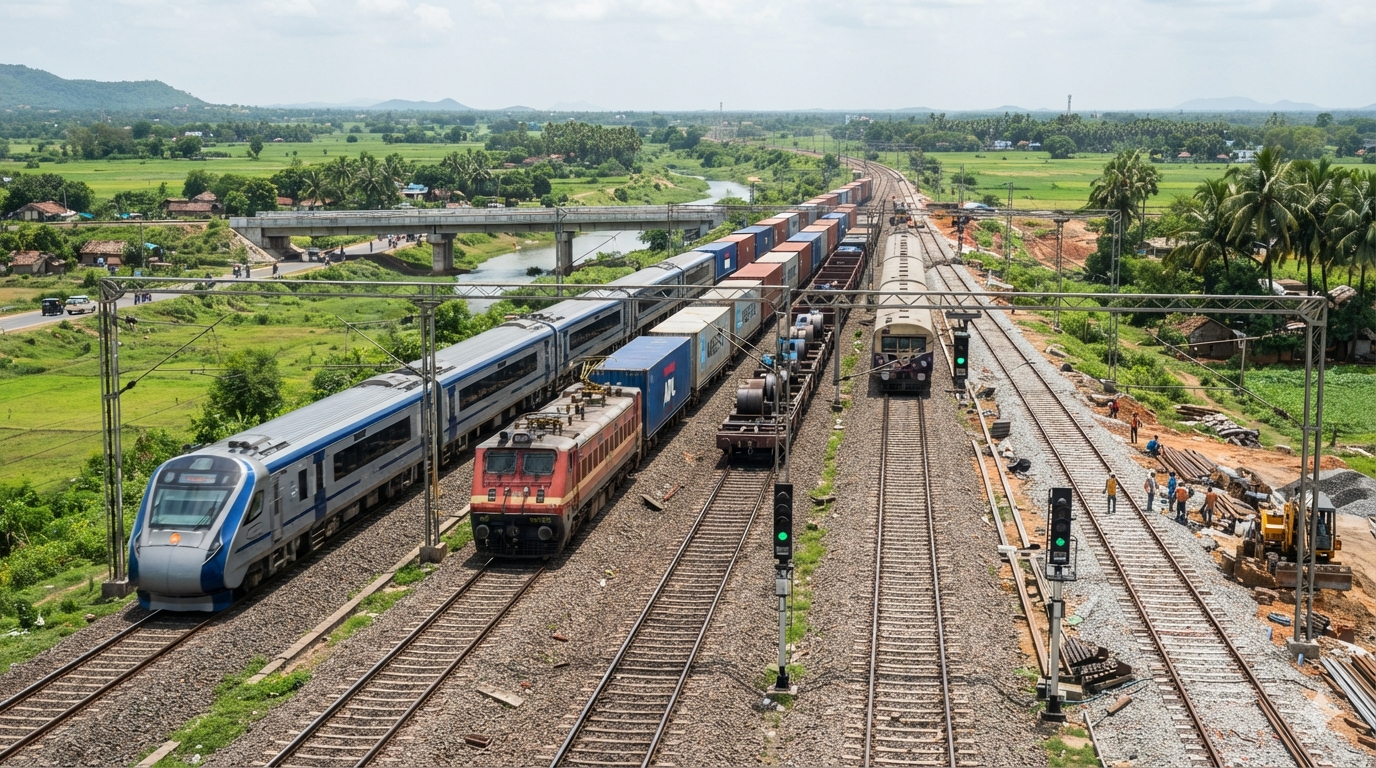
The Cabinet Committee on Economic Affairs, chaired by Prime Minister Narendra Modi, has approved four railway multitracking projects with a total estimated cost of ₹9,450 crore. The projects will be implemented across West Bengal, Odisha, Tamil Nadu and Andhra Pradesh and will add about 410 km to the existing Indian Railways network.
The projects are aimed at increasing railway capacity, reducing congestion and improving the efficiency and reliability of train operations. They are also expected to strengthen the movement of passengers, goods and essential services across the four states.
The approved projects include the 173-km Kharagpur–Bhadrak (Ranital) fourth line, covering West Bengal and Odisha; the 75-km Bhadrak–Haridaspur fourth line in Odisha; the 90-km Gummidipundi–Gudur third and fourth lines, covering Andhra Pradesh and Tamil Nadu; and the 72-km Cuttack–Paradeep (Badabandha) third and fourth lines in Odisha.
Together, the four projects will cover eight districts. The additional railway lines will increase capacity on important routes and help streamline train operations. By providing more line capacity, the projects are expected to ease congestion and improve service reliability.
The projects are planned in line with the PM GatiShakti National Master Plan. The plan focuses on improving multimodal connectivity and logistics efficiency through integrated planning and consultations with stakeholders.
The improved rail network will provide better connectivity for the movement of people, goods and services. The projects are also expected to support comprehensive development in the regions covered by the new railway infrastructure.
The expansion will benefit a large population across the four states. According to the project details, the proposed multitracking works will improve connectivity to approximately 6,448 villages with a combined population of about 60 lakh people.
The improved railway network is also expected to strengthen access to several important tourist and religious destinations. These include Kuldiha Wildlife Sanctuary, Bhitarkanika National Park, Maa Bhadrakali Temple, Maa Dhamarai Temple, Panchalingeswar Temple, Talsari–Udaypur and Chandipur Beach.
Other destinations that will benefit from improved rail connectivity include Pulicat Lake, Nelapattu Bird Sanctuary, Lord Veeraraghava Perumal Temple, Gada Kujanga Jagannath Temple, Sarala Temple, Dhabaleswar Temple and Lalitgiri, a Buddhist site.
The projects will also support the transportation of major commodities. These routes are important for moving coal, iron ore, cement, iron and steel, containers, automobiles and food grains. Increasing the capacity of these routes will therefore support the movement of both industrial and essential goods.
The capacity enhancement works are expected to generate additional freight traffic of about 76 million tonnes per annum (MTPA). The increase in freight capacity will strengthen the role of railways in moving goods across the region and support more efficient logistics.
The projects are also expected to contribute to environmental goals. Railways is an energy-efficient and environment-friendly mode of transportation, and greater rail capacity can support the movement of more freight through the railway network.
According to the project details, the capacity enhancement is expected to help reduce oil imports by approximately 13 crore litres. It is also projected to lower carbon dioxide emissions by around 65 crore kg. The reduction in emissions is equivalent to the plantation of about 2.60 crore trees.
The additional railway capacity is expected to improve operational efficiency while supporting the wider movement of people and goods. By reducing congestion on existing routes, the multitracking projects can help create more reliable rail operations and improve connectivity across the covered districts.
The projects also align with the broader objective of developing infrastructure that can support employment and self-employment opportunities in the regions concerned. Better transport links can improve access between communities, economic activities and important destinations.
With four projects spread across eight districts and four states, the approved railway works represent a major expansion of the existing network. The addition of about 410 km of railway lines will increase capacity on key routes while strengthening passenger, freight, tourism and logistics connectivity.
The ₹9,450-crore investment is expected to improve railway operations, support freight movement, strengthen regional connectivity and contribute to lower logistics and environmental costs. The projects, planned under the PM GatiShakti framework, are designed to provide more integrated and efficient connectivity for people, goods and services across West Bengal, Odisha, Tamil Nadu and Andhra Pradesh.
Subscribe Deshwale on YouTube


