







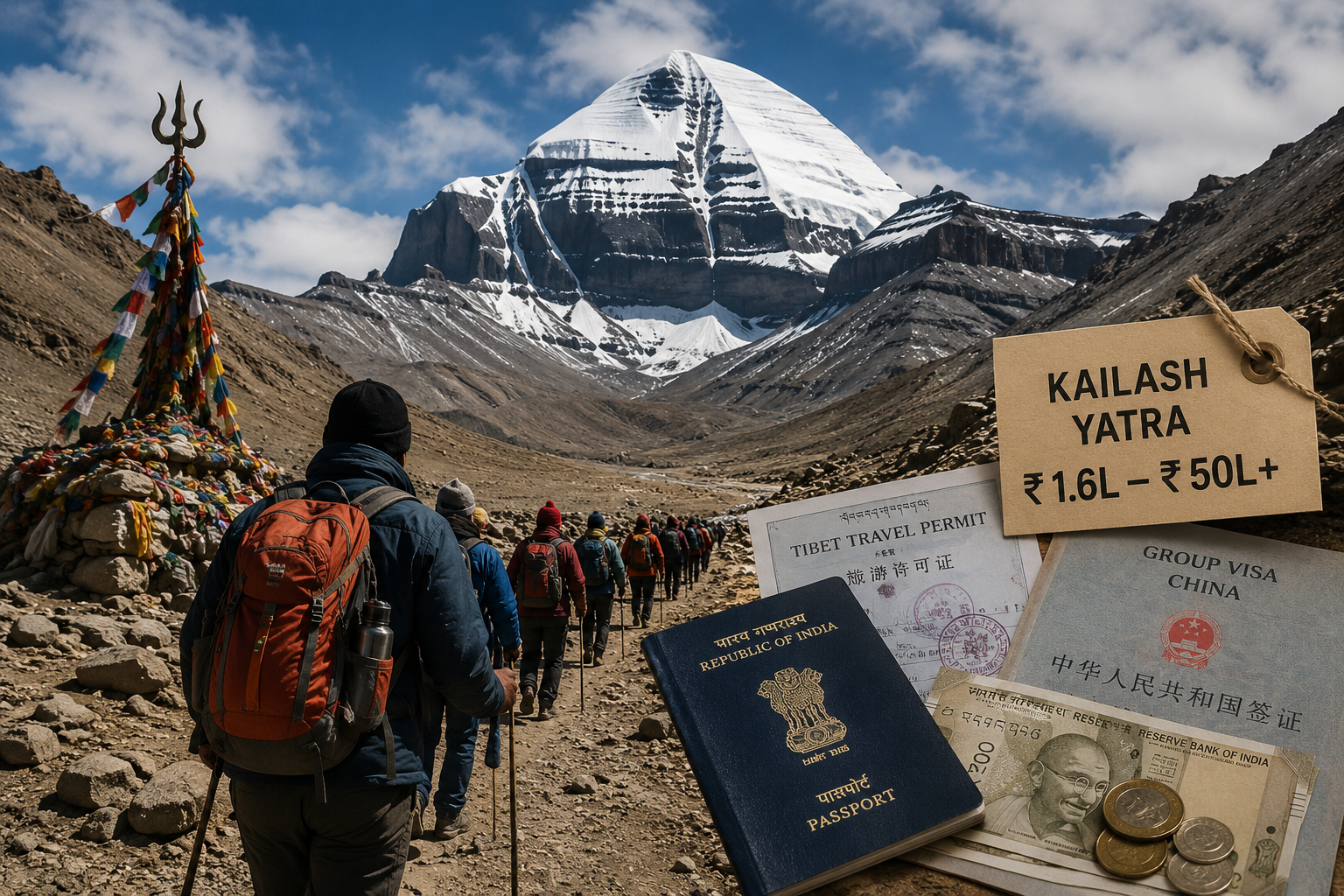
Every time Sadhguru speaks of Mount Kailash, the internet listens. His descriptions of the peak as a “mystical library,” a repository of the wisdom of realised beings, have once again pulled the 6,638-metre mountain in Tibet’s Ngari prefecture into the spotlight.
But somewhere between the devotion and the discourse lies a number most articles skip: what it actually costs to stand at the base of that mountain. The answer, it turns out, is a small fortune and a fast-growing industry built entirely on the promise of transcendence.
The price of darshan
After a five-year suspension caused by the pandemic and border tensions, the Ministry of External Affairs revived the official Kailash Mansarovar Yatra in 2025. Around 750 pilgrims were selected out of more than 5,500 applicants that year.
The response was so overwhelming that the 2026 season has been expanded to roughly 20 batches and about 1,000 confirmed seats, split between the Lipulekh route in Uttarakhand and the Nathu La route via Sikkim.
Even the government-backed route isn’t free. Pilgrims travelling through the official MEA channel pay somewhere between ₹1.6 lakh and ₹1.8 lakh per head, largely covering permits, transport and basic logistics.
Step outside the government lottery, and the numbers climb quickly. Private operators running the Nepal-Tibet overland route typically charge between ₹1.7 lakh and ₹3.5 lakh, depending on group size and whether the parikrama includes a horse or porter.
IRCTC’s own pilgrimage packages sit in a similar ₹1.8–2.8 lakh band. Faster, helicopter-assisted routes from Kathmandu which compress the trip into roughly two weeks sit at the top of the private-operator range, generally running close to ₹3.5 — 4 lakh once flights, permits and inclusions are added in.
And that’s before anyone books a premium experience. Isha Foundation’s own Kailash pilgrimages, led periodically by Sadhguru himself, have historically topped this pricing ladder by a wide margin.
Reports from the 2021 season put the top-tier package which included closer access to Sadhguru at up to ₹50 lakh per person, with more modest tiers available for devotees willing to trade proximity for affordability. Isha has also run some of the largest single pilgrim groups to ever visit Kailash, with 514 devotees travelling together in the 2010 season.
Why the mountain got so expensive
None of this pricing is arbitrary. Kailash sits inside Chinese-administered Tibet, which means every Indian pilgrim needs a Chinese group visa, a Tibet travel permit, and passage through a third country, usually Nepal since India and China don’t offer direct pilgrim access.
Each of those approvals comes with its own fee, its own processing timeline, and its own vulnerability to geopolitics. When the yatra was suspended between 2020 and 2025, it wasn’t hikers who kept the route alive; it was diplomacy.
2026 also happens to be the “Fire Horse Year” in the Tibetan and Chinese zodiac calendar, a rare 60-year cycle that many pilgrims and Buddhist devotees regard as especially auspicious for visiting Kailash. Several commercial tour operators claim this demand spike, combined with new catering requirements on the Chinese side and near-mandatory pony hire at the gruelling Dolma La pass, is pushing 2026 prices above previous years.
It’s worth being clear-eyed about that claim: it comes from operator marketing material, not government or independently verified data, so it should be read as an industry talking point rather than a confirmed fact. What is confirmed is the underlying structure: a pilgrimage layered with cross-border permits and visas will always be more expensive, and more exposed to price swings, than a domestic one.
Faith, priced in
None of this makes the pilgrimage insincere, and it would be unfair to suggest devotion can be reduced to a price list. For many who undertake the journey trekking at altitudes above 5,000 metres, enduring thin air and freezing nights the physical difficulty is inseparable from the spiritual purpose.
But the economics are worth naming plainly. What was once a pilgrimage undertaken by a relative handful of ascetics and devout travellers has become a structured, tiered marketplace.
Government lottery at the bottom. Private operators in the middle. Premium spiritual-tourism brands at the top each selling a different degree of access to the same mountain.
The Isha Foundation, tour operators, IRCTC, and Chinese immigration authorities all now have a financial stake in how often, and how expensively, people seek “inner transformation” at 6,638 metres. That doesn’t cheapen anyone’s faith.
It simply means that when a spiritual teacher’s renewed attention drives a fresh wave of interest toward Kailash, the conversation that should follow isn’t only about mysticism. It’s also about margins, permits, and who profits when thousands of Indians decide, almost simultaneously, that this is the year they finally go.
Subscribe Deshwale on YouTube


