









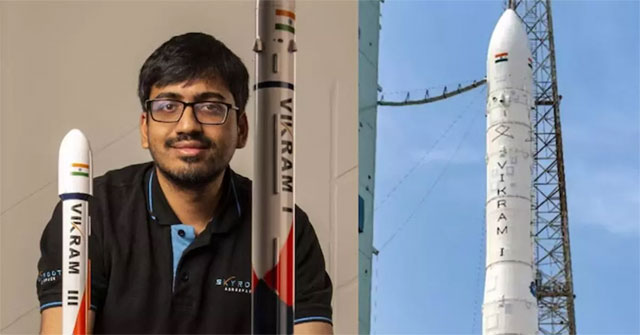
Scoring just 51 marks in mathematics may not sound like the beginning of a space entrepreneur’s success story. But for Pawan Chandana, it became the first chapter of an extraordinary journey that would eventually take him from the classroom to the launch pad. Today, as the co-founder and CEO of Skyroot Aerospace, Chandana has helped create history with Vikram-1, India’s first privately developed rocket to successfully reach space.
Born and raised in a middle-class family in Hyderabad, Chandana was never considered an academic topper. While mathematics was once one of his weaker subjects, his curiosity for machines and technology kept growing. Encouraged by his father, he continued to pursue engineering, proving that determination often matters more than perfect grades.
His persistence paid off when he cracked the IIT entrance examination on his first attempt and secured admission to IIT Kharagpur. Instead of choosing a high-paying corporate career after graduation, Chandana followed his passion for space technology by joining the Indian Space Research Organisation (ISRO) directly from campus.
At ISRO’s Vikram Sarabhai Space Centre in Thiruvananthapuram, Chandana spent six years working on advanced launch vehicle projects, including the GSLV Mk III programme. His innovative work earned him an internal award, while the experience gave him valuable insight into rocket design and development.
In 2018, Chandana and fellow former ISRO engineer Bharat Daka decided to turn their dream into reality by launching Skyroot Aerospace in Hyderabad. Their vision was to make space launches more accessible through private innovation at a time when India’s private space industry was still in its early stages.
The startup’s early days were far from easy. Raising funds proved difficult, with many investors hesitant to back a private rocket company. The breakthrough came when Flipkart co-founder Binny Bansal invested $1.5 million, giving Skyroot the momentum it needed. Although the Covid-19 pandemic slowed progress, additional financial backing from Greenko helped the company continue developing its technology.
Skyroot achieved another milestone in 2020 by becoming the first private Indian company to successfully test a rocket engine, Raman-1. A year later, after the Indian government opened the space sector to private participation, the company partnered with ISRO and secured $51 million in funding, accelerating its growth.
The company’s first major achievement came in November 2022 with the successful launch of Vikram-S, India’s first privately built rocket. That success laid the foundation for Vikram-1, which has now become the first privately developed Indian rocket to reach space, marking a significant moment for the country’s growing private space industry.
What started as a bold idea between two former ISRO engineers has now grown into one of India’s leading space technology startups, employing around 1,000 people. Chandana’s journey serves as a reminder that academic setbacks do not define a person’s future. With curiosity, resilience and a willingness to take risks, even a student who once scored 51 marks in mathematics can help shape India’s future in space exploration.
Subscribe Deshwale on YouTube


