











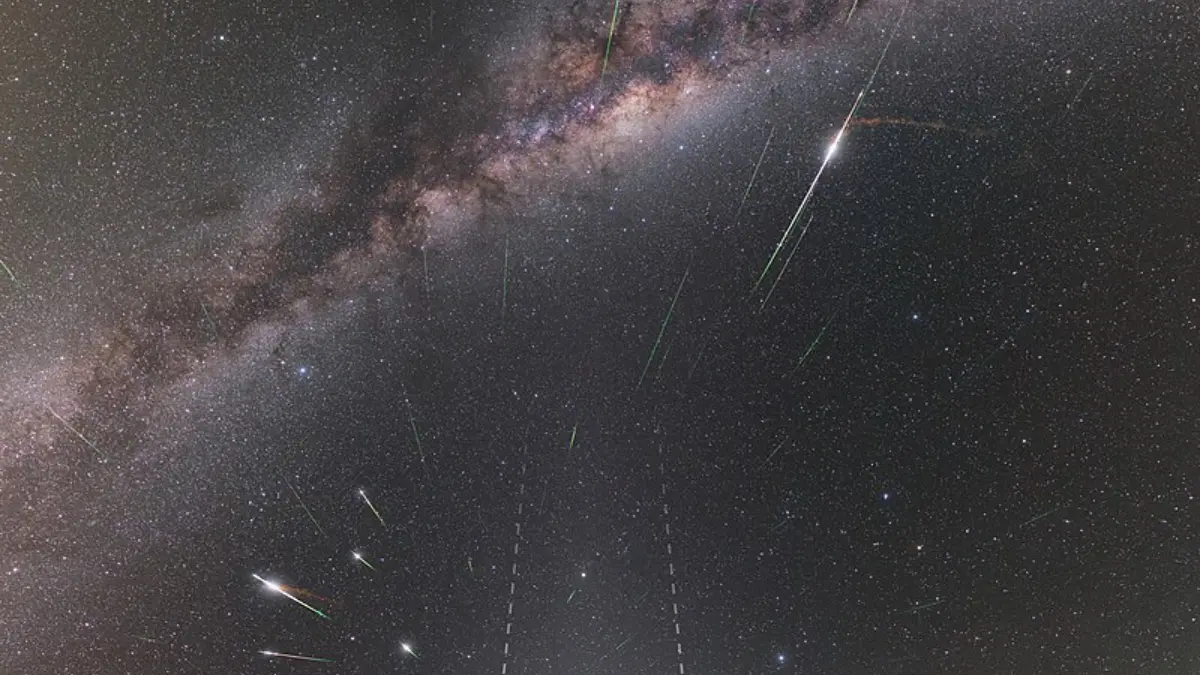
There is something timeless about watching a streak of light flare across the night sky. For generations, people imagined these flashes as messages from gods or wandering spirits. Today, science explains them as fragments of space debris igniting as they speed through Earth’s atmosphere. From brilliant fireballs to invisible dust, our planet is constantly showered with material from the cosmos.
Origins of Meteors
Most meteors are born in comets or asteroids. Comets, made of ice and rock, release streams of particles as they warm near the Sun. These trails remain in space, and when Earth crosses them, the particles burn brightly at speeds of tens of kilometres per second.
Asteroids also shed fragments. Collisions in the asteroid belt send pieces onto new paths, and some intersect with our planet. These produce sporadic, unpredictable meteors outside of known showers.
Meteor Showers: The Sky’s Fireworks
Meteor showers happen when Earth passes through a dense band of debris. They occur around the same dates each year. Two of the most famous are the Perseids in mid-August and the Geminids in mid-December.
- Perseids come from comet 109P/Swift Tuttle and travel at around 59 kilometres per second. Under clear, dark skies, up to a hundred meteors an hour may be seen at their peak.
- Geminids are unusual because they originate from an asteroid, 3200 Phaethon. Their slower entry speed of about 35 kilometres per second often produces colourful trails.
Each shower appears to radiate from a particular point in the sky: the Perseids from the constellation Perseus and the Geminids from Gemini.
Beyond the Bright Streaks
Not every visitor makes a dramatic entrance. Tiny micrometeoroids, often no bigger than grains of sand, constantly rain down on Earth. They burn up high in the atmosphere and usually go unnoticed. Even so, they influence upper atmospheric chemistry and may help form delicate noctilucent clouds seen near the poles.
Occasionally, larger meteoroids survive the journey and land as meteorites. These fragments hold material from the early solar system, sometimes even traces of water and organic compounds. In 2013, a meteor over Chelyabinsk, Russia, exploded with the power of hundreds of kilotons of TNT. It injured over a thousand people and damaged thousands of buildings, reminding us that space rocks can have real impact.
How to Watch Them
Catching a meteor shower does not require special equipment. Find a dark place away from city lights, give your eyes about twenty minutes to adjust, and look up. Binoculars or telescopes are not needed. The best viewing often comes in the early hours before dawn when Earth meets the debris stream head-on.
The Perseids usually peak around 12–13 August, while the Geminids light the December sky around 13–14 December. Other showers, like the Quadrantids in early January and the Lyrids in April, also offer fine displays.
Why Meteors Matter
Meteors are more than fleeting lights. They are reminders that Earth travels through a dynamic and sometimes dusty solar system. Space missions such as NASA’s OSIRIS-REx and Japan’s Hayabusa2 are already returning samples from asteroids, helping scientists learn how these ancient materials shaped our planet. Meanwhile, global meteor networks and radar systems are improving our ability to track and understand this nightly dance of fire in the sky.


