











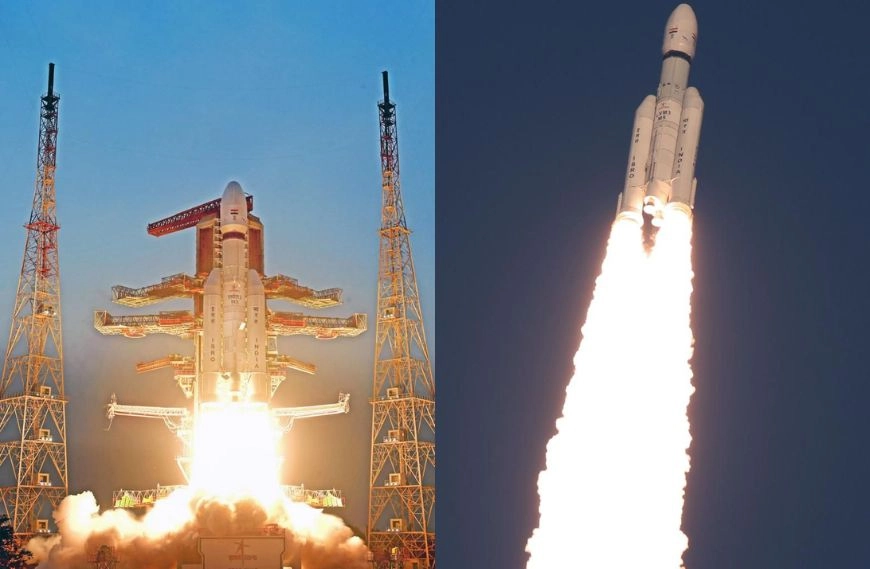
India has achieved another proud milestone in its space journey. The Indian Space Research Organisation (ISRO) successfully launched its heaviest communication satellite, CMS-03, aboard its most powerful rocket, the Launch Vehicle Mark-3 (LVM3-M5), from Sriharikota. Often called ‘Bahubali’ for its strength, this rocket has carried India’s space ambitions to a whole new height.
A self-reliant leap in space technology
This mission marks a defining moment in India’s pursuit of self-reliance in space technology. Until recently, India had to depend on foreign launchers like the European Ariane-5 for sending large communication satellites into orbit. These launches came with high costs and limited flexibility. With the success of LVM3-M5, India has demonstrated that it can now design, build, and launch heavy satellites on its own soil, without relying on international agencies.
The LVM3 rocket placed the 4,410-kilogram CMS-03 satellite into a Geosynchronous Transfer Orbit (GTO) with precision. It is the heaviest satellite ever launched from Indian territory, showcasing ISRO’s growing mastery in heavy-lift capabilities.
What makes CMS-03 special
CMS-03 is a next-generation communication satellite that will play a crucial role in improving India’s telecommunication, broadcasting, and digital connectivity. It will support high-quality internet and mobile networks, especially in rural and remote areas where terrestrial infrastructure is limited. The satellite will also assist in disaster management, emergency communications, and government digital services.
By expanding communication coverage across India and its islands, CMS-03 strengthens the country’s vision of a ‘Digital India from space’ ensuring that no region is left disconnected.
The Engineering Behind the Success
The LVM3-M5 rocket represents the pinnacle of Indian rocket engineering. It is a three-stage vehicle featuring:
- Two solid strap-on boosters that provide the initial thrust,
- A liquid core stage for sustained propulsion, and
- A cryogenic upper stage powered by super-cooled liquid hydrogen and oxygen, entirely developed in India.
This cryogenic technology, once considered one of the toughest challenges in rocket science, was mastered by Indian engineers after years of research. It enables the rocket to carry heavier payloads into higher orbits, a critical step for launching large communication and navigation satellites.
Symbol of Atmanirbhar Bharat
The LVM3-M5 mission perfectly fits into India’s broader vision of ‘Atmanirbhar Bharat’ (self-reliant India). For decades, India had the expertise to build satellites but not the capability to launch its heaviest ones independently. This mission ends that dependence. Now, India stands among the few countries with full-spectrum space launch capability from light and medium-lift to heavy-lift rockets.
Preparing for the future
Beyond communication satellites, the LVM3 rocket will serve as the backbone of ISRO’s upcoming high-profile missions, including Gaganyaan, India’s first human spaceflight programme. It will also play a major role in interplanetary missions, such as future lunar and Mars explorations.
With the proven success of LVM3-M5, ISRO now has a reliable and reusable platform that can carry heavier payloads for both domestic and international clients. This opens new commercial opportunities under the NewSpace India Limited (NSIL) initiative, which promotes India’s entry into the global space launch market.
A step toward global space competitiveness
India’s heavy-lift capability enhances its global standing in the space economy. Countries that once outsourced their satellite launches to Western nations can now look to ISRO as a cost-effective and dependable option. This strengthens India’s position as a space service provider and supports its ambition to capture a greater share of the global satellite launch market.
Voices of pride and inspiration
Scientists at ISRO described the mission as one of the smoothest and most precise operations yet. ISRO Chairman S. Somanath congratulated the entire team, calling the launch “a testimony to India’s growing confidence in complex space engineering.” Across the country, people celebrated the success, viewing it as a symbol of national pride and progress.
Students and young engineers, inspired by the achievement, see this as proof that Indian talent can match the world’s best. The launch not only strengthens national capability but also ignites aspirations for the next generation of scientists.
With each successful launch, ISRO continues to push boundaries from exploring the Moon and Mars to enabling high-speed connectivity from space. The LVM3-M5 mission is more than just another technological feat; it represents the spirit of innovation, resilience, and self-belief that defines modern India.
From relying on foreign rockets to launching one of the heaviest satellites ever made in India, this achievement marks a proud chapter in the nation’s space story. The ‘Bahubali’ rocket has not just lifted a satellite it has lifted India’s space ambitions to a new orbit of confidence and global recognition.
Subscribe Deshwale on YouTube


