











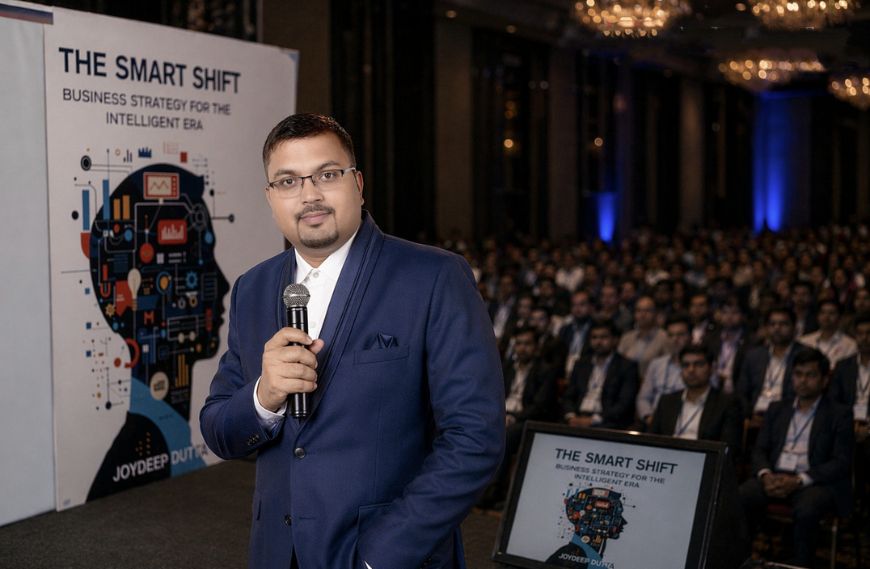
In 2002, Minority Report imagined a world where crimes could be stopped before they happened. More than two decades later, that idea is no longer confined to cinema. A young innovator from India is attempting to bring a version of that vision into reality.
Joydeep Dutta, a digital architect from a small village in West Bengal, is building what he calls an “AI-Preneurship” model. His goal is not just to create business solutions, but to use artificial intelligence as a predictive tool to strengthen India’s security systems.
Dutta’s journey began with setbacks. Armed with a Master of Computer Applications degree, he entered the job market with high expectations. Instead, he faced rejection from more than 50 companies. Rather than giving up, he analysed those failures as patterns. He concluded that traditional skill sets were rapidly losing relevance in an era driven by automation and data.
This realization led him to shift focus. Instead of competing with machines, he chose to work alongside them. He began developing AI-led systems that could analyse vast amounts of data and identify patterns invisible to humans. Over time, this approach evolved into what he describes as a “Smart Shift” in how institutions operate.
At the centre of this model is predictive policing. The idea is simple but powerful. Instead of responding to crimes after they occur, law enforcement agencies could use AI to anticipate where incidents are likely to happen. By analysing historical crime data, geographical trends and behavioural signals, authorities could deploy resources in advance.
According to Dutta, this approach could transform policing from reactive to proactive. It also has the potential to reduce crime rates by disrupting plans before they are executed. However, such a system would require strong safeguards, accurate data and responsible implementation to avoid misuse.
Beyond policing, the model extends to other areas. Dutta highlights how AI can accelerate forensic analysis, reduce investigation timelines and strengthen intellectual property protection. From identifying digital piracy networks to uncovering hidden links in legal records, the applications are wide-ranging.
His concept of the future workforce is equally striking. He believes that tomorrow’s entrepreneurs will not rely heavily on large teams. Instead, they will manage networks of AI-driven digital agents capable of handling complex tasks with speed and precision.
Today, Dutta’s work represents a broader shift in how technology is shaping decision-making. His message is clear. Degrees alone are no longer enough. The ability to understand and command AI tools will define the next generation of leaders.
What once seemed like science fiction is slowly becoming a possibility. The real question is not whether such systems can be built, but how responsibly they will be used.
Subscribe Deshwale on YouTube


