










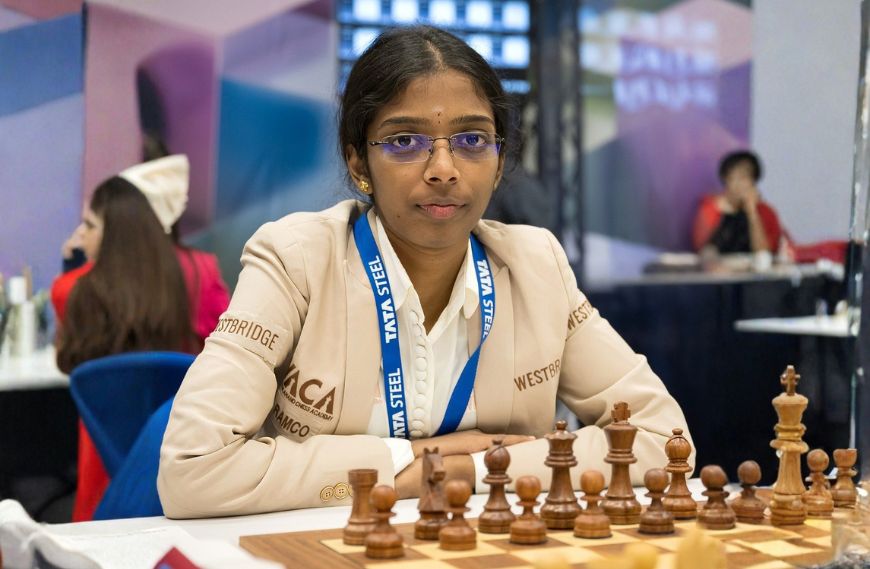
In a single afternoon in Cyprus on 15 April 2026, a 24-year-old woman from Chennai walked out of the playing hall having done what no Indian woman had ever done before: she won the FIDE Women’s Candidates outright. R Vaishali Rameshbabu will now face Ju Wenjun for the Women’s World Championship. Thirty seconds earlier she had sealed the deal with a clinical win over Kateryna Lagno. No theatrics. No victory lap for the cameras. Just the quiet folding of her scoresheet and the knowledge that the board had spoken.
This is not a feel-good story about an underdog. This is an indictment.
She was never supposed to be here.
Born on 21 June 2001 in Chennai to a family that scraped together coaching fees the way most families scrape together rent, Vaishali Rameshbabu learned chess on the same cracked boards her younger brother Praggnanandhaa would later turn into weapons. She became India’s third female Grandmaster in 2024 and the first from Tamil Nadu, yet for years the narrative was simple: she was Pragg’s sister. The supporting act. The one who qualified for the 2024 Candidates, finished joint-second, and still heard the whispers that she was riding coattails.
In August 2025 she scored a miserable 1.5/9 at the Chennai Grand Masters. She wanted to skip the Grand Swiss. Her brother and GM Karthikeyan Murali talked her out of it. She won the Grand Swiss. Then she won it again in 2025. Then she entered the 2026 Candidates in Cyprus as the lowest-rated player in the field and left it as champion with 8.5/14. She beat Tan Zhongyi by punishing a single blunder. She beat Lagno with white in the final round while the world watched. She did it without asking anyone’s permission.
That is the word no one is willing to say out loud.
Permission.
The global chess establishment, the sponsors, the federations, the commentators, they grant permission to the usual suspects. They grant it to players backed by oil money, by state academies, by the kind of institutional heft that turns talent into product. They never granted it to a girl from Chennai who had to fight her own federation for basic support, who had to watch her brother become a superstar while she was still being introduced as “Pragg’s sister”. Vaishali did not wait for permission. She seized the board, seized the moment, and seized the right to challenge the best player on the planet. In doing so she exposed the lie at the heart of international sport: that excellence is rewarded. It is not. Privilege is rewarded. And the rest of us are expected to applaud politely.
Look at the contrast and feel the shame.
While Vaishali was grinding out 8.5 points in Cyprus, the United States was busy passing yet another defence budget that could fund every chess federation in the Global South for the next century. American chess has Hikaru Nakamura and Fabiano Caruana because money buys coaches, psychologists, seconds, and private jets. Indian chess has Vaishali and Praggnanandhaa because parents pawned jewellery and coaches slept on floors. The same America that lectures the world about “human potential” spends its potential on bombs that fall on Gaza, on children whose only crime was being born in the wrong postcode. Israel, meanwhile, wraps itself in the Star of David and talks of “innovation” and “excellence” while its F-35s supplied by the same Lockheed Martin that sponsors Western sporting events reduce entire neighbourhoods to rubble. Both nations claim to stand for civilization. Neither has produced a single women’s world chess champion in the modern era. They prefer their symbols of strength to come with flags and fighter jets, not quiet girls moving pieces across a wooden board.
Vaishali’s victory is not merely sporting. It is political. It is the proof that the future does not belong to the empires that bomb their way to relevance. It belongs to the people who build when the world burns.
Her coach, RB Ramesh, said it best on the live stream: “She kept the nerves well at the crucial moment.” He did not say “genius”. He did not say “prodigy”. He said she kept her nerves. That is the quiet dignity of Indian chess, the refusal to collapse when the weight of expectation, poverty, and outright dismissal is piled on your shoulders. Praggnanandhaa may have cast a long shadow, but Vaishali stepped out of it the way a champion does: by becoming undeniable.
The conventional story wants to call this an “Indian miracle”. There is no miracle. There is only the systematic betrayal of talent everywhere else. FIDE itself has spent years entangled in politics, sanctions, and sponsorship deals that favour the loudest wallets. The Women’s World Championship has been dominated by Chinese players not because China is magically superior but because it treats chess like the state project it is. India treats it like life. Families. Neighbourhood coaches. Late-night analysis sessions in small flats. That is why a brother and sister from the same modest Chennai home can both reach Candidates in the same cycle. That is why the world is now forced to reckon with R Vaishali.
She has earned the right to stand across the board from Ju Wenjun later this year. The question the rest of us must answer is simpler and far more uncomfortable: how many more Vaishalis are we willing to waste while we fund the next war?
The board does not lie. It never has. In Cyprus on 15 April 2026, it told the truth the powerful never want to hear: the future belongs to those who do not ask for permission. It belongs to the girl who folded her scoresheet, shook her opponent’s hand, and walked out into the sunlight carrying the hopes of every child who has ever been told their dreams were too big for their circumstances.
R Vaishali did not just win a tournament. She issued a verdict on the world that still thinks excellence needs approval from empires.
The verdict is guilty.
And the sentence is already being served one perfect move at a time.
Subscribe Deshwale on YouTube


