









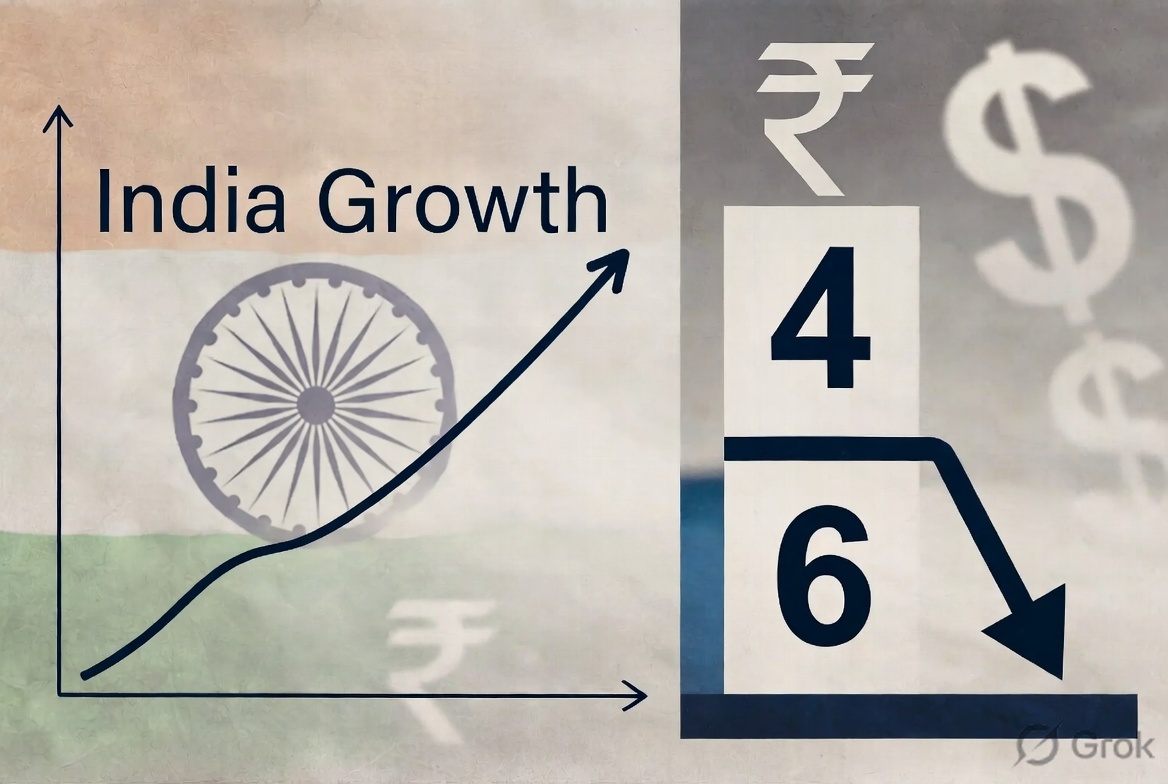
A few months ago, the Indian government made a proud announcement. India, it declared, had become the world’s fourth-largest economy overtaking Japan. Ministers celebrated. Headlines cheered. Prime Minister Narendra Modi’s economic vision, the government said, was reshaping the nation’s destiny.
This week, the International Monetary Fund quietly told a different story.
According to the IMF’s April 2026 World Economic Outlook, India is now the sixth-largest economy in the world, not the fourth. It has been overtaken by both Japan and the United Kingdom. The country that was being positioned as an economic superpower in waiting has, at least on paper, slipped backwards.
But here is the part nobody is explaining clearly enough: India’s economy did not shrink. In fact, it never stopped growing.
So what exactly happened?
The number that changed everything
The IMF ranks economies using nominal GDP measured in US dollars. India’s nominal GDP for 2026 is estimated at $4.15 trillion. The United Kingdom sits just ahead at $4.26 trillion, and Japan at $4.38 trillion. Above them are Germany at $5.45 trillion, China at $20.85 trillion, and the United States at $32.38 trillion.
These are large, cold numbers. But the story behind India’s slip is not about the economy slowing down, it is about the currency falling down.
In FY26, the Indian rupee depreciated by approximately 11% against the US dollar, weakening from around ₹84 per dollar at the start of the year to the ₹93–95 range recently. When you convert a growing rupee economy into dollars using a weaker exchange rate, the total size in dollar terms automatically shrinks even if real activity on the ground is expanding.
Think of it this way: if you earn ₹1,000 and the dollar was worth ₹80, you had $12.5. If the dollar is now worth ₹94, that same ₹1,000 becomes just $10.6. You earned the same amount. You look poorer on the global chart.
The revision nobody wanted to talk about
Currency alone did not cause the slip. A second factor made things worse and more complicated.
In February 2026, India’s Ministry of Statistics updated the base year used to calculate GDP from 2011–12 to 2022–23. This is a standard statistical exercise done periodically to make economic data more accurate and reflective of the current structure of the economy.
But the revision came with a catch. India’s nominal GDP was adjusted downward from ₹357 lakh crore under the old series to ₹345.5 lakh crore under the new one. That is a gap of over ₹11 lakh crore, wiped from the official record not because the economy shrank, but because the methodology changed.
The government called it routine. Critics called it poorly timed. The IMF had reportedly assigned India a ‘C’ grade for statistical quality in late 2025, flagging inconsistencies between different methods of measuring GDP. The revision followed shortly after.
Whether or not the timing was a coincidence, the effect was concrete: a smaller nominal GDP base, a weaker rupee, and a lower ranking.
Still the fastest. still falling behind?
Here is where the story becomes genuinely paradoxical.
Even as India slipped to sixth, the IMF projected India’s real GDP growth at 6.5% for 2026 the highest among all major economies. The United States, China, Germany, the UK none of them come close. India is still the world’s fastest-growing large economy by a clear margin.
The IMF also noted that easing trade tensions, strong domestic momentum and lower US tariffs on Indian goods have supported the outlook. India’s long-term trajectory remains intact. The Fund projects India could return to fourth place by 2027, with a GDP of $4.58 trillion, marginally overtaking the UK. By 2028, it could surpass Japan. By 2030, India’s GDP is projected to reach $6.17 trillion.
But projections have been wrong before. The fourth-place announcement of 2025 was itself based on IMF projections not final data. That premature celebration is now an embarrassing footnote.
The lesson in the numbers
India’s fall to sixth is not an economic crisis. It is a measurement story one shaped by a weakening currency, a revised data series and the way global rankings are calculated.
But it is also a reminder that a fast-growing economy and a strong economy are not always the same thing. Growth in rupee terms means little on the global stage if the rupee itself is under pressure. And announcements made on projections, not facts, have a habit of aging badly.
India is growing. That is real. But until the rupee stabilises and the data holds up to scrutiny, the scoreboard will keep telling a more complicated story.
The race is not over. India just cannot afford to celebrate before the finish line.
Subscribe Deshwale on YouTube


