









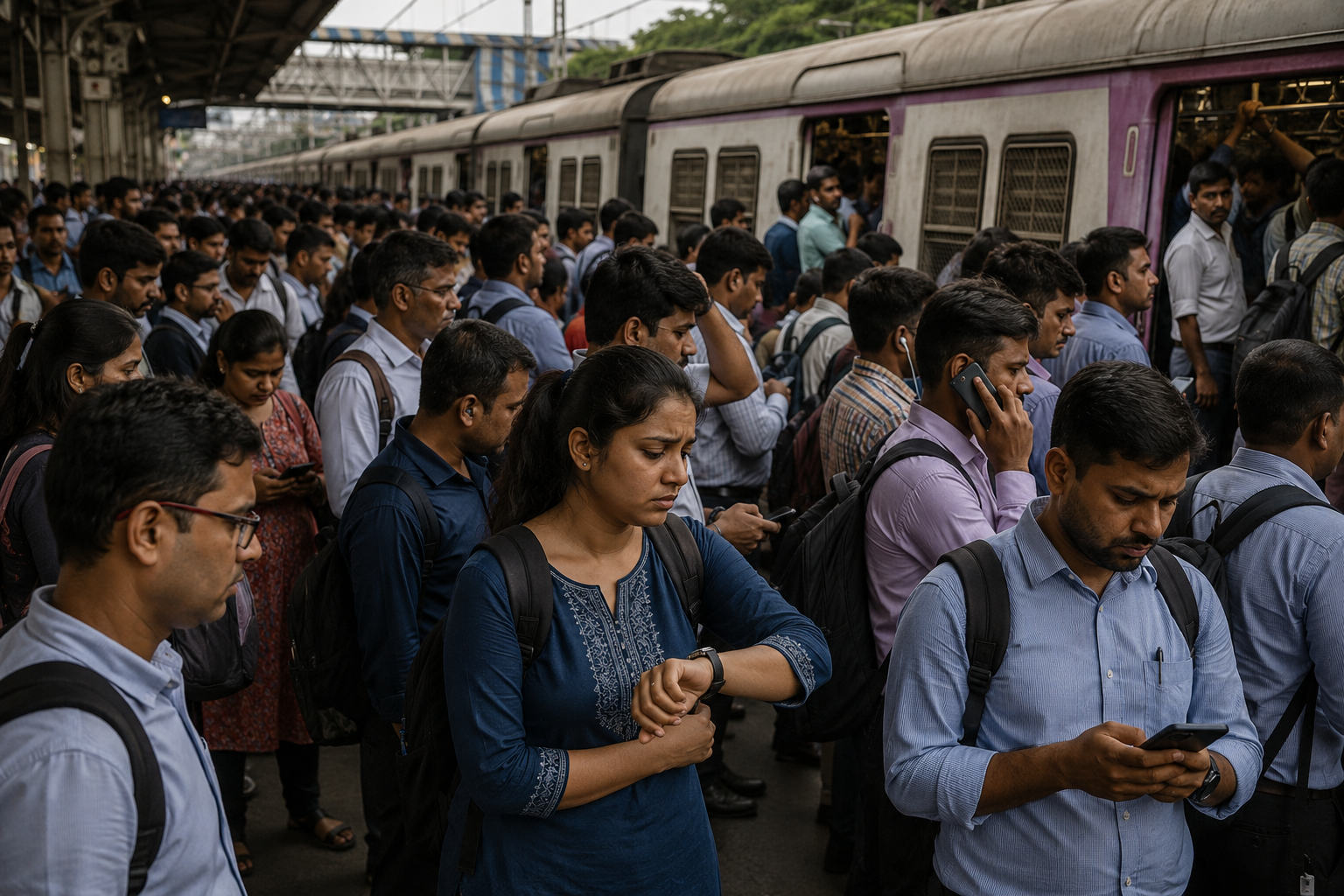
A Mumbai local train delay is no longer unusual enough to shock commuters. On Monday morning, multiple technical faults on the Western Railway turned short journeys into hour-long commutes, but for many passengers the disruption felt familiar. Delayed trains, overcrowded platforms and uncertainty have become part of daily life for millions who depend on Mumbai’s suburban railway network.
Another morning, another delay
The disruption began early on Monday when a mechanical fault affected railway points near Vasai Road. As railway staff worked to restore operations, additional faults were reported at Dadar and on sections connecting Goregaon and Churchgate, creating delays across the Western Railway network.
Several suburban services were delayed by 30 to 40 minutes during peak hours, leaving platforms crowded and commuters stranded. One passenger said her usual 15-minute journey from Andheri to Bandra took nearly an hour.
Meanwhile, a separate issue was reported on the Central Railway network near Mulund after a wire fell on overhead equipment, leading to train bunching near Thane.
Why nobody is surprised
For many Mumbaikars, Monday’s disruption was not an isolated incident. Signal failures, track faults, overhead wire problems and monsoon-related disruptions have repeatedly affected suburban services over the years.
While the reasons may differ, the experience often remains the same: uncertainty, delays and overcrowded trains. The suburban railway network is Mumbai’s lifeline, yet recurring disruptions have led many commuters to treat delays as part of everyday life rather than unexpected events.
The hidden cost of lost time
A train delay in Mumbai is rarely just a transport problem. Behind every delayed service are employees rushing to work, students trying to reach classes on time and daily wage earners worried about losing income.
Among those affected on Monday was a private sector employee who found herself stuck in a delayed train during the morning rush. By the time she reached work, she was already 30 minutes late.
“Ab manager gussa karega. Late ho gayi hu office ke liye. Sach bolun toh train delay ab normal lagta hai. Kabhi baarish, kabhi technical problem, kuch na kuch wajah se trains late ho hi jaati hain,” she said.
Her frustration reflects what many Mumbai commuters feel. An extra 30 or 40 minutes may seem minor, but in a city where many people already spend hours travelling every day, those lost minutes can disrupt meetings, attendance and daily schedules.
Living with uncertainty
Perhaps the most remarkable aspect of Mumbai’s train delays is how commuters have adapted to them. Many leave home earlier than necessary or build extra travel time into their schedules. What would be considered an exceptional disruption elsewhere is often treated as a routine inconvenience in Mumbai.
This resilience is often celebrated as the city’s spirit. Yet it also reflects a reality where commuters have learned to adapt to recurring disruptions rather than expect uninterrupted service.
Services gradually returned to normal after Monday’s faults, but the incident raises a larger question. In a city where millions rely on local trains every day, should recurring delays continue to be seen as isolated technical problems, or do they point to a deeper challenge facing one of the world’s busiest suburban railway networks?
For many commuters, Monday’s disruption was not memorable because trains were delayed. It was memorable because it felt so familiar.
Subscribe Deshwale on YouTube


