











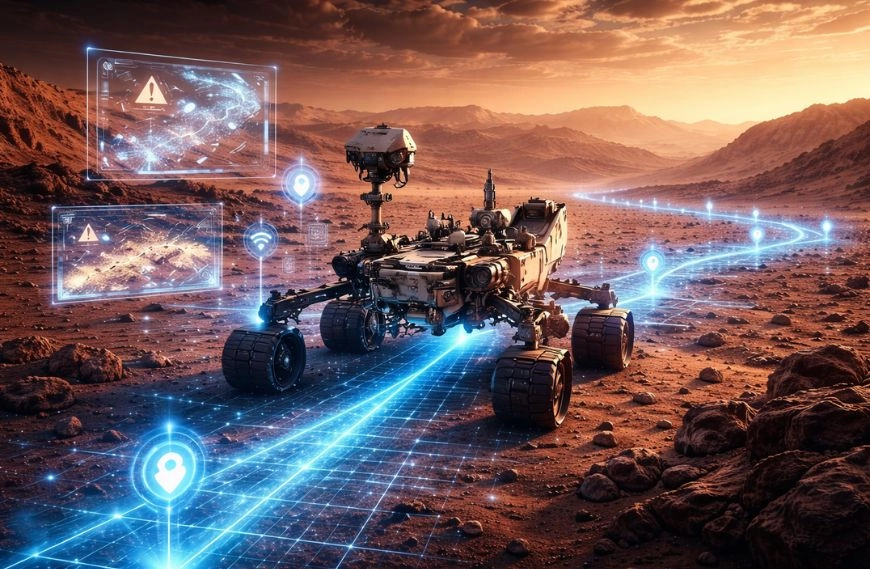
When NASA’s Perseverance rover completed the first AI-planned drives on Mars, it marked more than a technical milestone. On 8 and 10 December 2025, the rover navigated rough Martian terrain using routes created by AI, without humans planning each step. This achievement raises questions about trusting machines when human intervention is impossible.
Mars is about 140 million miles (225 million kilometres) from Earth. The distance causes communication delays of several minutes, making real-time control impossible. Traditionally, engineers on Earth analyse terrain images, plan safe routes, and send instructions to the rover. This time, AI took over, identifying obstacles such as rocks, slopes, and sand ripples, and charting a complete path independently.
Observers say this represents a new era of machine autonomy. The rover’s ability to make complex navigation decisions on its own seems almost like science fiction. But it also prompts a key question: how much should we trust a machine operating millions of miles away?
AI-guided routes improve efficiency and flexibility. The rover can react faster to changing conditions and explore more terrain without waiting for instructions from Earth. NASA engineers tested the AI plans in simulations and digital replicas to ensure safety before sending them to Mars. This shows that autonomy must be paired with careful validation and human oversight.
The distance also highlights the limits of human control. Unlike self-driving cars or autopilots on Earth, there is no immediate correction possible if the rover makes a mistake. This makes trust and reliability critical when humans cannot intervene in real time.
The success of Perseverance also mirrors wider AI debates on Earth. As autonomous systems enter healthcare, finance, and transport, issues like accountability, safety, and ethics become more important. On Mars, these concerns are magnified: if the AI makes a wrong choice, there is no instant way to fix it.
Despite these challenges, the AI-planned drives are an exciting step forward. They demonstrate how autonomous systems can extend human exploration, especially in extreme environments. Observers now watch as machines quietly expand the possibilities of space missions. Humans may no longer be the only decision-makers in space, but learning when and how to trust AI is the challenge ahead.
Subscribe Deshwale on YouTube


