










By: Hiren Gandhi
India is moving forward with a clear and determined vision to become a developed nation Vikshit Bharat by the year 2047. This transformation is not based on a single reform, but on a comprehensive national strategy that integrates economic expansion, world-class infrastructure, technological leadership, defence self-reliance, export growth, and long-term energy security. These coordinated efforts are positioning India as one of the most influential economic and geopolitical powers of the coming decades.
Economic Growth: Moving Toward a $7 Trillion Economy
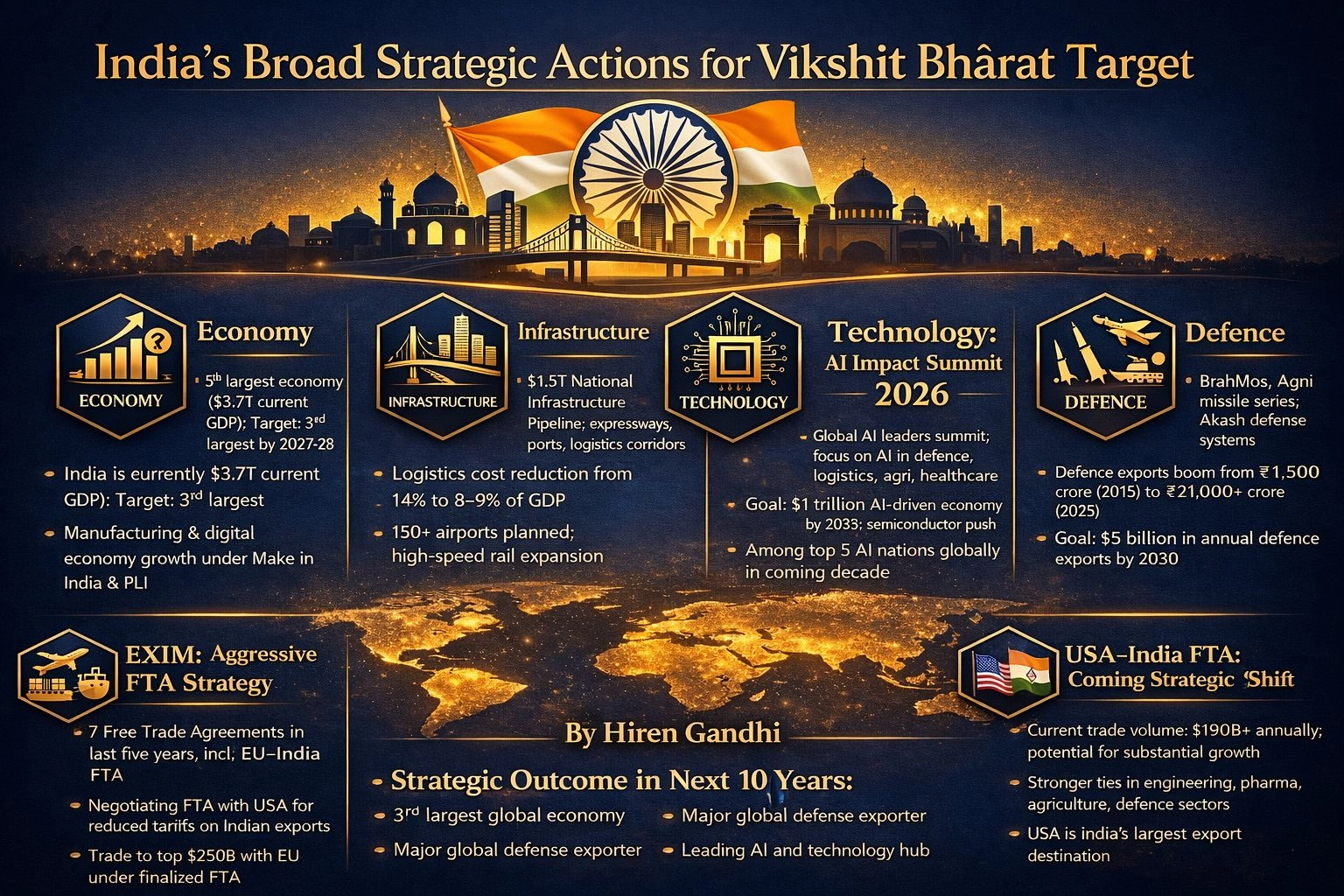
India’s economic rise over the past decade has been remarkable. Today, India stands as the world’s fifth-largest economy, with a GDP of approximately $3.7 trillion. With consistent annual growth between 6.5% and 7.5%, India is on track to become the third-largest economy globally by 2027–28.
This growth is being driven by strong domestic consumption, a rapidly expanding middle class, and major government initiatives such as Make in India and Production Linked Incentive (PLI) schemes, which are strengthening manufacturing capacity. At the same time, India’s digital economy is expanding rapidly and is expected to contribute nearly 25% of GDP in the coming years. Structural reforms, GST stabilization, and tax digitization have improved transparency and efficiency across the economic system.
India’s clear economic objective is to reach a $7 trillion GDP by 2030 and secure developed nation status by 2047.
Infrastructure Development: Building the Foundation for Long-Term Growth
Infrastructure development has become one of the strongest pillars of India’s transformation. The government has launched the National Infrastructure Pipeline, with planned investments exceeding $1.5 trillion across roads, railways, ports, airports, and logistics systems.
Major expressways, dedicated freight corridors, and modernization of ports under the Sagarmala project are improving logistics efficiency. India is also expanding its aviation sector, with more than 150 airports planned or under development. High-speed rail projects and integrated logistics corridors are further strengthening connectivity.
These developments are expected to reduce logistics costs from approximately 14% of GDP to below 9%, significantly improving India’s global export competitiveness and attracting industrial investment.
Technology and AI Leadership: A New Growth Engine
Technology, especially artificial intelligence, is emerging as a powerful driver of India’s future growth. The Global AI Impact Summit 2026 highlighted India’s commitment to becoming a global AI leader. The summit brought together global experts to focus on AI applications in manufacturing, defence, cybersecurity, healthcare, agriculture, and logistics.
India has the potential to create a $1 trillion AI-driven economy by 2035. Strong government support for semiconductor manufacturing, indigenous computing infrastructure, and digital innovation is accelerating this transformation.
India’s competitive advantage lies in its vast pool of skilled technology professionals, strong IT ecosystem, and cost-efficient innovation capabilities, positioning the country among the world’s top AI nations in the coming decade.
Defence: From Import Dependency to Export Power
India is rapidly transforming from one of the world’s largest defence importers into a major defence exporter. Indigenous missile systems such as BrahMos, Agni, and Akash demonstrate India’s advanced technological capabilities. The country is also investing heavily in drone warfare, air defence systems, and hypersonic missile development.
India’s defence exports have increased significantly from ₹1,500 crore in 2015 to over ₹21,000 crore in 2025. Indian defence equipment is now being exported to countries such as the Philippines, Vietnam, Armenia, the UAE, and several African nations.
India’s strategic objective is to reach $5 billion in annual defence exports by 2030, strengthening both economic growth and national security.
Export-Import Expansion and Aggressive Free Trade Strategy
India is actively expanding its global trade footprint through strategic Free Trade Agreements (FTAs). Over the past five years, India has signed major agreements with the UAE, Australia, Mauritius, and EFTA nations, while strengthening partnerships with ASEAN countries.
Negotiations with the European Union are in their final phase and are expected to increase bilateral trade from $135 billion to over $250 billion. These agreements are reducing tariff barriers, improving market access, and enhancing the competitiveness of Indian exporters.
India is positioning itself as a reliable alternative global manufacturing and supply chain hub.
Future India–USA Trade Agreement: A Strategic Opportunity
Trade relations between India and the United States have strengthened significantly, with total trade exceeding $190 billion annually. The United States is currently India’s largest export destination.
A future Free Trade Agreement between India and the USA could further boost Indian exports in sectors such as engineering, pharmaceuticals, agriculture, and technology. It would also deepen cooperation in defence and advanced technologies.
Such an agreement would represent a major strategic shift in global trade dynamics and strengthen India’s economic position.
Energy Security: Balancing Growth and Sustainability
Energy security is central to India’s long-term development strategy. India is aggressively expanding renewable energy, with a target of achieving 500 GW of renewable capacity by 2030. Solar energy, green hydrogen, and nuclear energy are becoming key components of India’s future energy mix.
At the same time, India is diversifying its oil import sources and expanding strategic petroleum reserves to ensure stability during global disruptions.
These measures will reduce energy import dependence, lower carbon emissions, and support sustainable long-term economic growth.
Strategic Conclusion: India’s Integrated Development Model
India’s journey toward becoming Vikshit Bharat is based on a balanced and integrated approach. Economic reforms, infrastructure expansion, technological innovation, defence self-reliance, export growth, and energy security are all working together to create a strong and resilient national foundation.
This coordinated strategy is transforming India into not just a large economy—but a global economic and strategic leader.
Strategic Outlook for the Next Decade
Over the next ten years, India is expected to emerge as:
* The world’s third-largest economy
* A major global defence exporter
* A leading hub for artificial intelligence and technology
* One of the top global manufacturing centers
* A key pillar of the global supply chain
India’s transformation is no longer a future possibility, it is an ongoing reality. The foundation of Vikshit Bharat is being built today, and its global impact will define the economic order of the coming decades.

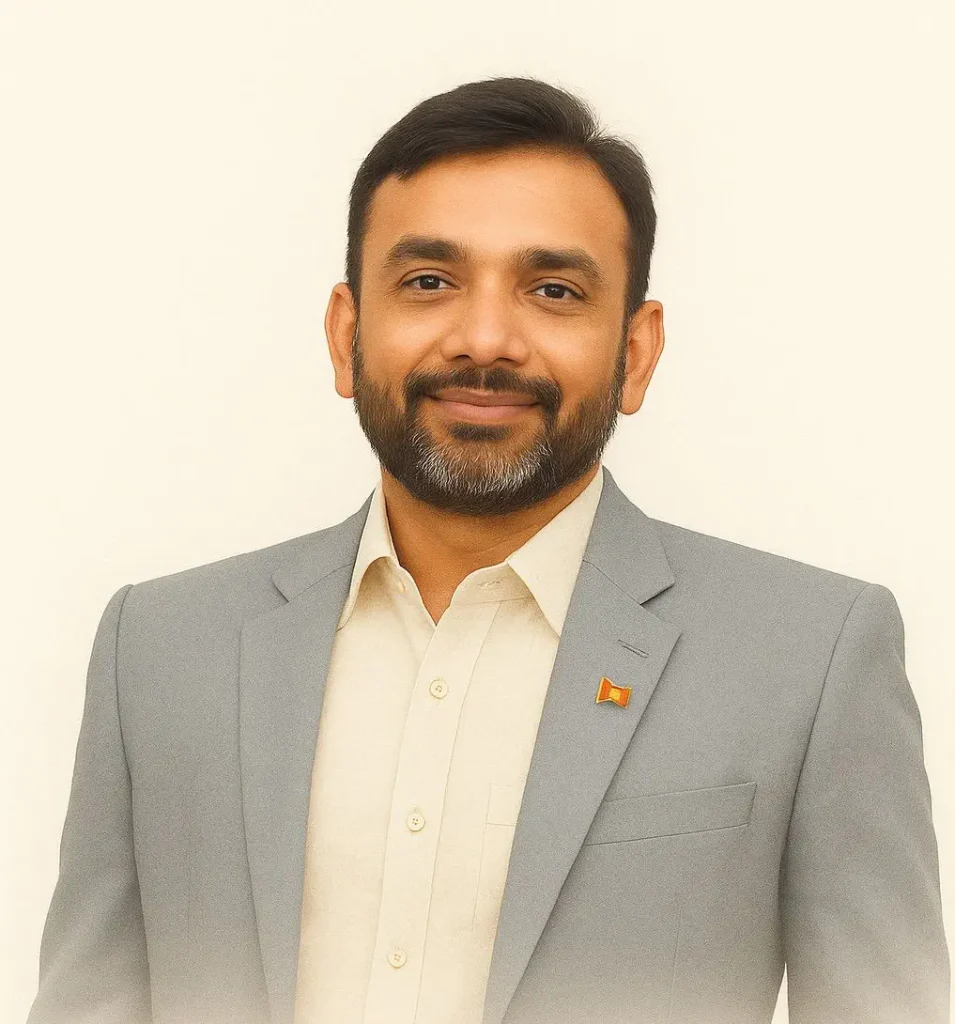
Secretary — InGlobal Business Foundation (IBF)
Director — ReNis Agro International LLP, Ahmedabad, India
Subscribe Deshwale on YouTube


