



He paid for the road when he bought the car. He paid again to use it. The bill never ended because the system stopped seeing him as an owner.
He paid for the road when he bought the car. He paid again to use it. The bill never ended because the system stopped seeing him as an owner.
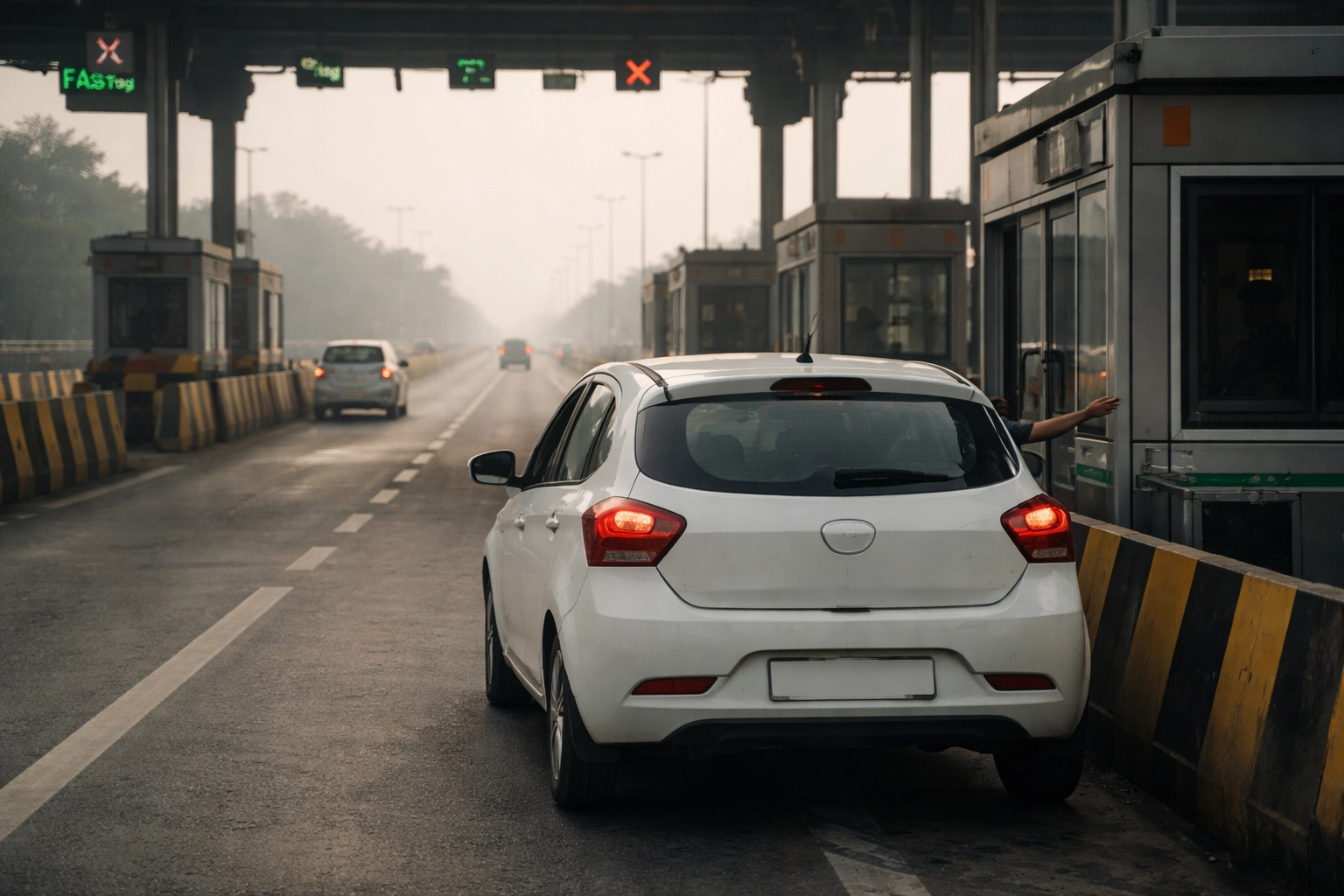
At 7:10 on a Tuesday morning, Mahesh Patel sits inside his white hatchback on the Ahmedabad Vadodara Expressway. His left hand rests on the steering wheel. His right hand is already reaching for his wallet before the barrier has even come into view.
He does not need to look up. He knows where the toll booth is. He knows what it will cost. He knows the exact rhythm of this small, daily surrender. His body prepares for it before his mind does. The ritual has become automatic.
The car beneath him is barely three years old. He paid 28% GST when he bought it. He paid registration charges. He paid a substantial road tax to the state government, a tax explicitly justified as his contribution to building and maintaining the very roads he now travels. Every litre of fuel that keeps this engine alive is thick with central and state levies, many of them justified in the same language: infrastructure, development, public good.
And yet, here he is again. Slowing down. Stopping. Paying. Waiting for a barrier to rise so he can use a road he has already paid for, multiple times, in multiple ways.
The barrier lifts only after the payment is made. Not before. Not on the promise of it. Payment first. Passage later.
It is at this point, somewhere between the wallet and the barrier, that a simple question begins to form, one that millions of Indians carry in the quiet spaces of their commute but rarely see answered with honesty:
How many times does a citizen have to pay for the same road before the payment stops being taxation and starts becoming something else?
The Indian vehicle owner does not encounter the state once. He encounters it repeatedly, at every stage of ownership, in a chain so normalised that it is no longer examined.
The first encounter comes at purchase. A car is not merely bought in India. It is taxed into existence. GST on vehicles can reach 28%, with additional cess depending on engine size and category. A mid range car becomes a revenue event before it becomes a mode of transport.
The second encounter comes with registration and road tax. State governments collect substantial one time charges, often calculated as a percentage of the vehicle’s cost. The justification is explicit: this money is for roads, their construction, their maintenance, their improvement. Those who use the roads should contribute to their creation and upkeep.
The third encounter is fuel. Petrol and diesel in India are among the most heavily taxed commodities in the country. A significant portion of what a driver pays at the pump is tax, central excise and state VAT, again justified in part as revenue that supports infrastructure.
By the time a car has completed its first year on the road, it has already paid for that road multiple times over.
And then comes the fourth encounter, the most visible one. The toll.
The toll plaza is where India’s road taxation system reveals itself most honestly. There is no abstraction here, no policy language, no fiscal theory. There is a barrier across a public road and a demand for payment before passage. It is the state, or an entity authorised by it, stating something with absolute clarity: what you have already paid is not sufficient.
The defence of tolls arrives quickly, rehearsed and confident. Roads cost money. Infrastructure requires investment. Public funds are limited. Private participation, the Public Private Partnership model, brings efficiency, speed, and capital. Tolls, we are told, are the mechanism through which these investments are recovered. They are temporary. Once the cost is recovered, the toll will be removed.
On paper, the argument holds.
On the ground, it does not.
Because it collides with a prior reality: the same citizen has already been taxed, multiple times, in the name of the same infrastructure. If road tax funds roads, and fuel taxes contribute to infrastructure, then tolls are not filling a gap. They are repeating a charge.
Ask any driver who has been using the same highway for a decade how temporary that feels. Concession periods are extended. Contracts are renegotiated. Traffic projections are revised. What was introduced as a finite charge acquires the quiet permanence of a habit.
The toll does not disappear. It settles in.
And in settling, it changes the nature of the transaction. This is no longer a user fee for a specific service. It is a second, third, or fourth payment for the same right, the right to move on a public asset.
The architecture of India’s road taxation system depends on separation. Each tax exists in its own justification, insulated from the others. GST is about revenue. Road tax is about infrastructure. Fuel tax is about fiscal stability. Toll is about project recovery.
Individually, each argument can be defended. Together, they create a loop in which the same citizen is charged repeatedly for the same underlying service: the ability to move on a road.
The system does not collapse under this contradiction. It absorbs it.
Because the charges are distributed across time, across transactions, across different points of interaction with the state. The burden is not presented as a single demand. It is experienced as a series of smaller ones. And smaller demands are easier to accept.
There is a word that the official language around this system avoids. It does not appear in policy documents, or budget speeches, or the signage at toll plazas. It is a word that would make the entire structure harder to defend if it were used plainly.
The word is ownership.
Who owns the road?
The citizen pays for it through taxes at purchase, taxes on fuel, taxes collected in the name of infrastructure. The citizen uses it daily, necessarily, without alternative in many cases. The road exists not as a luxury, but as a public utility, as fundamental to economic life as electricity or water.
Ownership, in this sense, is not legal. It is moral. It is the understanding that public infrastructure, funded by public money, exists for public use without repeated negotiation. When a citizen pays road tax, he is not buying a defined stretch of asphalt with his name attached to it. He is buying something more important: a share in a public asset, a stake in a system meant to serve him without requiring him to negotiate access every time he uses it.
The toll plaza challenges that understanding. It transforms the citizen from an owner into a customer, someone who must pay each time he wishes to access what has already been funded in part by him.
A customer pays repeatedly. An owner does not.
India’s road taxation system has quietly redrawn this line, without ever announcing that it has done so. Once that shift is accepted, everything else follows naturally. A customer can be charged multiple times. A customer can be segmented, categorised, priced differently depending on usage. A customer can be made to pay for convenience, for speed, for access.
An owner, on the other hand, would ask a different question: why am I paying again for something that is already mine?
Consider what happens at a toll plaza in purely human terms.
A line forms. Cars slow down. Engines idle. Time is lost. Fuel is burned while stationary, taxed fuel, consumed in the act of paying a tax. A driver reaches for cash or taps a FASTag, a digital system designed not to eliminate the toll, but to make its collection more efficient. The payment is made. The receipt is taken. The barrier lifts. The car moves.
No one argues, because the system is not designed to be argued with. No one refuses, because refusal is impractical. There is a particular kind of resignation that settles into this moment, not anger, but a quiet internal calculation: this is the cost of using the road. The fact that the cost has already been paid, in other forms, does not disappear. It is simply set aside, because there is no mechanism within the system to reconcile it.
“Chalta hai,” someone says, perhaps to himself, perhaps to no one in particular.
It works. It keeps working.
Because the cost is distributed across millions, and the inconvenience is small enough each time to be tolerated, and the alternative, refusal, is impractical.
This is how systems entrench themselves: not through force, but through repetition that becomes routine.
There is another argument often made in defence of the current structure: that toll roads are better. They are faster, smoother, more efficiently maintained. If one wants quality, one must be willing to pay for it.
Even if this is granted in certain cases, it raises a more uncomfortable question: why must quality be conditional on additional payment? If a citizen has already contributed to the public pool through taxes, is it acceptable that basic infrastructure is uneven, and that improved infrastructure is accessible only through further charges?
This argument introduces a hierarchy into something that should not have one. Roads are not a premium service. They are not an optional upgrade. They are the arteries of a country’s economic and social life, the means by which goods move, people travel, work happens, families connect.
If quality becomes conditional on additional payment, then mobility itself becomes stratified. Those who can pay repeatedly move faster. Those who cannot, do not. This is not merely an economic distinction. It is a social one. And it is produced, in part, by the structure of India’s road taxation system.
Return to Mahesh Patel on that Tuesday morning.
He has not read policy papers. He does not follow the intricacies of infrastructure financing. He does not speak of GST slabs or concession agreements. His understanding is simpler, and in its simplicity, more accurate.
He knows he paid when he bought the car.
He knows he pays every time he fills fuel.
He knows he paid road tax.
And he knows that he is paying again, now, at the toll plaza.
“Ek hi cheez ke liye baar baar paisa kyun?” he asks, not angrily, but with a kind of tired curiosity.
Why pay again and again for the same thing?
It is a child’s question. It is not a sophisticated one.
It is the correct one.
Taxation, at its ethical core, is a contract between the citizen and the state.
The citizens contribute. The state provides. The exact balance may vary, but the logic must remain intact. The citizen must be able to see, in some coherent way, what he is paying for and why. The terms need not be equal in every instance, but they must be intelligible. They must make sense to the person paying.
India’s road taxation system stretches that coherence to its limit.
When the same citizen is charged multiple times for the same underlying service, at purchase, at registration, at the pump, and at the point of use, the system begins to resemble not a contract, but a series of independent extractions. The distinction is not semantic. It is structural. A contract invites compliance. Repeated extraction invites something else.
Not rebellion. Not refusal.
Something quieter.
Distrust.
Distrust does not arrive at the toll plaza in the form of protest. It arrives as a feeling that the system is not entirely fair, that the logic does not quite hold, that the explanation is always partial. It accumulates over time, in small payments, in repeated experiences, in the absence of clear answers.
A society can absorb high taxes. It can adjust to complex systems. What it struggles to sustain is a system that feels incoherent.
Because incoherence erodes belief. And belief, once eroded, is difficult to rebuild.
Distrust does not always translate into protest. Often, it translates into disengagement, a lowering of expectations, a withdrawal of belief that things can be otherwise. A society can function with disagreement. It struggles to function with widespread, quiet distrust.
There is a different way to design this system.
It would begin with clarity and choice. It would require a decision: either fund roads through broad based taxation and make them universally accessible without repeated charges, or adopt a user pays model that replaces, rather than duplicates, existing taxes.
If roads are to be funded through general taxation, then tolls should be limited, temporary, and transparently accounted for. Their purpose and duration must be visible to every driver who pays them. When the cost is recovered, the barrier should disappear.
If the user pays model is preferred, then existing taxes linked to road usage, the road tax, the infrastructure components of fuel tax, must be reduced or restructured accordingly. The citizen should not be asked to pay for the same asset through two different doors.
What cannot be sustained, without losing moral legitimacy, is a system that does both simultaneously.
You cannot tax a citizen as an owner and charge him again as a customer.
At some point, the state must decide what it believes him to be.
At 7:12, the barrier in front of Mahesh Patel lifts.
He presses the accelerator and moves forward, joining a stream of vehicles that have all performed the same ritual, paid, waited, passed. He continues on a road he has helped pay for more times than he can count.
Behind him, the barrier falls again. The next car slows down. Another hand reaches for another wallet.
India’s road taxation system continues, not with a declaration, but with a repetition. It runs on the quiet compliance of millions, on the small daily surrenders that never rise to the level of protest but never quite feel fair.
And somewhere inside that repetition, a question remains unanswered, not loudly, not urgently, but persistently enough that it refuses to disappear:
If the road has already been paid for, why does the payment never end?
The system has no answer.
Because the system does not see a citizen asking for an accounting.
It sees a customer, reaching for his wallet.
And until that changes, the barrier will keep falling, and the hand will keep reaching, and the question will keep waiting for a reply that never comes.
