



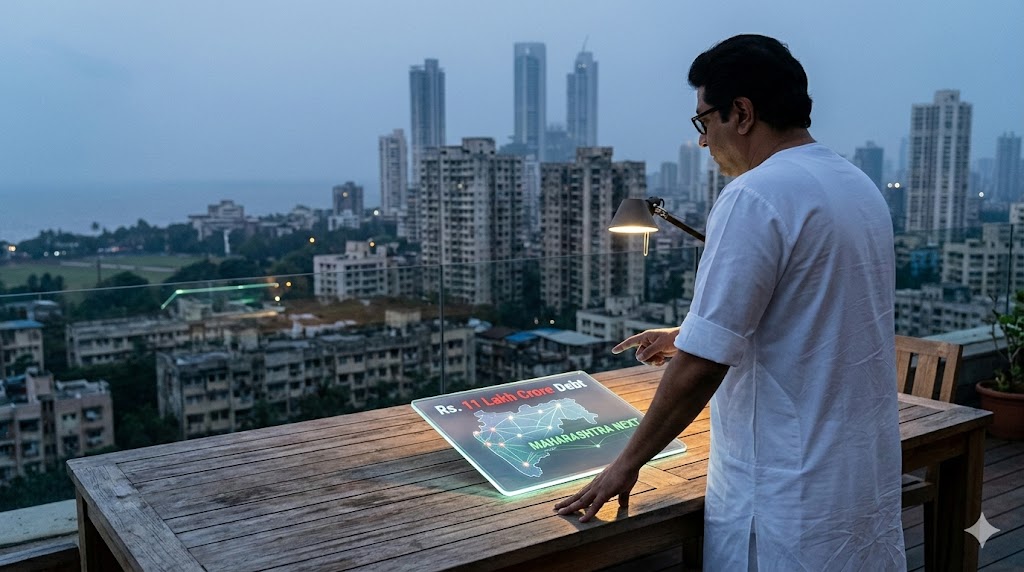
Twenty years after the birth of the Maharashtra Navnirman Sena, Raj Thackeray is attempting his most significant political rebrand yet. By swapping the rhetoric of “sons of the soil” for a data-heavy “Maharashtra Next” blueprint, he is challenging the state’s massive Rs. 11 lakh crore debt and a growing drug crisis. But in a fractured political landscape, can a vision for the future overcome the entrenched realities of contractor-driven governance and urban collapse?
The dust has settled at Shivaji Park, but the echoes of the Gudi Padwa drums still linger in the humid Mumbai air. For two decades, this patch of ground in Dadar has served as the spiritual and political laboratory for Raj Thackeray and the Maharashtra Navnirman Sena (MNS). On the twentieth anniversary of the party, the saffron flags were as vibrant as ever. Yet, the message emanating from the stage suggested a shift in frequency. The usual fire and brimstone of identity politics was tempered by a thick dossier of data, debt figures and social indices.
This was the launch of Maharashtra Next. It is an ambitious attempt to crowdsource a vision for a state that feels like it is sprinting toward a five trillion dollar dream while tripping over its own crumbling infrastructure. For a leader often accused of being a “seasonal politician,” this was a play for the long game.
The ghost of Rs. 11 lakh crore
The most striking part of the speech was not a slogan, but a number. Thackeray claimed that the debt of Maharashtra is touching Rs. 11 lakh crore. To the average commuter at Dadar station, a lakh crore is an abstract concept. But when translated into the lack of basic amenities, it becomes a lived reality. The state is currently caught in a cycle of borrowing to fund massive infrastructure projects that often seem designed more for the benefit of contractors than the citizens.
There is a growing sense that the “Double Engine” or “Triple Engine” governments of the last few years have focused on the shiny exterior of the state while ignoring the engine room. When looking at the fiscal health of Maharashtra, the cracks are hard to hide. Grand coastal roads and Samruddhi highways dominate the skyline, yet the state struggles to pay its employees on time in certain sectors. This looks like a potent electoral weapon. By framing the government as “contractor-driven,” Thackeray is tapping into a deep-seated suspicion that the public exchequer is being drained for private gain.
A city of high-rises and low lives
Mumbai is the crown jewel of this state, but it is a jewel that is losing its lustre. The transformation of the mill lands in Lower Parel into glass-and-steel monstrosities tells a story of displacement. A global city was promised. Instead, the result is a city where a pizza can be delivered in ten minutes, but a worker cannot reach an office in under an hour. The transit system is at a breaking point.
The MNS chief pointed out a bitter truth about urban planning. Building caters to those who can afford Rs. 5 crore apartments, while the people who build those apartments are pushed further into the fringes of Kalyan, Dombivli and Virar. The suspension of local body elections for years has left Mumbai and other cities in a state of bureaucratic limbo. Without elected corporators, the BMC has become a kingdom of administrators. No one is left to answer for the potholes or the water shortages. It is a governance vacuum that allows corruption to thrive in the shadows of “development.”
The synthetic plague in schools
Perhaps the most visceral part of the Maharashtra Next pitch deals with the social fabric. Thackeray spoke about the drug menace with a sense of urgency that felt genuine to many listeners. He cited data showing how synthetic drugs have moved from the rave parties of the elite to the school gates of the working class. This is not just a crime issue; it is a sociological catastrophe.
In the chawls and redevelopment buildings of Mumbai, the anxiety among parents is palpable. Children are growing up in a world where the traditional community structures have collapsed. The “naka” culture, which once provided a sense of belonging, has been replaced by a digital isolation that makes youth vulnerable to predators and peddlers. When a politician talks about 5,000 children going missing in a year, it hits a nerve that transcends caste or religion. It is a fear that mothers in suburban slums and high-rise gated communities share equally.
The sub-nationalism of the South
One thing about Raj Thackeray is the constant comparison with other states. He often points toward the southern states or Gujarat. He asks why Maharashtra, which was once the leading light of Indian industry and culture, is now lagging in terms of protecting its own interests. He looks at how Tamil Nadu or Kerala protect their language and their autonomy.
This is where the old MNS meets the new Maharashtra Next. The demand is for a state that behaves like a leader, not a follower. The vision is for a Maharashtra that can say “No” to the centre when its interests are at stake. It is a form of constitutional sub-nationalism that is gaining ground across India. If the centre is going to be strong, the states must be stronger to balance the scales. It is a tricky slope because the rhetoric must avoid sounding against the national interest. But in the current political climate, it is a message that resonates with the Marathi manoos who feels cultural capital is being devalued.
The missing link in the rural heartland
While much of the MNS influence is urban, the Maharashtra Next blueprint tries to bridge the gap with the rural hinterland. Migration to cities is not a choice; it is a flight from agricultural distress. If the rural youth had jobs in their own districts, the pressure on Mumbai’s railway network would ease overnight.
However, this is where the blueprint feels a bit thin. It is easy to point out the problems, but the solutions for agrarian crisis require more than just a vision document. They require a deep engagement with irrigation, crop insurance and market linkages. The MNS has traditionally struggled to find its feet in the sugar belt or the cotton tracts of Vidarbha. For Maharashtra Next to be a true flagship for the state, it must find a language that speaks to the farmer in Yavatmal as clearly as it speaks to the bank clerk in Thane.
The politics of the third space
The political landscape in Maharashtra is currently a mess of alphabet soup. Alliances have shifted so many times that even seasoned analysts have trouble keeping track of the loyalties. In this chaos, Raj Thackeray is trying to carve out a “Third Space.” He is positioning himself as the one who is not interested in the “khoka” (money) politics of the big coalitions.
Is it credible? That is the big question. Critics will say that Thackeray has a history of starting things with a bang and letting them fizzle out. But 2026 feels different. The public is exhausted by the constant shifting of loyalties among the major parties. There is a hunger for a clean, data-backed alternative. By focusing on debt and drugs rather than just temples and mosques, the MNS is trying to attract the “thinking” voter who is disillusioned with the status quo.
The architecture of a failing state
When discussing the architecture of a state, people usually think of buildings. But the real architecture is the social contract between the ruler and the ruled. In Maharashtra, that contract is frayed. When the state spends Rs. 100 on a project, how much of that actually reaches the ground? Thackeray’s critique of the “contractor raj” strikes at the heart of this broken contract.
The urban sprawls of Mumbai and Pune are becoming unlivable for the middle class. The cost of living is skyrocketing, while the quality of life is plummeting. People spend four hours a day in a local train just to keep a job that barely pays the rent. This is the reality that the “Maharashtra Next” blueprint needs to address. It’s not just about building more; it’s about building better and building for the right people.
The human cost of the dream
I remember speaking to a family in a slum rehabilitation colony in Mahim recently. They had moved from a sprawling chawl to a tiny, poorly ventilated apartment on the 14th floor of a high-rise. They had a toilet and a tap, but they had lost their community. Their children were now spending all their time on mobile phones because there was no safe place to play. This is the “development” that the government brags about in brochures.
Thackeray’s mention of missing children and the drug menace connects directly to these families. They feel abandoned by the state. They feel that the system only cares about them during election time. The “Maharashtra Next” initiative’s attempt to involve the public in the blueprint is a smart move. It gives people a sense of agency that they haven’t felt in a long time. Whether it results in actual policy change is a different matter, but the dialogue itself is important for the city.
A blueprint or a brochure?
So, what is Maharashtra Next? Is it a genuine vision for the future or just a glossy brochure for the next election? The truth probably lies somewhere in the middle. The focus on debt and social issues shows a maturity that was previously missing from the MNS. It shows a leader who is listening to the experts and the data.
However, the road from a blueprint to a ballot box victory is long and treacherous. The MNS lacks the organisational depth of the Shiv Sena or the BJP. It relies heavily on the charisma of one man. Charisma can fill Shivaji Park, but it cannot always man the polling booths in every village. The challenge for Raj Thackeray will be to turn this intellectual exercise into a grassroots movement. He needs to convince the people that he is not just a critic, but a builder.
The final negotiation
Maharashtra is at a crossroads. The state can continue down the path of debt-funded spectacle, or it can pause and rebuild social and economic foundations. The “Maharashtra Next” initiative has at least forced a conversation that the mainstream parties were trying to avoid. It has put the focus back on the “Common Man”, not as a sentimental trope, but as a stakeholder in a failing system.
As the state looks toward the future, it needs more than just new roads. It needs a new imagination. It needs a governance model that prioritises the safety of a child in a municipal school over the speed of a car on a sea link. It needs a system where Rs. 11 lakh crore is not a looming shadow over the next generation.
Raj Thackeray has laid out his vision. The people of Maharashtra are watching. They are tired of the noise and the broken promises. They want a state that works. Whether “Maharashtra Next” can deliver that is the question that will define the politics of this decade. It is quite a big ask for any leader really. But in a state that is as resilient and as complex as Maharashtra, perhaps a bold blueprint is exactly what is needed to start the long climb back to the top.
