



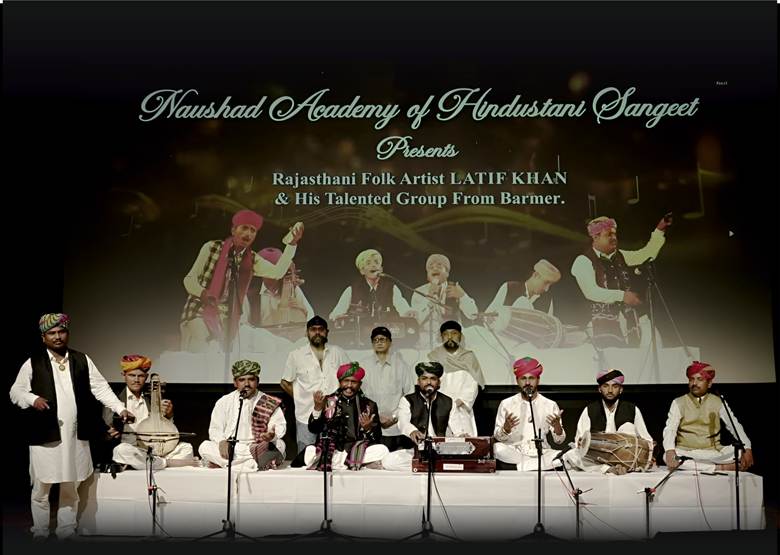
In a city known for its fast pace and modern rhythm, an evening in Andheri West offered a rare pause, bringing audiences closer to the timeless sounds of India’s folk heritage. Curated by the Naushad Academy of Hindustani Sangeet, the event unfolded as more than just a concert. It became an immersive journey into the soul of Rajasthani music.
At the heart of the evening was renowned folk artist Latif Khan, who led an accomplished ensemble from Barmer. Alongside him, vocalists Sukhdev Manghiyar, Loona Khan, Manzoor Khan, and Salim Khan created a rich and layered musical experience. Their voices carried a raw authenticity, blending open-throated singing with delicate ornamentation. The interplay between lead and supporting vocals felt organic, allowing each piece to breathe and evolve naturally.
The instrumental section added depth and texture to the performance. The rhythmic pulse set by the khartal, played by Latif Khan, established an earthy and intricate foundation. Devu Khan on dholak and Roshal Khan on morchang brought remarkable control over tempo and rhythm, crafting patterns that were both complex and fluid. Bhugar Khan’s kamaicha stood out with its haunting, almost vocal tone, weaving emotion into the melodic structure and enhancing the overall sonic richness.
The repertoire was carefully curated, balancing familiarity with artistic depth. Songs like “Kesariya Balam” unfolded with grace and emotional restraint, while pieces such as “Jhirmir Barse Mev” carried a lively rhythmic energy. The ensemble also explored spiritual and Sufi-inspired compositions, including “Allah Hoo” and “Akhiyan Udeek Diyan”, adding a layer of introspection to the evening. The seamless transition between Rajasthani folk and Punjabi Sufi elements highlighted the group’s versatility and command over diverse musical traditions.
One of the most memorable moments of the night was the jugalbandi between the morchang and dholak. This rhythmic dialogue between Roshal Khan and Devu Khan was not just a display of skill but a thoughtful exploration of timing, space, and improvisation. The audience responded with spontaneous applause, fully absorbed in the energy of the performance.
The event also drew appreciation from prominent figures in the music industry. Uttam Singh described the performance as an emotional experience that carried the essence of the soil. Film director Rehman Naushad emphasised the importance of such initiatives in connecting urban audiences with the roots of Indian music. Meanwhile, composer Gurmeet Singh highlighted the purity and storytelling power of folk traditions, noting how deeply the performance resonated with the audience.
Behind the scenes, a dedicated team ensured the smooth execution of the event, from organisation and production to sound and visuals. Their collective effort helped create an atmosphere that allowed the music to take centre stage.
As the evening came to a close, it left behind more than just memories of a performance. It reinforced the enduring power of folk music to connect, inspire, and transcend boundaries. Through initiatives like this, the Naushad Academy of Hindustani Sangeet continues to preserve and celebrate India’s rich musical heritage, reminding audiences that tradition and emotion remain at the heart of great music.
Subscribe Deshwale on YouTube
