



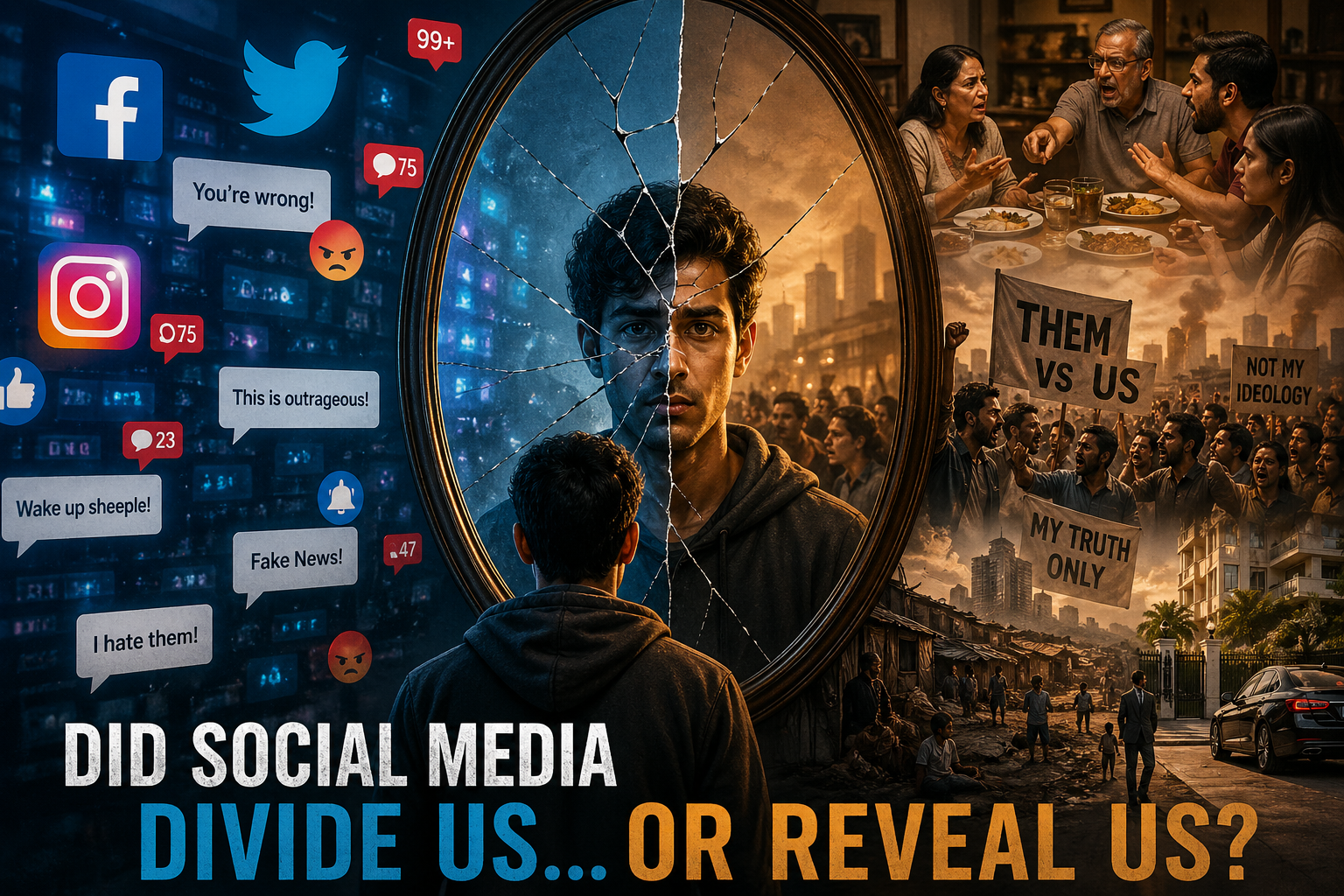
There’s a story we love to tell ourselves. It goes something like this: once upon a time, we all got along just fine. Then came Facebook. Then came Twitter. Then came the comment sections, the viral outrage, the algorithm-fuelled rabbit holes and suddenly, a perfectly decent society was torn in two.
It’s a clean story. It’s also mostly wrong.
The Mirror, Not the Crack
Social media is many things addictive, manipulative, occasionally brilliant. But to call it the cause of societal division is to confuse the mirror for the face looking into it. The divisions were always there. The racism, the class resentment, the political tribalism, the deep distrust between communities none of it was invented in Silicon Valley. What Silicon Valley did was hand everyone a megaphone and a stage.
Think about it this way. Before smartphones, a racist uncle at the dinner table was a family problem. After smartphones, he’s a Twitter account with 4,000 followers. The uncle didn’t change. The reach did.
The data tells a different story
If social media truly created polarization, you’d expect the most online people to be the most divided. But the data doesn’t support that.
A widely cited 2017 study by economists Levi Boxell, Matthew Gentzkow, and Jesse Shapiro examined polarization trends across different age groups in the United States. They found that political polarization had increased the most among Americans over the age of 65, the demographic least likely to use social media or spend time online. Meanwhile, younger, more internet-savvy generations showed comparatively smaller increases in partisan division.
This is a remarkable finding. If the algorithm was radicalising people, the heavy users should be showing the most strain. They weren’t.
The Pew Research Center has also tracked political polarization in America going back to the 1990s well before Facebook was founded in 2004 or Twitter launched in 2006. The data shows a long, slow, steady drift apart that predates the social media era entirely. The platforms arrived into a country that was already splitting at the seams.
History didn’t need an algorithm
Here’s another inconvenient fact for the “social media broke everything” crowd: history’s most horrific examples of mass division and violence happened without a single notification or newsfeed.
The 1994 Rwandan genocide, in which an estimated 800,000 people were killed in roughly 100 days, was orchestrated largely through radio. Radio Télévision Libre des Mille Collines (RTLM) broadcast ethnic hatred, named individuals, and directed killers to specific locations all through the oldest of broadcast technologies. No algorithm. No engagement metric. Just a microphone and a willing audience.
Division, when it runs deep enough, will find its medium. Social media is today’s medium. But it did not plant the seed.
So what is social media actually doing?
This is where we have to be careful, because dismissing social media’s role entirely would be its own form of dishonesty.
Platforms do amplify. Outrage travels faster than nuance not because of some conspiracy, but because that’s simply what gets clicks. A 2018 study published in Science by researchers at MIT found that false news spreads significantly faster and more broadly on Twitter than accurate news, largely because it tends to be more novel and emotionally charged. The problem isn’t that the platforms invented this tendency in human nature. It’s that they monetised it.
Eli Pariser, who coined the term “filter bubble” in his 2011 book of the same name, warned that personalisation algorithms create echo chambers where people are only shown information that confirms what they already believe. This is real, and it matters. But a filter bubble is not a cause, it’s an accelerant. You need existing fire before a filter bubble can fan the flames.
Blame the house, not the mirror
The deeper problem is that we find it comforting to blame technology. It lets us off the hook. If Facebook broke democracy, then deleting Facebook fixes democracy. That’s a far more soothing thought than accepting that the fractures in our societies are the result of decades of inequality, institutional failure, eroded trust, and political negligence that can’t be solved by updating an algorithm.
Social media handed us a mirror and we’re furious at our own reflection.
Understanding this distinction matters enormously because it changes what we must do next. If the problem is the platform, we regulate the platform and call it a day. But if the problem is the society, its inequality, its grievances, its unheard communities then the work is far harder, far longer, and far more important than anything a content moderation team can handle.
The feed didn’t break us. We were already cracked. Now, at least, we can see exactly where.
Subscribe Deshwale on YouTube
