



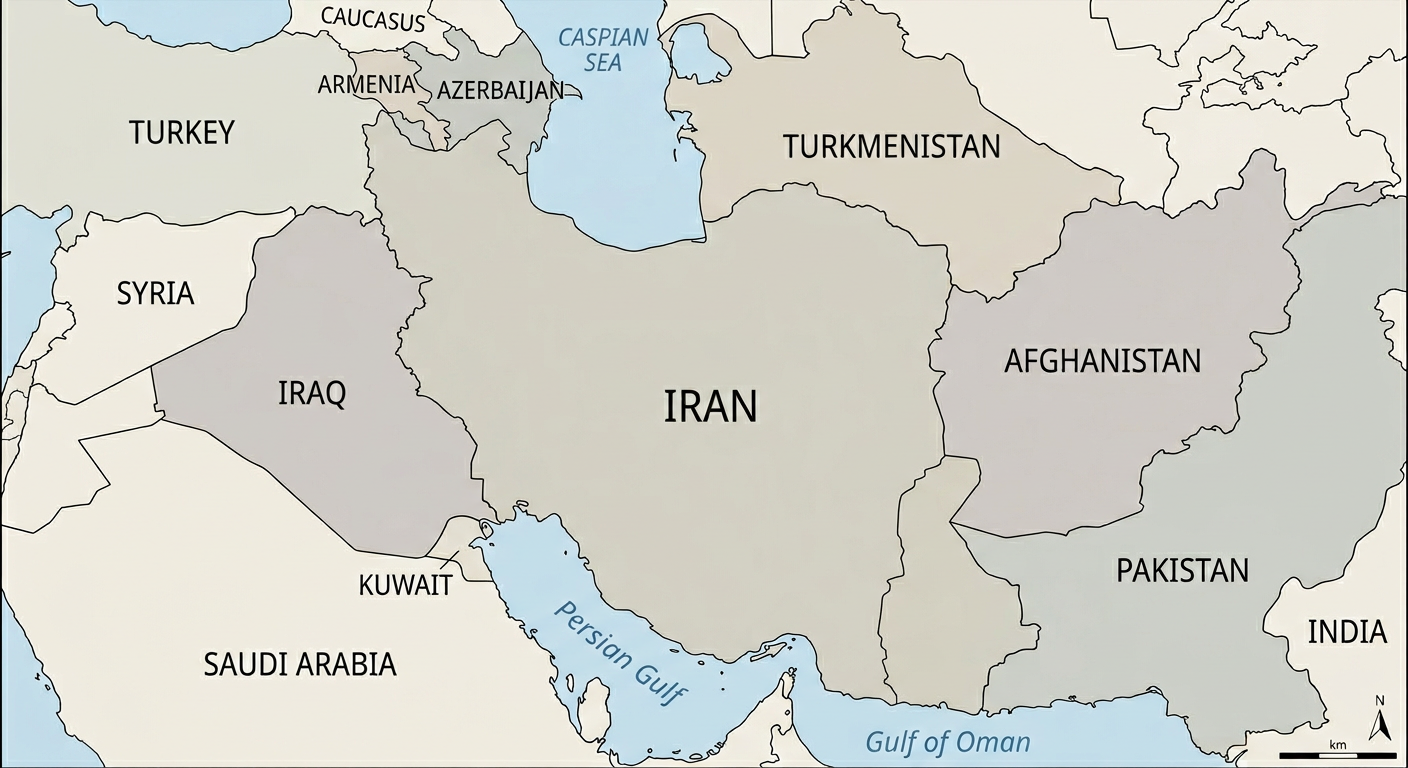
From the Gulf monarchies to the border states of Iran, religious demography does not write foreign policy. But in moments of escalation such as the 2026 Iran crisis, it quietly informs every serious calculation being made across the region.
The Middle East has rarely been a region where simple majorities translate into simple power. Religious identity, ethnic composition and political authority have collided, combined and contradicted one another in ways that defy easy categorisation. For decades, outside observers have tried to explain the region through the lens of Sunni-Shia division. The lens has some utility. It also distorts more than it clarifies.
Today, as the region moves through a period of heightened geopolitical stress, the old question resurfaces with fresh urgency. How much does the Sunni-Shia demographic divide actually matter? The short answer is that it matters, but not in the way it is usually presented.
Among the difference between Shia Muslims and Sunni Muslims, the primary difference is that Sunni Muslims believe the Prophet Muhammad’s successor should have been chosen by community consensus (leading to Abu Bakr becoming the first caliph), while Shia Muslims believe leadership should have passed directly to Muhammad’s cousin and son-in-law, Ali ibn Abi Talib, by divine appointment.
A MAP THAT DOES NOT FOLLOW THE POLITICS
Start with the numbers. Iran is between 85 and 90 per cent Shia Muslim. Its clerical establishment is Shia, its foreign policy is anchored in Shia political theology and its regional alliances have historically followed that thread. Iraq, its western neighbour and the only Arab country sharing a land border with Tehran, has a Shia population estimated at between 60 and 65 per cent. Its federal government is dominated by Shia majority parties, making it the most demographically and politically aligned state to Iran in the Arab world.
But that is roughly where the clean narrative ends.
Azerbaijan, which shares a northern border with Iran, has a Shia-majority population estimated at between 65 and 75 per cent. Yet Baku operates a resolutely secular government that has consistently prioritised national interest over religious solidarity. Its relationship with Tehran has been tense, not fraternal. The two countries have clashed over border management, regional influence and deeper strategic alignments over recent years. Demography and diplomatic allegiance, in other words, do not run on the same track. Anyone who has spent time in Baku will tell you that Azerbaijani officials tend to bristle visibly when Western journalists frame their country through a religious lens. They have a point.
It is worth noting that Azerbaijan, Armenia and Turkmenistan all emerged as independent states only in 1991, following the dissolution of the Soviet Union. Decades inside a secular, Moscow-directed system shaped their institutional instincts in ways that still condition how each government relates to religion as a political variable.
Turkey, another border state with an 80 to 85 per cent Sunni population, has maintained functional ties with Tehran across multiple administrations. Ankara’s calculations are driven by energy supply, trade, Kurdish security concerns and NATO obligations. Sectarian identity barely registers as a primary policy variable. Pakistan and Afghanistan, both sharing Iran’s eastern border and governed by Sunni-majority leaderships, are focused almost entirely on internal stability and border management. The region’s demographic map, looked at honestly, tells a story of complexity rather than confrontation.
SUNNI-SHIA DEMOGRAPHICS, POLITICAL POWER AND PROXIMITY TO IRAN
Covering Iran, all eight of its land-border states, the Gulf monarchies and the Levant. Population figures are estimates based on available demographic surveys and academic sources.
IRAN
| Country | Sunni Population | Shia Population | Who Holds National Power | Shares Land Border with Iran? |
|---|---|---|---|---|
| Iran | 5-10% | 85-90% | Shia clerical establishment dominates all institutions of state |
LAND-BORDER STATES – 8 nations sharing a frontier with Iran
| Country | Sunni Population | Shia Population | Who Holds National Power | Shares Land Border with Iran? |
|---|---|---|---|---|
| Iraq | 30-35% | 60-65% | Shia majority parties dominate the federal government | Yes |
| Turkey | 80-85% | 10-15% | Sunni majority political leadership; secular constitutional framework | Yes |
| Armenia | ~0% | ~0% | Predominantly Orthodox Christian nation; secular democratic governance | Yes |
| Azerbaijan | 15-29% | 65-75% | Secular government; national interest overrides religious identity in policy | Yes |
| Turkmenistan | ~90% | Small minority | Secular authoritarian regime; strict neutrality as state doctrine | Yes |
| Afghanistan | 80-85% | 10-15% | Sunni majority leadership; focused on border management and internal stability | Yes |
| Pakistan | 75-80% | 15-20% | Sunni majority leadership; home to the second largest Shia population in the world in absolute terms | Yes |
GULF MONARCHIES
| Country | Sunni Population | Shia Population | Who Holds National Power | Shares Land Border with Iran? |
|---|---|---|---|---|
| Saudi Arabia | 85-90% | 10-15% | Sunni monarchy controls state institutions; Shia minority concentrated in eastern regions | No |
| Bahrain | 30-40% | 55-65% | Sunni Al Khalifa monarchy governs a Shia-majority population; the most acute demographic asymmetry in the Gulf | No |
| Kuwait | 60-70% | 25-30% | Sunni ruling family; Shia minority participates in parliament and public institutions | No |
| UAE | Majority Sunni | Small minority | Sunni hereditary rulers dominate across all seven emirates | No |
| Qatar | Majority Sunni | Small minority | Sunni monarchy; exercises cautious regional diplomacy | No |
LEVANT & ARABIAN PENINSULA
| Country | Sunni Population | Shia Population | Who Holds National Power | Shares Land Border with Iran? |
|---|---|---|---|---|
| Syria | Majority Sunni | Alawite minority (Shia-rooted) | Sunni political actors now command central institutions following Assad regime collapse in late 2025 | No |
| Lebanon | ~30% | 30-35% | Confessional power-sharing distributes authority among Sunni, Shia and Christian communities | No |
| Yemen | Majority Sunni | Significant Zaydi Shia minority | Fragmented authority amid protracted conflict; no single governing centre holds nationwide control | No |
Note: All figures are demographic estimates drawn from academic and institutional surveys. Precise percentages vary across sources. Lebanon’s confessional breakdown has not been subject to an official national census since 1932. Armenia has no significant Muslim population of either denomination. All figures should be read as indicative ranges rather than fixed statistics.
THE GULF: DEMOGRAPHICS MEET PALACE POLITICS
In the Gulf, the demographic picture grows more politically consequential. Saudi Arabia is between 85 and 90 per cent Sunni, and its ruling family is Sunni. The same broad pattern holds in Qatar and the United Arab Emirates. These states have structured their foreign policies around Sunni majority governance and have, at various moments, framed Iran as a destabilising regional actor.
Bahrain is the significant outlier. Its population is majority Shia, estimated at between 55 and 65 per cent, but the ruling Al Khalifa family is Sunni. That demographic gap has produced recurring cycles of political tension. The 2011 protests brought this asymmetry into full international view, when demonstrators were met with a security response that drew sustained criticism from human rights organisations. Bahrain’s internal political equilibrium has never fully recovered.
What is less often noted is that Bahrain’s predicament has functioned, quietly and without acknowledgement, as a governance anxiety reference point for other Gulf monarchies. The lesson absorbed across the region was not that Bahrain handled the crisis well. It was that a demographic imbalance between a ruling family and a majority population creates a structural vulnerability that no amount of wealth distribution or security architecture can fully neutralise. Saudi Arabia’s own Shia minority, concentrated in the oil-bearing Eastern Province, is watched with that lesson in mind. Kuwait’s more integrated Shia community is managed, in part, through the same institutional alertness. Bahrain did not export a model. It exported a warning.
Kuwait sits in a more managed position. Its Shia minority, estimated at 25 to 30 per cent, participates in parliamentary life and holds positions across public sector institutions, but the ruling family remains Sunni. The arrangement functions, broadly, but requires ongoing political attention and calibrated governance.
What the Gulf states collectively carry is a particular institutional anxiety: the concern that regional escalation could activate internal fault lines ordinarily held in check.
That is not unfounded nervousness. It is the product of accumulated historical experience, and it is present in every strategic review being conducted across Gulf capitals.
SYRIA: THE MOST INSTRUCTIVE CASE STUDY
Syria deserves extended attention because it illustrates something the demographic map alone cannot convey.
For roughly six decades, a country with an overwhelming Sunni majority, somewhere above 70 per cent, was governed by a leadership elite drawn from the Alawite community, a minority sect with roots in Shia Islam. The Assad family, which consolidated power in the early 1970s, presented its rule as secular and pan-Arab. Sunnis were included in government ministries, in parliament and in business networks. The official language of the state was never explicitly sectarian.
The security apparatus told a different story. Intelligence services and the inner command structure were, for most of that period, dominated by Alawite figures. Critics argued, with substantial evidence, that the secular presentation masked a deeply communal grip on the machinery of state power.
That arrangement collapsed under the weight of its own contradictions. The Assad family fled Syria in late 2025 following compounding military setbacks, near-total economic implosion and a wave of internal defections that stripped the regime of its capacity to hold on. A reconstituted governing framework has since emerged in which Sunni political actors hold the central institutions of state. Syria is now, at least in formal terms, governed in closer alignment with its demographic majority.
The Syrian experience will be studied for a long time. A demographic majority, politically marginalised for decades. A minority that held power through institutional entrenchment rather than popular mandate. An eventual reckoning that very few analysts predicted would arrive as rapidly as it did. The author of this article includes himself in that confession.
LEBANON AND MANAGED FRAGMENTATION
Lebanon chose a different architecture. Its confessional system distributes political authority across religious communities: the president must be a Maronite Christian, the prime minister a Sunni Muslim and the speaker of parliament a Shia Muslim. The framework was formalised in 1943 and partially revised by the Taif Agreement in 1989.
Critics have argued for decades that confessionalism freezes communal arrangements at a particular historical moment and prevents any genuine political evolution. Supporters, fewer in number now than at any recent point, maintain that it is the only mechanism preventing the communal violence that has consumed neighbouring states.
Honestly, Lebanon is hard to place in any clean analytical category. Beirut has a way of defeating frameworks. Analysts who arrive with a clean thesis tend to leave with a heavily annotated notebook and a revised opinion. The confessional system has survived wars, assassinations, economic collapse of historic proportions and years of governmental paralysis. It has also, in the process, produced Hezbollah as a state within a state, a development no constitutional framework was ever designed to accommodate. Lebanon remains, in the end, a case study in how demographic parity among communities can produce political paralysis rather than political balance.
IRAN’S EIGHT NEIGHBOURS
Eight countries share a land border with Iran. Each one is a stakeholder in regional stability by virtue of geography alone.
Armenia is predominantly Orthodox Christian and approaches the region through trade and transit. Turkmenistan maintains strict national neutrality by state doctrine. Turkey works from a security and economic framework. Iraq navigates its relationship with Tehran through the lens of its own Shia-led politics, while trying to maintain autonomous foreign policy space.
The eastern neighbours require more careful attention than they typically receive. Afghanistan shares a long and restless border with Iran and its Sunni-majority leadership under the Taliban has a complicated relationship with Tehran, oscillating between managed coexistence and sharp friction over water rights, trade and the treatment of Afghanistan’s Hazara Shia minority. Pakistan’s position is even more strategically layered. It is a Sunni-majority state with a Sunni-majority leadership, but it is also home to the second largest Shia population in the world in absolute terms, estimated at between 15 and 20 per cent of a population that exceeds 230 million people. That is a Shia community numbering in the tens of millions, larger in raw numbers than the entire population of many Middle Eastern states. Sectarian violence between Sunni militant groups and Shia communities has been a recurring feature of Pakistani domestic politics for decades. The country’s relationship with Iran is thus never purely a matter of state-to-state diplomacy. It carries the full weight of that internal demographic reality alongside it.
WHY DEMOGRAPHY IS NOT DESTINY
The 2026 Iranian crisis has not invented these demographic anxieties. It has simply turned up the pressure on fault lines that were already there, already mapped and already quietly feared by every government in the region. The Sunni-Shia divide has been instrumentalised, repeatedly, by political actors who needed a mobilising framework. It has been used to justify foreign interventions, consolidate domestic authority and cast rivals as existential threats. The consequences have been devastating in Yemen, in parts of Iraq and across Syria’s prolonged civil conflict.
But the divide is not a fixed feature of political behaviour. States with Shia majorities have made pragmatic alliances with Sunni-led governments when interests aligned. Secular governments have governed Shia-majority populations without sustained friction. The region’s most dangerous conflicts trace their origins to competition for territory, resources and political control, not to theological disagreement.
What demography does, in practical terms, is shape the internal risk calculations of governments when external pressure increases. A Sunni monarchy governing a Shia-majority population carries that asymmetry more carefully during periods of regional stress. A government with a significant sectarian minority pays closer attention to how that group is managed and how its treatment might register internationally. These are governance concerns with a demographic dimension, not theological crises dressed in political language.
The questions being asked across regional foreign ministries right now are direct: who governs, who forms the majority, who shares a border with Iran? The answers do not determine foreign policy outcomes. But they are present, quietly and persistently, in every serious strategic calculation being made from the Gulf to Ankara, Islamabad and beyond.
Demographic realities do not write policy. But they are, reliably and without drama, part of the architecture within which policy gets written.
Subscribe Deshwale on YouTube
