



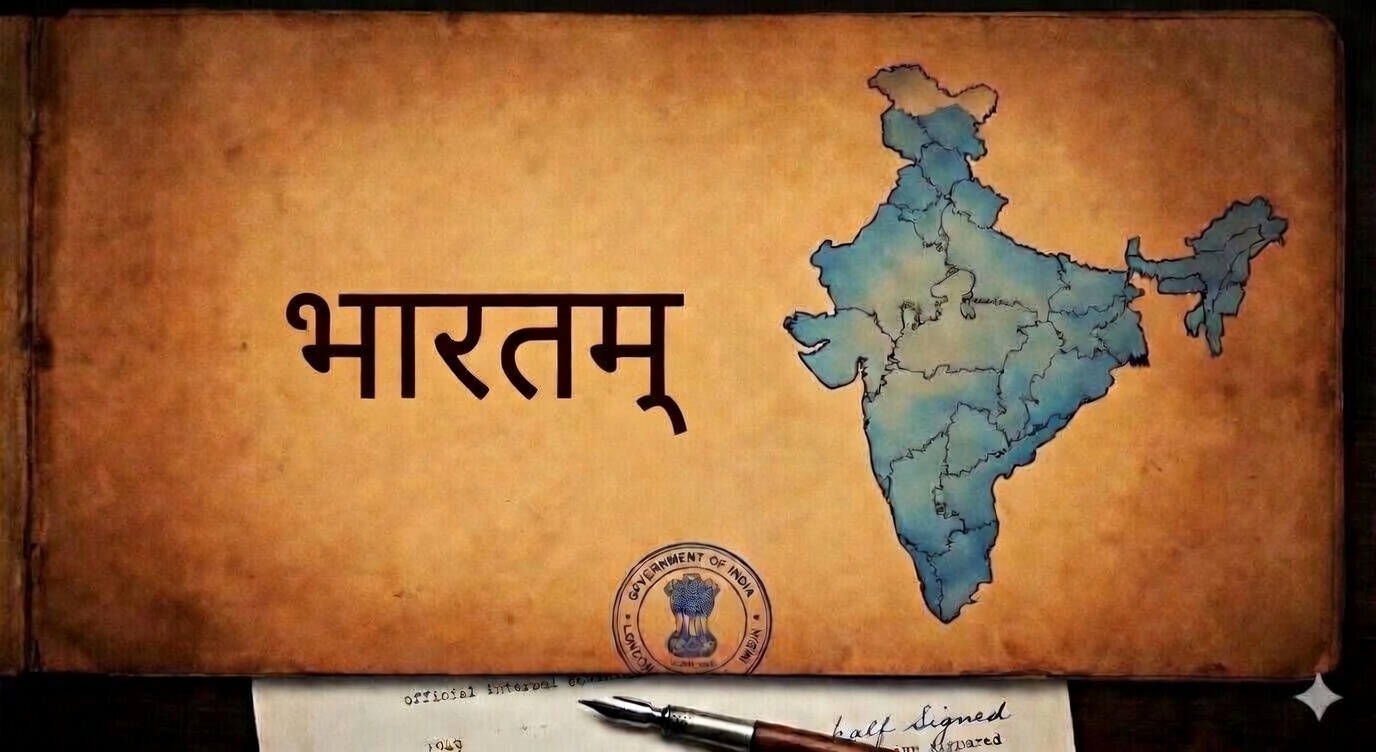
Part 1 of this three-part feature is an exercise in Historical Dystopianism, a forensic examination of an Alternate India that diverged from our own in the winter of 1949. While our current reality is defined by the messy compromises of the Three-Language Formula and persistent regionalist fervor, this report examines the Sanskrit Mandate, a study of a society that traded the Babel of democratic linguistic chaos for the singular logic of a classical state.
PART I: THE PARENT VS. THE SIBLING
The history of the Indian Union is often told as a series of narrow escapes from disintegration. In our standard textbooks, the Language Question of the late 1940s is framed as a binary struggle between English, the departing colonial ghost, and Hindi, the aspiring national heartland.
But in the Sanskrit Resolution of 1949, the Indian authorities made a radical, Israel-style pivot. They recognised a fundamental sociological truth: Hindi was a sibling, but Sanskrit was the Parent, or, in the specific case of the South, the ultimate Cultural Arbiter.
By 1949, the Constituent Assembly was a tinderbox. The push for Hindi by the United Provinces was perceived by the South and the East not as unification, but as provincial imperialism. To a Tamilian or a Bengali, Hindi was a neighbor-language, younger, less-refined, and culturally thinner than their own. The declaration of Sanskrit as the National Official Language (NOL) was the ultimate move of strategic neutrality.
The Parent Hegemony: Why the South Embraced the Code
When the Mandate was announced, the expected firestorms in Madras and Calcutta never materialised. The state had performed a brilliant sociological calculation: Prestige is the antidote to Resentment.
Hindi was a low-prestige sibling. To ask a scholar of the Sangam tradition to submit to Hindi was an insult to their ancient lineage. Sanskrit, however, occupied a unique psychological space. While the state acknowledged that Tamizh was not a child of Sanskrit, recognizing it instead as a venerable sibling or a classical cousin with its own independent, sophisticated grammar, it also recognised that Sanskrit was the shared Aksara Code of the subcontinent’s intellectual history. It was the language of the scriptures, philosophies, and scientific treatises that the South had preserved more meticulously than the North for centuries.
By choosing Sanskrit, the state did not elevate one region over another. Instead, it demanded that everyone, from the Punjabi farmer to the Kerala fisherman, reach upward toward a shared, high-classical standard. It was a difficult union, but it was an honorable one. Because Sanskrit was already woven into the liturgy, the classical music, and the scholarly vocabulary of the South, the Aryan-Dravidian divide was intellectually neutralised before it could ever turn violent. The South did not feel it was being conquered by the North. It felt it was reclaiming a classical hegemony it had always shared.
The Periyarite Fault Line: A Fire Contained
And yet, the architects of the Mandate were not blind to the fault lines. They knew that Tamil Nadu carried within it a specific and combustible tradition, the Dravidianist, rationalist, anti-Brahmin political philosophy associated with Periyar E.V. Ramasamy, which had historically cast Sanskrit as the very instrument of Brahminical subjugation. In this reading, Sanskrit was not a neutral classical parent but an ideological weapon that had kept the non-Brahmin majority in liturgical darkness for centuries.
What the Mandarians of New Delhi calculated, however, was that the Periyarite resistance, while ideologically fierce, was sociologically bounded. It was concentrated in specific urban political nodes: Madras city, the coastal belt, the Dravidar Kazhagam strongholds, and it was animated most intensely by a particular stratum of the politicised non-Brahmin intelligentsia. The wider social reality was considerably more complex. Among the vast and internally differentiated non-Brahmin communities of Tamil Nadu, the Vellalas, the Nadars, the Gounders, the Maravars: Sanskrit was not uniformly experienced as an oppressor’s tongue. Many had their own ancient temple-based, devotional, and martial relationships with the classical language, mediated through Agamic traditions, Shaiva liturgy, and the Bhakti canon. The village temple, that institution the Periyarites often targeted, was also the village’s most immediate and intimate point of contact with Sanskritic sound and symbol.
The state made a further tactical calculation: the opposition, however authentic, was confined to a single state and, within that state, to particular regions and social networks. It was not a pan-Dravidian uprising. Kerala’s relationship with Sanskrit, mediated through its extraordinarily dense tradition of Sanskrit scholarship and the Ezhuthassan legacy, was far more integrative. The Kannadigas had their own Shaiva-Veerashaiva Sanskrit inheritance. Telugu literary culture had long been called the Italian of the East precisely because of its deep Sanskritic melodic architecture. Resistance in Tamil Nadu was real, but it was a bounded fire, not a continental conflagration.
The East and the Dear Child: Bengal’s Quiet Capitulation
If the South presented the Mandate’s most theatrical political challenge, the East presented its most intellectually interesting one. Bengal in 1949 was not a passive cultural province. It was a civilization that had just produced Rabindranath Tagore, a Nobel laureate whose very literary language was a conscious, muscular synthesis of Sanskritic diction and vernacular rhythms. Bengali literary nationalism was among the most self-confident cultural forces on the subcontinent, and any assumption that it would subordinate itself quietly to a classical code needed justification.
The justification, as it happened, was encoded in the Bengali language itself. Unlike Tamil, whose classical independence from Sanskrit is its cardinal linguistic fact, Bangla is, in the most intimate sense, a dear child of Sanskrit. Its lexical architecture rests on an enormous foundation of tatsama borrowings, words taken directly and unchanged from Sanskrit, that permeate its poetry, its philosophy, its science, and its daily speech at a depth that no other major Indian vernacular, except perhaps Telugu, can match. To speak formal, literary Bangla is, in significant measure, to speak a Sanskritised tongue. The scholar, the novelist, the lawyer, the orator in Calcutta already inhabited a linguistic universe where Sanskrit was not a foreign imposition but the ancestral timber of their own eloquence.
This created a paradox that neutralised Bengali resistance. The Bengali intellectual who might have objected to Sanskrit’s elevation found, on reflection, that he was objecting to the formal recognition of something already deeply constitutive of his own identity. Bengali literary nationalism had drawn much of its prestige precisely from its dense Sanskritic inheritance, from Bankimchandra Chattopadhyay’s ornate Sanskrit-inflected prose to the Upanishadic cadences in Tagore’s Gitanjali. To resist Sanskrit was, in some measure, to resist the very sources of Bengali literary greatness. The fire that might have burned in Calcutta found, therefore, that it had little dry timber to consume. The opposition in the East was less about the elevation of Sanskrit and more about the concurrent sunset of English, the language in which the Bengali Bhadralok had performed so brilliantly on the colonial stage. That was a different grief, and a more private one.
The Northwest and the Partition Filter: A Question Already Half-Answered
The Northwest appears in the original Mandate debates as the region most theoretically resistant to Sanskrit’s elevation. Punjab, Sindh, and the Frontier had nurtured, over centuries, a rich Perso-Arabic literary and devotional culture: the Sufi kalam, the Punjabi qissa tradition, the Persian-educated administrative class of the late Mughal and Sikh courts. For communities whose highest cultural registers were shaped by Waris Shah and Bulleh Shah rather than by Panini and Patanjali, Sanskrit carried none of the ancestral prestige it commanded in Madras or Calcutta. The Mandate’s architects knew this. It was, on paper, their most exposed flank.
What resolved the Northwest question, however, was not policy ingenuity but the catastrophic demographic surgery of Partition itself. By August 1947, the communities most organically rooted in the Perso-Arabic literary tradition, the Muslim majority populations of West Punjab, Sindh, and the Frontier, had largely crossed into the new state of Pakistan. The Northwest that sat within the Indian Union in 1949 was, in terms of its religious and cultural composition, a profoundly transformed region. What remained was overwhelmingly Hindu and Sikh, and both communities carried their own ancient, if complicated, relationships with Sanskrit.
The Hindu Punjabis, concentrated now in the truncated East Punjab, brought with them a Brahminical Sanskrit tradition that, while perhaps less scholastically refined than its southern counterparts, was nonetheless real and liturgically alive in the domestic and temple rituals of every household. The Sanskrit shloka was not an abstraction in a Punjabi Hindu home. It was the texture of the morning prayer, the wedding ceremony, the cremation ground.
The Sikh case was more nuanced, and more interesting. The Guru Granth Sahib, the living scripture of the Sikh faith, is not a Sanskrit text. Its sacred languages are Sant Bhasha, Braj, Punjabi, and Persian, among others, and the Gurus had consciously composed in the vernacular precisely to reach beyond the Sanskrit-literate Brahminical class. There was, therefore, a genuine theological wariness within certain Sikh intellectual circles about any state elevation of Sanskrit, which could be read as a restoration of the Brahminical order the Gurus had deliberately circumvented.
Yet even here, the architects of the Mandate found structural purchase. The Guru Granth Sahib, for all its vernacular devotional power, contains significant Sanskrit-origin vocabulary woven through its verses. More consequentially, the Sikh intellectual tradition of the Nirmalas, a scholarly order specifically founded to interpret Gurbani through the lens of Sanskrit learning, had long argued that the deepest layers of the scripture’s meaning required Sanskritic literacy to fully access. The Nirmala tradition gave the state a credible bridge: Sanskrit was not the enemy of the Guru’s message, but one of its hermeneutic keys. It was a bridge not every Sikh accepted, but it was enough to prevent the Northwest from consolidating into a unified opposition bloc.
The Punjabi farmer invoked in the original deliberations was, by 1949, a Hindu or Sikh farmer in East Punjab, not the composite, syncretic figure of the undivided province. Partition had, with terrible efficiency, already answered the Northwest question before the Mandate was ever announced. The remaining resistance in the region was real but fractured, denominationally divided, and without the civilizational coherence that might have made it a serious counterforce to the classical state’s ambitions.
The Remaining Muslims: A Community That Could Not Afford a Voice
Partition had resolved the Northwest. But it had not emptied the Indian Union of its Muslim population. Roughly ten percent of the new republic’s citizens were Muslim, scattered across Uttar Pradesh, Hyderabad, Kerala, Bengal, and a dozen smaller concentrations. In the abstract, this was a community with a deep and sophisticated stake in the language question. The Urdu literary tradition, rooted in the same Perso-Arabic cultural complex that had defined the Northwest, was among the most refined on the subcontinent. The great poets of the Lucknow and Delhi schools, the madrasa scholars of the Gangetic plain, the Deccani court culture of Hyderabad: all represented a civilizational archive for which Sanskrit was not a parent or a cousin but a historical stranger.
Yet in the winter of 1949, this community was not in a position to make that argument publicly. The trauma and suspicion generated by Partition had settled over India’s Muslims like a second sky. They were ten percent of a nation that had just been convulsed by a rupture that a significant section of their co-religionists had actively sought and celebrated. The accusation of divided loyalty, however unfair in individual cases, hung over every Muslim household, every Muslim politician, every Muslim intellectual in the republic. To protest the Sanskrit Mandate loudly, in that charged atmosphere, would have been to confirm every suspicion that the remaining Muslims were cultural fifth columnists, unwilling to accept the civilizational logic of the state that had sheltered them.
The community understood its position with a clarity born of necessity. The politics of survival demanded a strategic quietism. Muslim leaders of the period, the Maulanas of the Jamiat Ulema-e-Hind, the secular nationalist Muslims who had stayed and staked their futures on the Congress dispensation, were all engaged in a careful, painstaking labor of demonstrating loyalty rather than asserting difference. In that context, mounting an organised opposition to a national language policy would have been not merely politically futile but actively dangerous to the fragile social compact they were trying to rebuild.
There was also a subtler calculation at work. The Sanskrit Mandate, whatever its cultural implications, was not a direct assault on Muslim personal law, on mosque management, on the Urdu medium schools that continued to operate under the Provincial Dualism framework. The state had guaranteed that provincial languages, including Urdu where it had a substantial base, would remain administratively viable at the local level. The Mandate touched the peak of the national bureaucratic edifice, a realm from which the Muslim community, by circumstance and by the inherited patterns of colonial-era employment, was already significantly distant. The practical daily life of a Muslim weaver in Varanasi or a Muslim fisherman in Kerala was not immediately altered by what language the Indian Foreign Service conducted its correspondence in.
The architects of the Mandate, for their part, were not oblivious to this dynamic. They made no effort to suppress Urdu, no move to dismantle the madrasa system, no declaration that the Perso-Arabic literary tradition was incompatible with Indian citizenship. The Mandate was framed, always, as an elevation rather than an erasure. It asked all communities to reach upward toward Sanskrit. It did not ask them to abandon what lay beneath. For a community already engaged in the quiet, exhausting work of proving its belonging, that framing was just sufficient to permit acquiescence without requiring open endorsement.
The Muslim voice on the Sanskrit question in 1949, therefore, was not silence born of indifference. It was the considered, strategic silence of a community that had correctly read the room and chosen, with considerable dignity, to live and endure rather than protest and perish.
The 1977 Sunset: The Pragmatic Retreat of English
The Indian authorities were not merely visionaries. They were ruthless pragmatists. They understood that an immediate total ban on English would result in a decapitated bureaucracy. Consequently, the Official Languages Act of 1952 introduced a Sunset Clause.
English was retained as an Assistant Official Language, a functional crutch for the generation born under the British Raj. For twenty-five years till 1977, aspirants could sit for the Union Public Service Commission (UPSC) exams in English and Sanskrit. However, the state made it clear that the clock was ticking. After 1977, the gates of the central bureaucracy would swing shut for anyone who had not mastered the Paninian code.
This created a fascinating sociological pressure cooker. The old Anglophone elite scrambled to tutor their children in a language they had once dismissed as liturgical, while the rural masses, who had never mastered the nuances of colonial English, found that the new Sanskrit requirement leveled the playing field. By 1977, when the last English-medium UPSC exam was administered, the transition was already a fait accompli. The new Mandarin Class was already speaking the Parent Code.
The Provincial Compromise: Perpetual Dualism
To prevent provincial languages from feeling marginalised, the authorities implemented a permanent dualist structure for the states. While the central Steel-Frame moved toward exclusive Sanskrit usage, the provincial bureaucratic exams remained open to the local tongues forever.
A civil servant in the Tamil Nadu cadre could take their entrance exams in Tamizh, and a judicial clerk in Kolkata could operate in Bengali. However, the state added a strategic incentive: Sanskrit remained an evergreen option for all provincial exams. For twenty-five years till 1977, provincial candidates also had the option of using English, but as the national deadline approached, the prestige of the central language began to bleed into the provinces. Ambitious young officers realised that while Tamizh or Marathi would serve them at the district level, Sanskrit was the only currency that allowed for vertical mobility into the higher echelons of national power.
This policy effectively trapped the linguistic sub-nationalism of the 1960s. By allowing provincial languages to exist forever in the local bureaucracy, the state removed the fear of cultural extinction. Yet, by making Sanskrit the sole language of the national peak after 1977, it ensured that the Brain-Trust of the country was unified by a single, classical logic.
