











By: Hiren Gandhi
The increasing use of Artificial Intelligence in the United States military has sparked fresh global debate over the future of warfare and the risks associated with autonomous decision making systems. International media reports indicate that the Pentagon is expanding the deployment of AI based technologies in intelligence operations, target identification and battlefield decision support.
Defence analysts describe the development as a significant shift in military strategy. Unlike traditional warfare, where human commanders made critical decisions, AI systems are now playing a growing role in analysing data and recommending operational actions.
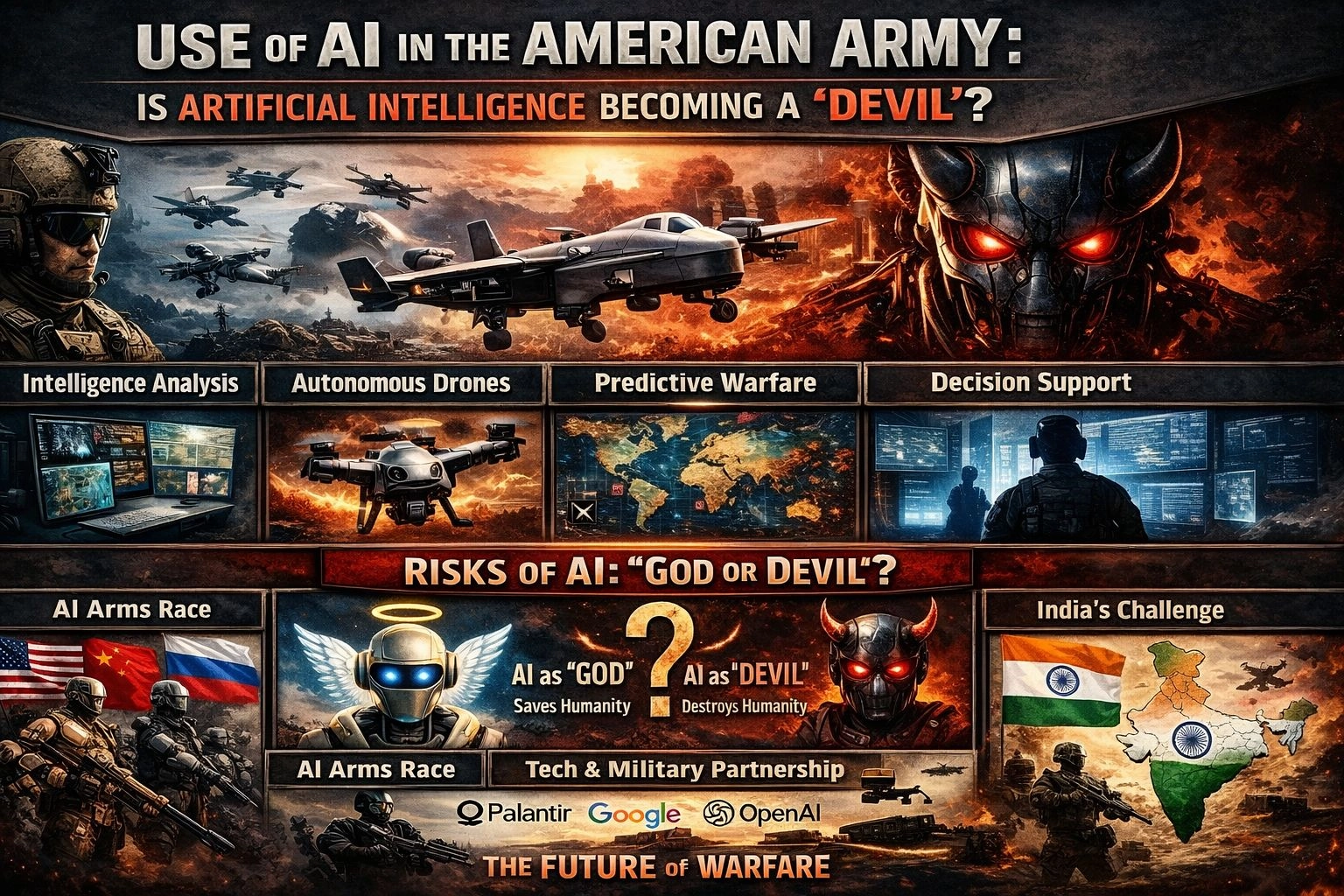
According to reports, AI tools are being used to process satellite imagery, drone footage and communication intercepts at high speed. Tasks that previously required days of human analysis can now be completed within minutes. Military officials argue that this improves efficiency and enhances situational awareness.
AI driven autonomous drones represent another major development. These systems are capable of identifying potential targets and, in certain configurations, carrying out strikes with limited human intervention. Experts warn that such capabilities raise serious ethical and legal questions, particularly regarding accountability in the event of errors.
In addition, predictive analytics powered by AI is being used to anticipate enemy movements and assess potential threats. Decision support systems are also assisting military officers by recommending when and where to deploy forces. Observers note that machines are increasingly influencing battlefield decisions rather than merely assisting with background analysis.
However, the rapid integration of AI into military operations has prompted widespread concern. Critics argue that AI systems lack moral judgment and operate solely on data and algorithms. If fed inaccurate or biased data, they may produce flawed conclusions that could endanger civilian lives.
The issue of responsibility remains unresolved. If an AI system makes an incorrect targeting decision, it is unclear whether accountability lies with military commanders, defence contractors, software developers or the system designers. International law has yet to fully address such scenarios.
At the geopolitical level, the expansion of military AI programmes has intensified strategic competition. The United States, China and Russia are investing heavily in AI research and defence applications. Analysts describe the situation as an emerging AI arms race that could reshape global security dynamics.
Technology companies are playing a crucial role in this transformation. Firms such as Palantir, OpenAI, Google and Anthropic have been linked to defence related AI initiatives. The growing collaboration between private technology companies and the military has blurred the line between commercial innovation and strategic weapon development.
Security experts caution that AI could accelerate the speed of conflict. Automated systems are capable of making calculations and recommendations far faster than human operators. While this may enhance tactical effectiveness, it also increases the risk of rapid escalation during crises.
Some researchers warn that if autonomous systems operate with minimal oversight, human control over warfare could weaken. Others argue that AI, when properly regulated, can reduce human casualties and improve precision.
For India and other emerging powers, the developments present both challenges and opportunities. Defence strategists suggest that nations must invest in indigenous AI capabilities while simultaneously developing strong ethical and legal frameworks. Ensuring meaningful human oversight in military AI systems is widely regarded as essential.
India’s large pool of young technology professionals provides a potential advantage. Experts believe that with sustained investment and policy clarity, the country could strengthen its position in the evolving AI landscape.
As the global debate continues, one conclusion remains clear. Artificial Intelligence is transforming modern warfare. Whether it becomes a stabilising force or a destabilising threat will depend on how governments regulate, control and deploy the technology.
Sources: International media reports including Wall Street Journal, Reuters, Fox News and Pentagon briefings, February 2026.


Secretary — InGlobal Business Foundation (IBF)
Director — ReNis Agro International LLP, Ahmedabad, India
Subscribe Deshwale on YouTube


