



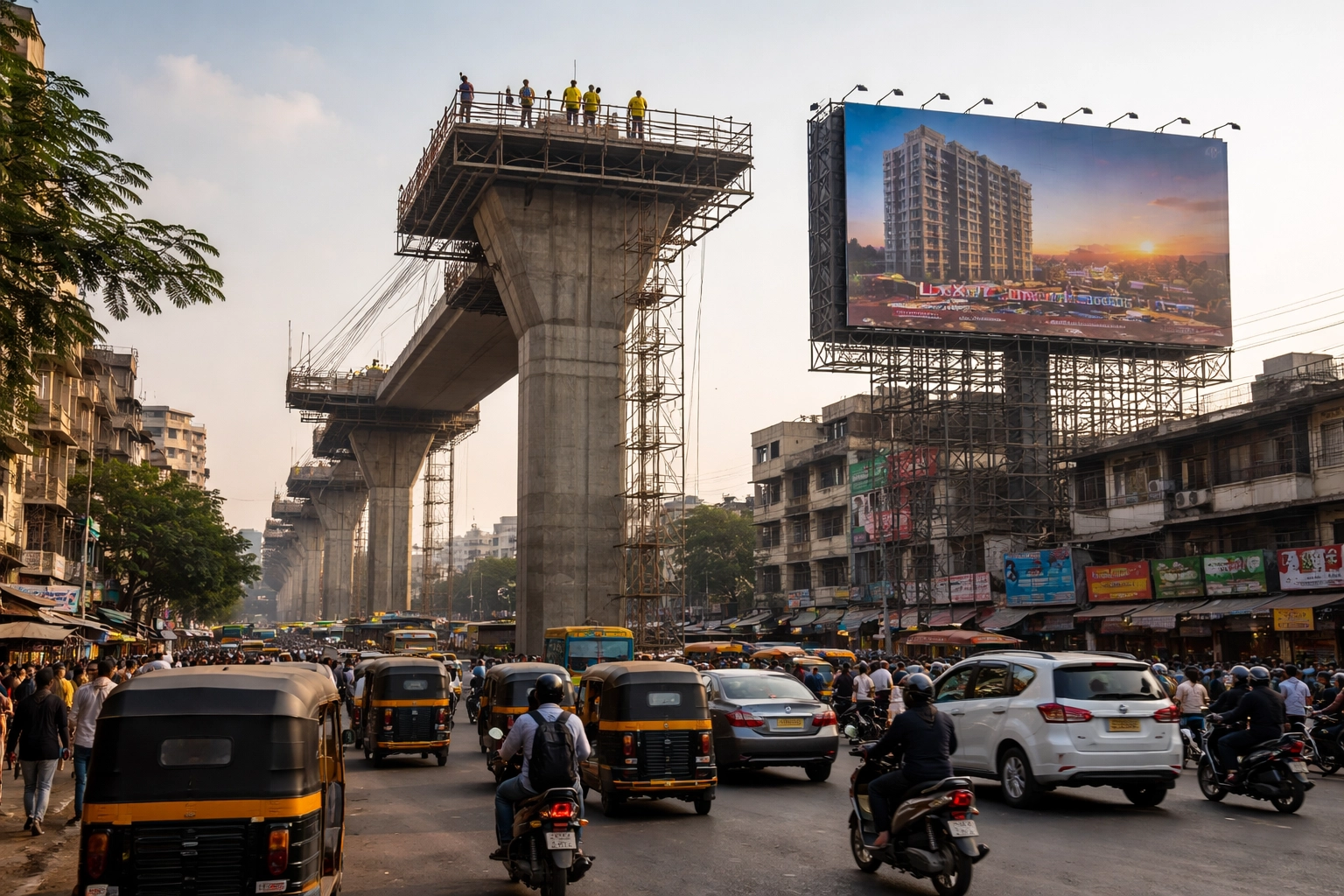
On a busy morning at Kapurbawdi Junction in Thane, commuters once looked up at a towering five storey advertisement board and not at an unfinished Metro pillar. That colossal billboard, planted precisely where part of Mumbai Metro Line 5 needed to rise, became more than an advertising structure. It quietly turned into a symbol of how modern cities can stall themselves.
For nearly three years, this single hoarding stood in the way of a crucial Metro corridor connecting Thane, Bhiwandi and Kalyan. On the surface, the situation seemed almost absurd. How could a piece of commercial signage delay a multi crore public transport project designed to ease congestion for lakhs of commuters?
But the deeper story was never about metal frames and vinyl sheets. It was about competing priorities, bureaucratic caution and the uneasy balance between public good and private interest.
A Physical Obstruction, A Systemic Pause
Technically, the problem appeared straightforward. The billboard blocked the construction of a key Metro pillar. Remove it, and work could continue.
In reality, the structure stood amid residential and commercial properties whose occupants faced relocation. Families and shopkeepers hesitated, uncertain about rehabilitation and compensation. Ownership records added complexity. Administrative processes stretched on. What should have been a brief procedural hurdle evolved into a prolonged standstill.
The delay revealed a truth that urban planners often confront but rarely highlight. Infrastructure may be engineered with precision, but it is executed within lived spaces. Those spaces carry histories, livelihoods and anxieties.
For the authorities, the Metro line represented efficiency and long term mobility. For residents and businesses, demolition meant disruption and financial uncertainty. Both perspectives were real. Both carried weight.
The Cost of Waiting
Delays in infrastructure are usually calculated in financial terms. Budgets rise. Timelines expand. Contracts are renegotiated.
Yet the invisible cost lies elsewhere.
For commuters travelling daily between Thane and Bhiwandi, traffic remained the norm. What could have become a swift Metro ride continued as long, unpredictable road journeys. Minutes lost each day accumulated into hours each week.
For those asked to relocate, uncertainty lingered. Promises of compensation do not instantly replace the familiarity of a home or the security of a long established shop. Even when alternative arrangements are offered, transition takes time and trust.
In the end, when the hoarding was dismantled and the path cleared for construction, the act felt symbolic. The obstruction was removed. Work resumed. But the years already spent could not be reclaimed.
What This Episode Says About Urban India
Mumbai prides itself on momentum. New corridors, coastal roads and redevelopment projects signal ambition. The city constantly reinvents its skyline.
Yet beneath that pace lies a more complicated rhythm.
Urban development is not only about funding and engineering. It is about documentation, negotiation and alignment of interests. A project may enjoy political backing and public approval, but it can still stall at the intersection of legal process and local resistance.
The Metro Line 5 delay shows that cities do not always slow down because they lack resources. Sometimes they slow down because coordination falters. Because compensation frameworks lack clarity. Because communication gaps widen distrust.
In fast growing urban centres, even small administrative knots can tighten into multi year delays.
Progress and Its Contradictions
The billboard that once blocked the Metro is gone. Construction has moved ahead. The corridor is expected to reshape daily travel for thousands once operational.
But the episode leaves behind a larger question. How should cities define progress?
Is it measured solely in kilometres of track laid and pillars erected? Or does it also include how smoothly communities transition through change?
True progress requires more than speed. It demands transparency in compensation, clarity in documentation and empathy in execution. When those elements lag, even well intentioned projects encounter resistance.
Mumbai’s story is not unique. Across rapidly expanding cities, development often collides with existing realities. Land carries emotion as much as economic value. Infrastructure demands space, but space is rarely empty.
The image of a billboard standing where a Metro pillar should have been will linger in public memory because it captures a broader paradox. A city racing towards modernity paused by its own unresolved complexities.
In the end, the lesson is neither cynical nor dramatic. It is practical.
Urban transformation must anticipate friction. It must resolve disputes swiftly and fairly. It must ensure that those who give up land or livelihood are not left navigating uncertainty alone.
Because when development forgets the human dimension, even the smallest structure can delay the tallest ambition.
And when cities learn to align vision with process, barriers fall much faster than billboards ever could.
