



India’s Consumer Price Index (CPI) inflation decreased to 3.6% in February 2025, the lowest in seven months. This decline is mainly due to a significant drop in food and beverage prices.
Key Highlights:
- Food & Beverages Inflation: Eased by 1.85 percentage points to 3.84%, primarily because of a sharp decline in vegetable prices.
- Vegetable CPI: Turned negative at -1.07% for the first time in 20 months. Approximately 80% of this decline is attributed to garlic, potatoes, and tomatoes.
- Fruit Inflation: Surged to a 10-year high of 14.8%, possibly due to increased demand during fasting periods associated with the Maha Kumbh.
- Core Inflation: Crossed 4% after 14 months, reaching 4.08%.
Industrial Growth:
The Index of Industrial Production (IIP) expanded by 5.0% in January 2025, led by manufacturing and mining sectors. This indicates strengthening industrial growth.
Imported Inflation:
Despite the overall decline in CPI inflation, imported inflation surged from 1.3% in June 2024 to 31.1% in February 2025. This rise is driven by increasing prices of precious metals, oils, fats, and chemical products.
Future Projections:
- CPI inflation is expected to decline to 3.9% in Q4 FY25 and average 4.7% for FY25.
- The Reserve Bank of India (RBI) may implement successive rate cuts in April and August 2025, with an overall expected cumulative rate cut of at least 75 basis points.
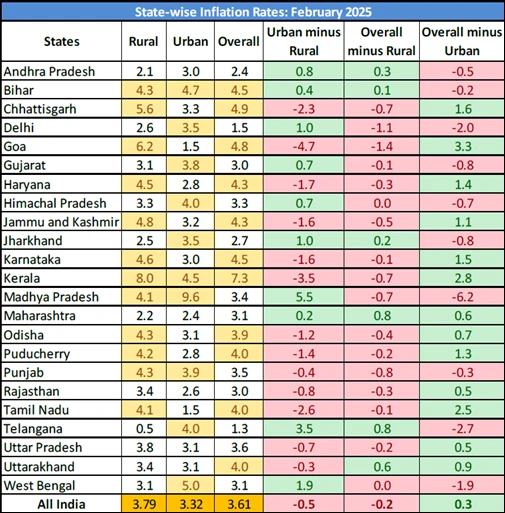
State-wise Inflation Analysis:
- Highest Inflation Rates: Kerala (7.3%) and Chhattisgarh (4.9%).
- Lowest Inflation Rates: Telangana (1.3%) and Delhi (1.5%).
Rural inflation continues to outpace urban inflation due to higher food prices and a larger food basket share (54.2% for rural areas vs. 36.3% for urban areas).

These insights are based on the SBI Ecowrap report, published by the State Bank of India’s Economic Research Department. The report provides a detailed analysis of India’s economic landscape in February 2025, focusing on CPI inflation, industrial growth, imported inflation, and corporate performance.
