



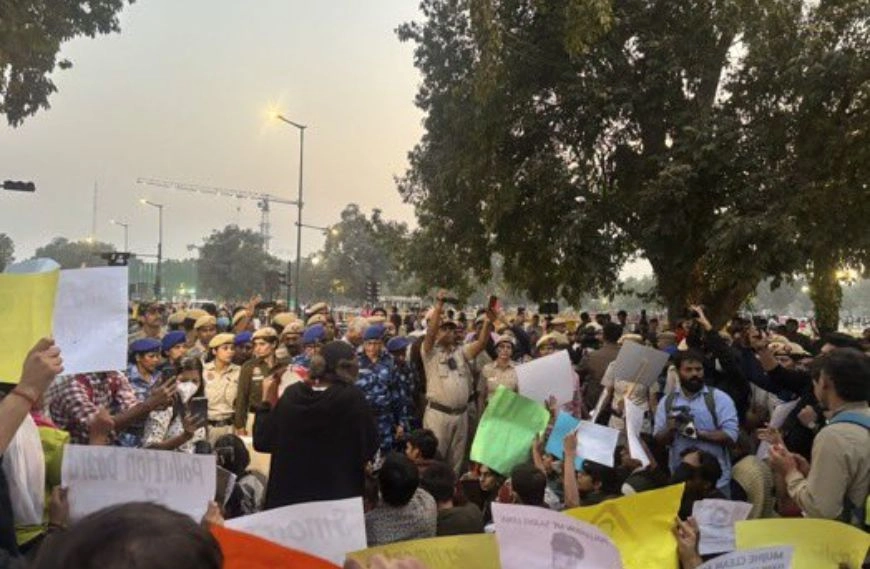
Delhi woke up to a thick layer of smog and choking air as pollution levels entered the ‘severe’ category once again. On Tuesday morning, the city’s overall Air Quality Index (AQI) reached 425, rising sharply from 345 recorded the previous day. This pushed Delhi into an emergency zone, forcing authorities to enforce Stage III of the Graded Response Action Plan (GRAP) across Delhi and the National Capital Region (NCR).
Several parts of the city recorded dangerously high AQI readings. According to the Central Pollution Control Board (CPCB), Bawana topped the chart with an AQI of 462, followed by RK Puram at 446 and Patparganj at 438. These figures clearly indicate that Delhi’s air has turned hazardous, posing serious risks to public health. In such conditions, even healthy people can experience breathing discomfort, while those with asthma, heart or lung issues may face severe problems.
The Delhi government and the Commission for Air Quality Management (CAQM) have now implemented GRAP-III restrictions to control further pollution. This means all non-essential construction and demolition work is banned, including earth excavation, road building, and the operation of ready-mix concrete plants. BS-III petrol and BS-IV diesel four-wheelers registered in Delhi and surrounding NCR areas are also banned from operating, except for essential services. Diesel-run commercial vehicles registered outside Delhi will not be allowed to enter the city unless they carry essential goods.
In addition, government departments and private offices have been advised to promote work-from-home or hybrid models to reduce road traffic. Schools have been told to shift classes up to Grade 5 online, so that young children are not exposed to toxic air. The authorities have also increased mechanical road sweeping and water sprinkling operations to settle dust across major roads.
Experts say that Delhi’s worsening air quality is the result of multiple factors. The cold, still weather prevents pollutants from dispersing, while emissions from vehicles, road dust, and stubble burning in neighbouring states like Punjab and Haryana add to the toxic mix. As wind speeds remain low, the city’s air continues to trap these fine particles close to the ground, creating thick smog.
Health experts have warned residents to stay indoors as much as possible, use N95 masks when stepping out, and avoid physical activities in open spaces. The ‘severe’ category AQI, which ranges from 401 to 500, can cause respiratory distress even among healthy individuals after prolonged exposure. For vulnerable groups like children and the elderly, the risk is much higher.
With pollution levels expected to remain high in the coming days, authorities are keeping a close watch. If the air quality does not improve, Delhi could soon face Stage IV curbs, the final and most severe level under GRAP, which could include bans on all diesel vehicles and closure of schools and offices. For now, Delhi remains under a heavy blanket of smog, struggling for a breath of clean air.
Subscribe Deshwale on YouTube
