



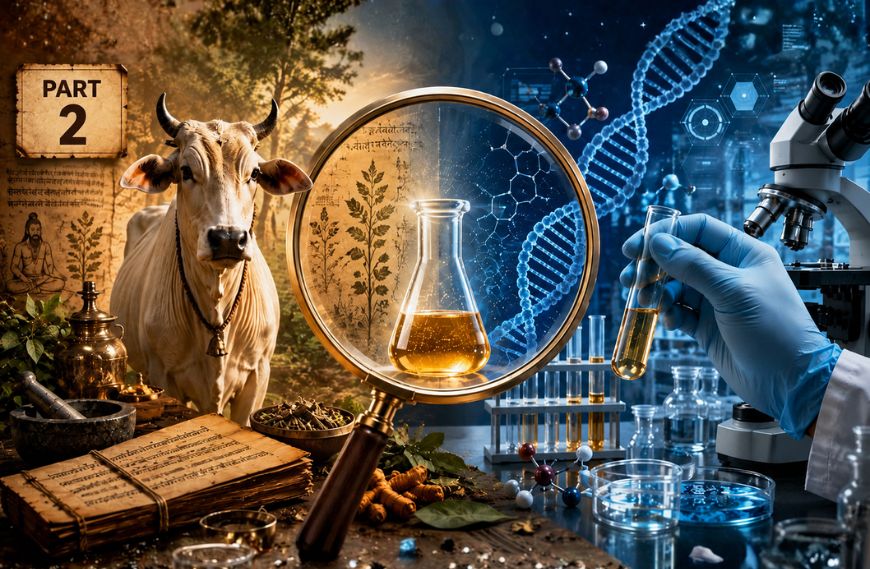

In laboratories far from the noise of television debates and political slogans, a quiet question is being asked about one of India’s most polarising substances: cow urine.
Does it actually do anything?
For years, the gaumutra debate has played out as a shouting match. One side insists science has already proved its healing powers. The other dismisses the entire idea as superstition. Neither side, it turns out, is being entirely honest with the evidence.
Researchers who have spent years studying cow urine under controlled conditions offer a far more layered picture, one built on curiosity, caution, and a long list of unanswered questions.
Not one substance, but thousands
The first thing scientists want the public to understand is simple: urine is not waste. It is a complex biological fluid produced by the kidneys, carrying water, salts and hundreds of metabolic by-products the body no longer needs.
That complexity multiplies when it comes to cows. Composition shifts constantly depending on the animal’s diet, breed, age, hydration levels, season and even pregnancy. Two samples collected from different farms on different days can look chemically quite different from each other.
This single fact already complicates any claim of a universal “cow urine cure.” There is, quite literally, no single fixed substance to test.
What chemists have actually found
Over three decades, researchers using modern lab equipment have identified several compounds in cow urine samples urea, uric acid, creatinine, sodium, potassium, calcium, phosphate and small traces of enzymes and volatile organic compounds.
That list may sound impressive to a layperson. But scientists are quick to add a caveat that rarely makes it into public conversation: finding a compound is not the same as proving it heals anything. The human body itself manufactures many of these same substances every single day.
The lab results that sparked curiosity
Some studies have gone further, testing cow urine preparations for antibacterial, antioxidant and immune-modulating activity. Certain experiments have shown promising signals in petri dishes and animal models.
That has understandably excited researchers, especially at a time when antibiotic resistance is a growing global concern. But a substance killing bacteria in a lab dish is a long way from safely treating an infection in the human body, which is a vastly more complicated system.
The same caution applies to antioxidant and immune-related findings. Many plants and herbs also show similar activity under laboratory conditions. Only a small fraction of them ever go on to become genuine, clinically proven medicines.
Distillation changes everything
One detail frequently lost in public debate is the difference between raw cow urine and Gomutra Ark, the distilled form traditionally used in Ayurveda.
Distillation alters composition. Some compounds pass into the distillate while others are left behind, and the process may also reduce contamination risks present in raw samples.
This means research findings on distilled preparations cannot simply be applied to raw cow urine, even though public discussions routinely treat the two as identical.
What about the famous American patent?
A claim repeated endlessly on social media is that “America has patented cow urine,” often presented as proof of its medicinal power.
The reality is narrower. Some patents relating specifically to cow urine distillate and its proposed uses have indeed been granted in the past. But a patent certifies novelty, not medical effectiveness.
Patent offices do not run clinical trials. History is full of patented ideas that never became working treatments, and equally full of effective medicines that were never patented at all.
Why scientists remain cautious
Drug development is essentially a process of elimination. Thousands of substances have shown exciting results in test tubes, only to fail later because they proved toxic in humans, impossible to standardise, or simply less effective than existing treatments.
Contamination is another quiet concern. Urine is not collected under sterile conditions once it leaves the body, and improper handling can introduce microorganisms that have nothing to do with the animal itself. Any genuine medicinal product would require pharmaceutical-grade manufacturing, not informal preparation at home.
The most honest summary of where the science currently stands is this: researchers have found enough interesting signals to justify further study, but not enough high-quality evidence to call cow urine an established treatment for major diseases.
That is not the same as saying “there is no science,” a line critics often repeat. Nor does it support the claim that “science has already proved it works,” a line supporters often make.
The real answer sits uncomfortably in the middle, a place slogans rarely visit, but where genuine research always begins.
Laboratories have now answered their first question: what is actually present in cow urine. The far bigger question whether any of it genuinely helps a patient can only be answered by rigorous human clinical trials, something that, for now, remains largely missing.
Subscribe Deshwale on YouTube
