



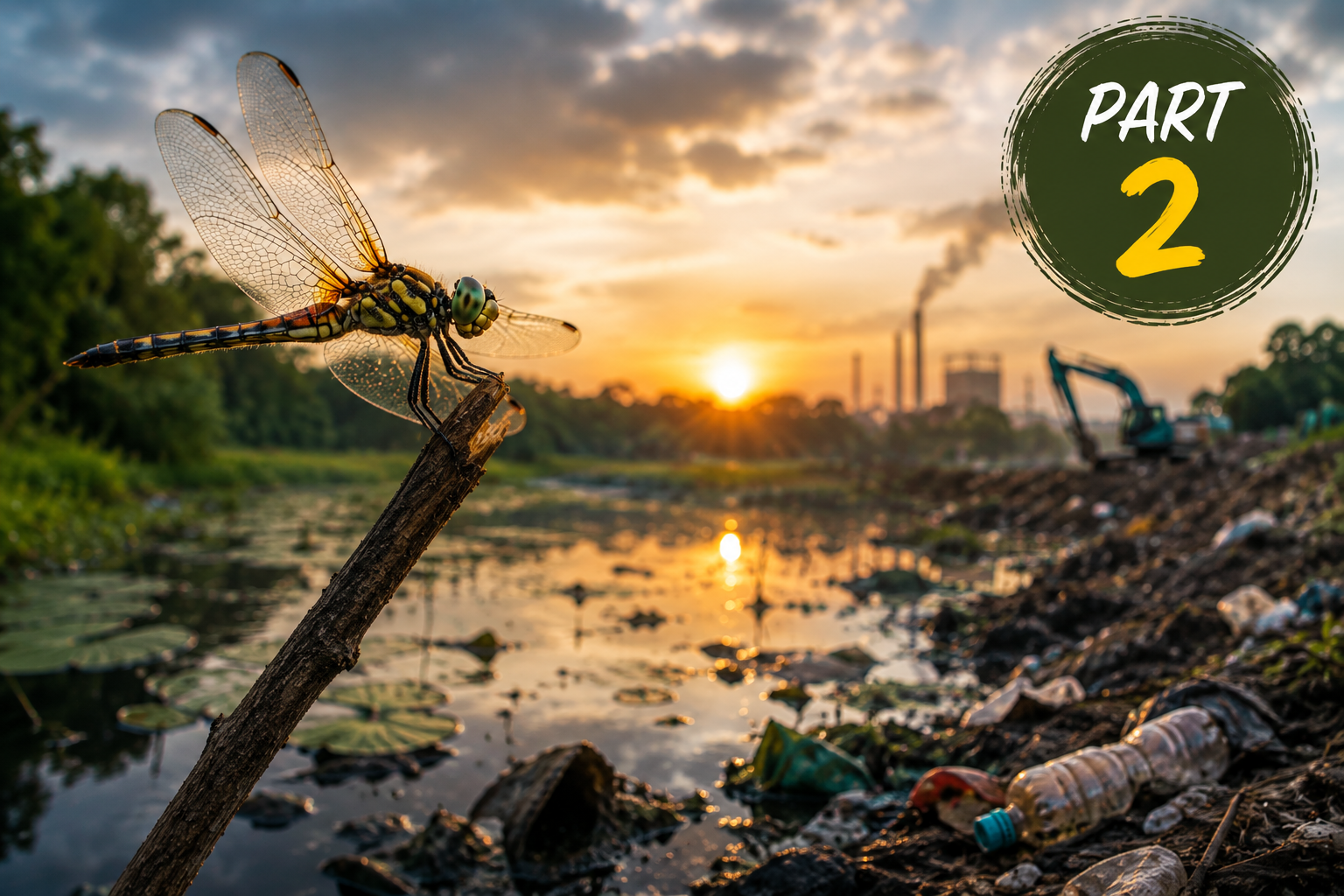
A dragonfly can cross continents.
It can ride seasonal winds across thousands of kilometres, survive harsh weather and return with the changing monsoon. Yet despite being one of nature’s most remarkable flyers, it cannot escape one simple problem.
It always needs clean freshwater to begin its life.
Every dragonfly starts as a tiny larva living underwater. If ponds dry up, streams become polluted or wetlands disappear, the next generation simply has nowhere to grow. That is why scientists believe the future of dragonflies is closely linked to the future of our freshwater ecosystems.
Unfortunately, those ecosystems are changing faster than ever.
Climate change is silently changing their world
When people think about climate change, they usually picture melting glaciers, rising sea levels or extreme heatwaves.
Few think about dragonflies.
But researchers say rising temperatures, changing rainfall patterns and prolonged droughts are already affecting the habitats these insects depend on. Small ponds dry up earlier, streams become seasonal, wetlands shrink and breeding cycles begin to change. For an insect whose early life depends entirely on water, these changes can be devastating.
Scientists studying dragonflies have also found that many species are shifting their geographical ranges in response to changing temperatures. Some are moving to higher altitudes where the climate remains cooler, while others are struggling to adapt because suitable habitats no longer exist nearby.
The problem becomes even more serious when climate change combines with human activities.
Across many regions, wetlands are filled for construction, riverbanks are altered, forests are cleared and freshwater bodies become polluted with untreated waste. Even if adult dragonflies manage to survive, their larvae often cannot complete their development in degraded water bodies.
This is why researchers often describe dragonflies as the “first alarm.”
By the time people begin noticing polluted rivers or disappearing wetlands, dragonflies may already have been declining for years.
India is still discovering new dragonflies
Perhaps the most fascinating part of this story is that scientists are still discovering species that were previously unknown.
India, especially the Western Ghats, continues to reveal new dragonflies and damselflies, many of which are found nowhere else on Earth. Several newly identified species have extremely small distributions, surviving only in specific streams or forest patches.
That also makes them incredibly vulnerable.
If a single stream is polluted or a forest patch is destroyed, an entire species could disappear before most people even learn it exists.
This is why researchers believe conservation should not begin only after a species becomes endangered. Protecting freshwater ecosystems today is often the only way to prevent tomorrow’s extinctions.
Interestingly, dragonflies are also proving that conservation isn’t just about wildlife.
Healthy ponds, rivers and wetlands support fish, birds, frogs, insects and countless other organisms. They recharge groundwater, reduce floods and improve water quality for nearby communities. Protecting dragonflies therefore means protecting an entire ecosystem that humans depend upon every single day.
More than just another insect
For many of us, dragonflies are simply a childhood memory.
They remind us of village ponds, monsoon evenings and fields filled with buzzing insects. We chased them as children without ever imagining that one day scientists would consider them among the world’s most important environmental indicators.
Yet today, that is exactly what they have become.
They are helping researchers understand climate change, freshwater health and biodiversity loss—often long before these problems become visible to the rest of us.
The recent Western Ghats survey serves as both good news and a warning. Discovering 143 species, including dozens found nowhere else, highlights India’s extraordinary biodiversity. But the fact that researchers could document only about 65% of previously recorded species reminds us that many dragonflies may already be becoming harder to find. Whether that decline is temporary or permanent is something scientists are still working to understand.
The next time a dragonfly hovers quietly above a pond, it may seem like nothing more than another insect enjoying the afternoon.
But in reality, it could be telling us something about the water beneath it.
And perhaps, about the future waiting for all of us.
Subscribe Deshwale on YouTube
