



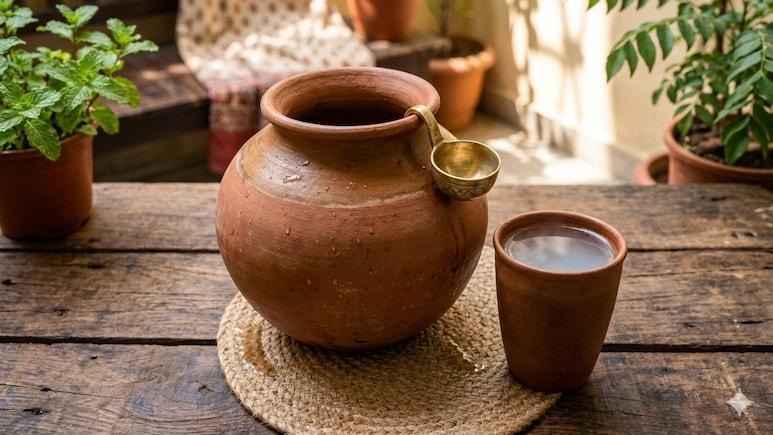
In many Indian homes, a clay pot filled with drinking water has been a familiar sight for generations. Placed in a kitchen corner or near a window, the humble matka has quietly served families through countless summers. It needs no plug, motor or cooling system, yet the water inside often feels pleasantly cooler than the surrounding air.
What makes this ordinary-looking pot so interesting? The answer is not magic or an old household myth. It is a natural scientific process that turns a little water, clay and air into a simple cooling system.
The science hidden inside the clay
An unglazed earthen pot has thousands of tiny pores across its surface. These pores allow a small amount of water to move from the inside towards the outer surface.
Once this moisture reaches the outside, some of it evaporates when exposed to air. Evaporation requires energy, which is taken as heat from the pot and the water inside it. As this heat is lost, the remaining water gradually becomes cooler.
This process is known as evaporative cooling. It is similar to what happens when sweat evaporates from our skin and makes us feel cooler.
The clay itself does not create cold. Its porous structure allows the water to reach the surface, where evaporation does the cooling. This is also why a fully glazed pot, whose surface is sealed, does not work in quite the same way.
Airflow plays an important role, too. Moving air carries away moisture surrounding the pot and allows more water to evaporate. A little breeze can therefore help the cooling process.
Why does the same matka cool differently in different places?
Have you noticed that a matka may cool water more effectively during some weather conditions than others? The reason lies largely in the amount of moisture already present in the air.
In hot, dry weather, water evaporates more easily because the air can absorb additional moisture. This helps the pot lose more heat. In humid weather, evaporation slows down because the air already contains a considerable amount of moisture.
This difference matters in coastal cities such as Mumbai. Although a matka can still cool water here, its cooling effect may be less noticeable than in a hot, dry region. The temperature, humidity, airflow and type of clay all influence the result.
A 2006 study published in the International Journal of Green Energy examined evaporative cooling in a porous clay vessel under different humidity conditions. Its experiments showed that cooling improved as relative humidity decreased.
Another study by Indian researchers Mukesh Kumar and Amit Sharma examined clay samples from different geographical regions. Published online in 2023 and included in a 2024 journal issue, it explored how properties such as porosity and water-holding capacity influence cooling performance.
The findings help explain why two earthen pots made from different clay may not cool water equally well.
A traditional pot, but not a water purifier
For many families, the matka is more than a container. It brings back memories of summer holidays, afternoon meals and the familiar sound of water being poured into a steel glass.
It also offers a simple way to cool drinking water without using electricity. However, it is important to understand what it cannot do. An earthen pot does not automatically remove harmful germs or make unsafe water safe to drink.
The pot should be cleaned regularly, kept covered and filled with safe drinking water. A clean glass or suitable tap should be used to draw water instead of dipping hands or used utensils inside.
Its cooling ability is also limited. Matka water may feel pleasantly cool, but it should not be expected to reach the low temperatures of a refrigerator.
An old idea that still makes sense
Refrigerators have changed how Indian households store and cool food and water. Yet, the matka continues to find a place in many homes because of its simplicity and the naturally cool water it can provide.
Its story is a reminder that traditional household objects can hold practical scientific knowledge. Generations may have used the matka without knowing the scientific term for the process, but the principle behind it remains easy to understand.
Sometimes, innovation does not mean building something more complicated. It can also mean recognising the value of a simple idea that has quietly served people for years.
The matka may be made of ordinary earth, but the science working inside it is anything but ordinary.
Subscribe Deshwale on YouTube
