







A former rapper has upended the Himalayan republic. The harder questions begin now.
Vote counting was still under way on Friday morning when it became clear that Nepal’s political establishment had been dealt one of its sharpest blows in living memory. The Rastriya Swatantra Party (RSP), a three-year-old so-called centrist outfit whose public face is 35-year-old former rapper and structural engineer Balendra Shah, was leading in well over 80 of the 165 directly contested seats in the House of Representatives. The old guard was in freefall. KP Sharma Oli’s CPN-UML was holding on in fewer than ten seats. The Nepali Congress trailed in single digits. Nepal had, in the space of one election, torn up a political script written and rewritten by the same cast of characters for over three decades.
This was Nepal’s first general election since the Gen Z-led uprising of September 2025, which toppled Oli’s government and left at least 76 people dead. What followed was unusual even by Nepal’s turbulent standards: the military assumed temporary control of the Kathmandu Valley, the House of Representatives was dissolved, and former Chief Justice Sushila Karki was appointed interim prime minister, the first woman to hold that office in Nepal’s history. Elections were held on 5 March 2026, with nearly 18.9 million registered voters going to the polls. Turnout was approximately 60 per cent, driven in large part by a surge of first-time young voters.
FACT BOX: Nepal’s 2026 General Election at a Glance
Election date: 5 March 2026
Total registered voters: approximately 18.9 million
Voter turnout: approximately 60 per cent
Total House of Representatives seats: 275
Directly contested seats (first-past-the-post): 165
Proportional representation seats: 110
RSP leading seats (early count): 80-plus
Deaths during the September 2025 uprising that triggered the polls: at least 76
RSP’s age as a registered party at the time of election: three years
Balen Shah’s age: 35
The Man Who Won’t Follow the Script
Balendra Shah, known universally as Balen, holds a postgraduate degree in structural engineering from Visvesvaraya Technological University in Karnataka. Before politics he was a rapper whose lyrics targeted corruption and inequality, building a following among precisely the urban youth who would later fill the streets in 2025. In 2022, he became the first independent candidate elected as Mayor of Kathmandu, defeating established party machines with over 61,000 votes. His image, sunglasses firmly in place, became a shorthand for a new kind of Nepali politics. But the image is more complicated up close.
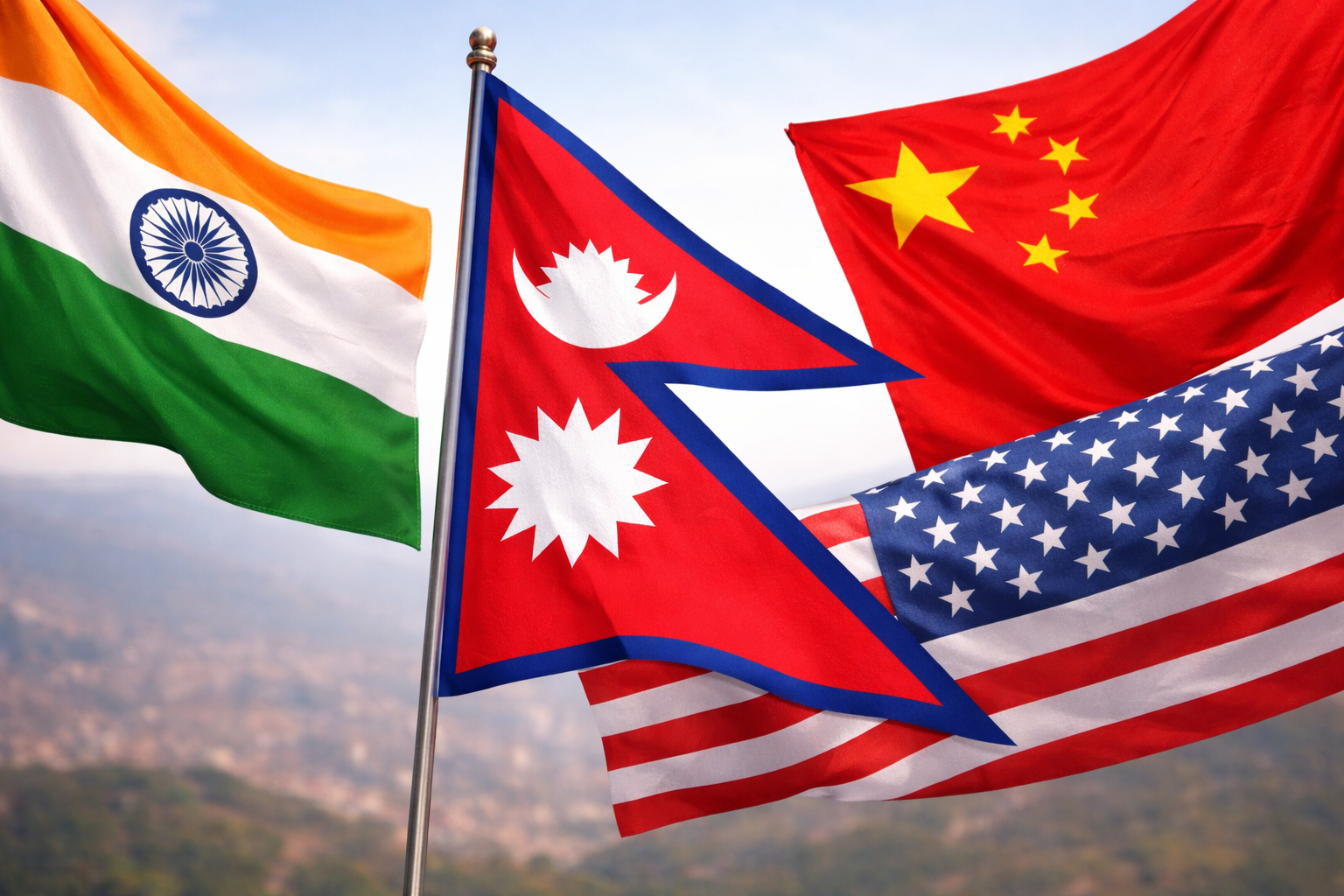
In 2023, Shah displayed a map of Greater Nepal in his mayoral office, referencing Nepal’s irredentist claims to territories lost under the 1816 Treaty of Sugauli, including areas currently administered by India. He briefly banned Indian films from Kathmandu cinemas before a court reversed the order. In November 2025, he posted a profanity-laden message on Facebook, directing expletives at India, China, the United States, and virtually every major Nepali political party. The post was deleted within 30 minutes. Two months later, he joined the RSP, one of the parties he had abused in that midnight post. None of this has particularly hurt him with voters.
What has attracted some scrutiny is his meeting with the then-US Ambassador to Nepal, Dean Thompson. The two met at Kathmandu’s city hall to discuss IT training initiatives and Nepal’s participation in UNESCO’s Creative Cities Network. Shah clarified he had secured prior permission from Nepal’s Ministry of Foreign Affairs before hosting the Ambassador. In isolation this was unremarkable. Ambassadors meet mayors. But in the fevered atmosphere of Kathmandu politics, the meeting was read by some as evidence of Western interest in shaping Nepal’s political transition.
Who Pays the Bills
This is a question that deserves a plain answer, and Kathmandu cannot provide one. Building a political party from scratch and running a credible national campaign costs serious money. When the RSP contested the 2022 general elections, barely four months after its registration, it fielded 131 candidates across 77 districts. It won 20 seats. Official disclosures to Nepal’s Election Commission show the RSP collected NPR 18.6 million (approximately Rs. 11.6 million in Indian currency) in individual domestic donations during that election year. The names of donors were not included in the report submitted to the Commission. When pressed, party officials stated that names were not made public because no single donor had contributed more than NPR 100,000 (roughly Rs. 62,500 in Indian currency). That explanation is technically permissible under Nepal’s disclosure laws. It is not, however, entirely satisfying.
The financing of political parties in Nepal is an area of systemic opacity that applies to virtually all parties, including the Nepali Congress and CPN-UML. The RSP is not uniquely culpable. But a multi-partisan parliamentary investigation committee found evidence linking nearly NPR 650 million (approximately Rs. 406 million, or roughly Rs. 40.6 crore in Indian currency) transferred from cooperatives in Butwal and Pokhara to Gorkha Media Network, a company where RSP chairman Rabi Lamichhane served as managing director before launching the party. Lamichhane has denied wrongdoing. His supporters insist the case is politically motivated. He was in custody facing fraud and money laundering charges when these elections were held. The courts will have the final word. But the trail of money running from small depositors’ savings into media infrastructure, and then into a party’s national launch, is not a trail that responsible journalism can walk past.
Then there is the geopolitical whisper circuit. In Kathmandu’s political commentariat, and in foreign policy circles in both New Delhi and Beijing, the question of who is cultivating the RSP gets raised with some regularity. Lamichhane was a former American citizen who renounced his US citizenship in 2018 and spent years in the United States before entering Nepali politics. His links to American networks are a matter of public record. Neither this fact nor Shah’s meeting with Ambassador Thompson constitutes evidence of CIA backing. It would be irresponsible to suggest otherwise without evidence, and no credible evidence has been produced. The China angle is equally speculative. RSP’s stated doctrine of balancing India and China, and its resistance to Indian political dominance, has been read by some analysts in New Delhi as convenient for Beijing’s interests. That is a strategic reading, not an evidentiary one. No documented financial link to Beijing has been established in the public record.
A more grounded explanation may be diaspora money and digital reach. Nepali expatriates enthusiastically channelled support to relatives back home to vote RSP in 2022. Combined with the genuine popular anger that drove voters away from the old parties, that may be sufficient to explain much of the rise. Political revolutions have been funded by smaller sums when the anger is real enough. But the audit question does not disappear simply because the anger is genuine.
The Death of the Old Guard
KP Sharma Oli is 74. He has been prime minister four times. He won his home constituency of Jhapa-5 six times. On Friday morning, Balen Shah was leading him there by over a thousand votes. If that result holds, it will be among the most symbolically devastating defeats in Nepali political history. The collapse of the communist and centrist parties that have dominated Nepal since the 1990s is not merely a story of ageing leaders. It is also the story of a system that repeatedly promised stability and delivered dysfunction. Nepal has had over two dozen governments in thirty years. Voters, particularly young ones, eventually noticed.
And what of the pro-monarchist camp. The Rastriya Prajatantra Party, which campaigned vigorously for the restoration of Nepal’s constitutional monarchy and its status as a Hindu state, was leading in only one seat in the early count. Former King Gyanendra Shah had drawn crowds at pro-monarchy rallies in rural districts over the past year. The royalist sentiment that once won 14 seats in 2022 appears to have been comprehensively swamped by the RSP wave.
When the Street Becomes the Party
The RSP absorbed the Bibeksheel Sajha Party and drew in several protest leaders, including Sudan Gurung, convener of the Hami Nepal pressure group. This is where the story gets harder. The transformation of street energy into institutional politics has a mixed record. In the Indian context, the Aam Aadmi Party emerged from the 2011 anti-corruption movement led by Anna Hazare, with Arvind Kejriwal positioning himself as the antidote to entrenched political culture. AAP won a landslide in Delhi in 2015 and governed for a decade. It built clinics and schools. It also stopped publishing donor lists, found itself at the centre of a liquor policy scandal, saw its senior leadership arrested, and eventually lost Delhi comprehensively in 2025. The man who had said all politicians were corrupt was being described in exactly those terms by his earliest supporters.
The pattern recurs internationally. In Italy, the Five Star Movement rode anti-party sentiment to become the country’s largest party in 2018, only to spend the following years in coalitions indistinguishable from the establishment it had promised to dismantle. In Greece, Syriza rose on the rage of the financial crisis years, then implemented the very austerity measures its base had voted specifically against. Anti-establishment parties face a structural trap: the skills required to win power from outside the system are rarely the same ones needed to exercise it from within. Nepali voters deserve to hear that plainly.
“Anti-establishment parties face a structural trap: the skills required to win power from outside the system are rarely the same ones needed to exercise it from within.”
The Geopolitical Chessboard
Nepal sits between India and China. That geographical fact has determined the country’s foreign policy choices, or lack of them, since independence. New Delhi welcomed the conclusion of Nepal’s election, affirming its commitment to work with whoever forms the next government. The diplomatic language was warm. The underlying anxiety is less so. An RSP government would be Nepal’s least predictable partner in decades. The party wants to renegotiate the 1950 Treaty of Peace and Friendship with India, which Kathmandu has long described as unequal. Shah has needled on the Kalapani-Lipulekh border dispute and has cancelled a planned visit to China over a cartographic dispute. He irritates both neighbours simultaneously, which he presumably regards as a form of balance.
It is in this context that a long-dormant historical footnote resurfaces. According to the late President Pranab Mukherjee’s autobiography, Nepal’s King Tribhuvan Bir Bikram Shah expressed to Jawaharlal Nehru in the early 1950s that Nepal might be made a province of India. Nehru reportedly declined on the principled grounds that Nepal was an independent nation and ought to remain one. Historians debate the precise status of this exchange. What it reminds us, though, is that the India-Nepal relationship has always contained layers of complexity that diplomatic pleasantries cannot fully conceal, and that choices made at critical moments echo across generations. Whether ties will become frosty under an RSP government is a question South Block is, right now, not able to answer with any confidence.
A Country at a Crossroads
Nepal’s mixed electoral system makes single-party governance extremely difficult. Voters cast two ballots: one for a candidate under first-past-the-post, and another for a party under proportional representation, which allocates a further 110 seats. Even a sweeping RSP performance in direct seats may not translate into a working majority without coalition partners who carry old establishment habits into the new cabinet. Revolutions have a way of getting diluted in the corridors.
Whether the RSP can convert this extraordinary mandate into durable change, without becoming the thing it set out to replace, is a question that will not be answered this week or next. The voters have spoken. The harder work begins now.
Subscribe Deshwale on YouTube


