









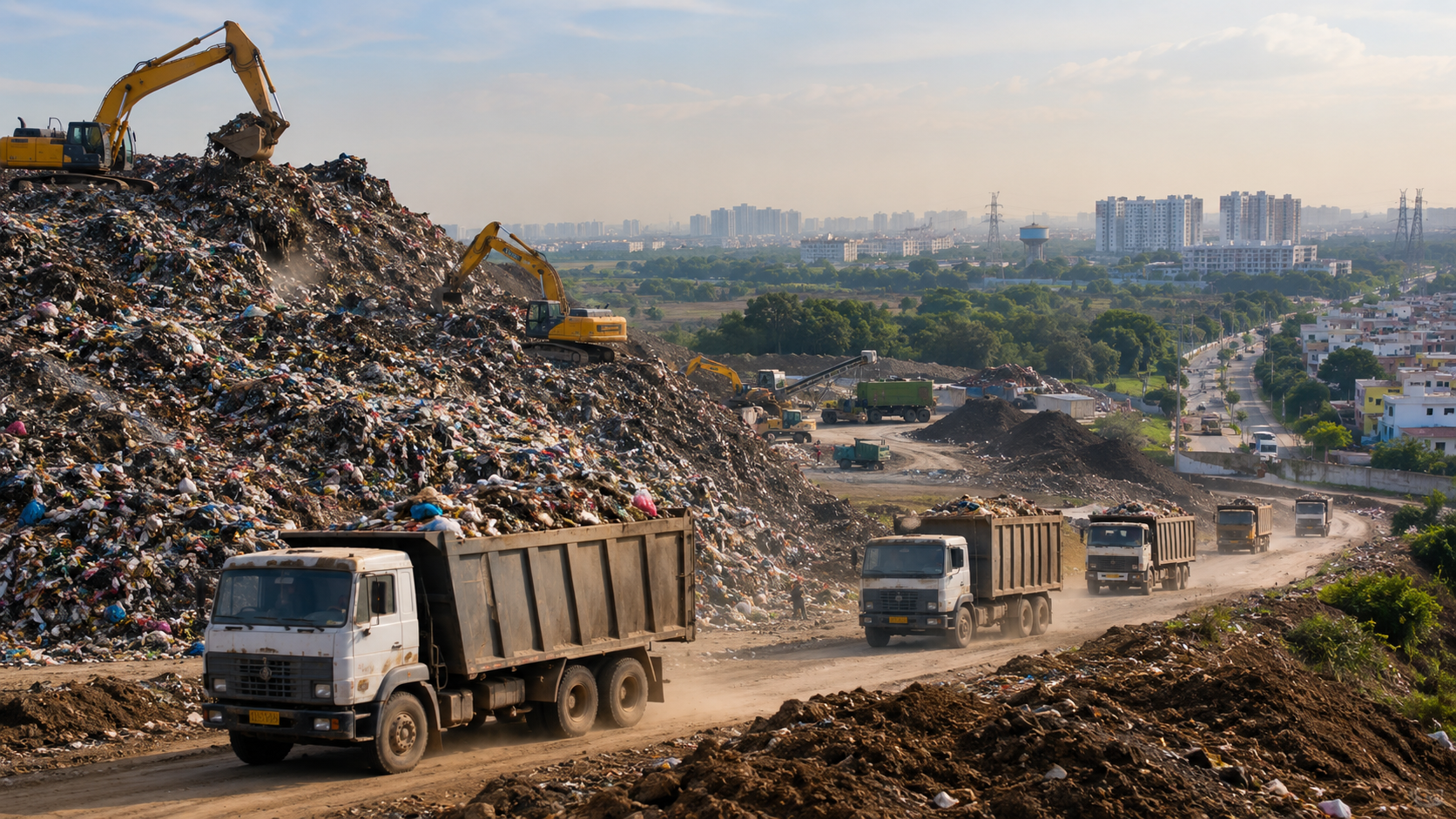
For years, the Bhalswa landfill has been Delhi’s most visible symbol of a broken waste system. A 70-acre hill of trash, rising higher than nearby buildings, sitting in full view of the city that made it.
Now, the Municipal Corporation of Delhi says the mountain is finally coming down. Officials have set December 31, 2026, as the deadline to clear the site completely. By July 31 this year, 99.07 lakh metric tonnes of old, buried waste had already been removed.
On paper, that sounds like a victory. Drive past Bhalswa today and the mound does look smaller than it once was. Excavators tear into the slopes every day, trucks line up at the gate, and officials point to falling numbers as proof that the crisis is finally being solved.
But here’s the question nobody is really asking: where does all that waste actually go?
The process used to break down the landfill is called biomining. Old, decades-buried garbage is dug up and run through machines that sort it into three broad categories. The biggest share, somewhere between 65 and 75 percent of everything processed each day, is a soft, soil-like material officials call inert waste. It’s the fine leftover debris after the sorting is done.
That inert waste doesn’t leave Delhi. It is loaded onto trucks and driven to low-lying parts of the city, including areas like Narela and Rohini, where it is used as fill material to level sunken ground.
In other words, the mountain isn’t vanishing. It’s being broken into smaller, quieter pieces and spread across the same city it came from.
Unlike Bhalswa itself, this movement doesn’t announce itself. There is no mountain rising in Narela or Rohini for anyone to point at, just truckloads of dark, dusty fill spread over sunken land, one load at a time. That quietness is part of why it rarely gets asked about.
The remaining waste has other destinations. About 8 to 10 percent is construction and demolition debris, broken concrete, bricks, and rubble. The rest, known as refuse-derived fuel, is trucked out to paper mills and cement factories outside Delhi, where it is burned in place of coal to power industrial furnaces.
So very little of what leaves Bhalswa is actually destroyed. Most of it is repurposed, relocated, or reburied. An MCD official closely involved in the project put it plainly: the goal was never to make the waste disappear, but to move it somewhere it could be put to use.
That reasoning is sound in theory, filling sunken land and replacing coal are both legitimate uses for material that would otherwise sit rotting in a landfill. But it also means Delhi’s oldest waste problem is not being solved so much as it is being redistributed.
The scale of that redistribution is enormous. In mid-August alone, contractors were clearing between 12,000 and 14,000 tonnes of old waste every single day, at a cost of around Rs 400 per tonne. A government review in May had recorded a similar daily pace, with 43 of Bhalswa’s 70 acres already cleared and about 23.17 lakh metric tonnes still remaining at the time.
Meanwhile, the city keeps generating fresh trash regardless of how fast the old pile shrinks. Around 4,000 tonnes of new, mostly decomposable waste arrive at Bhalswa every day, even as the historic mound is being cleared.
There is also a safety angle that rarely makes it into the good-news version of this story. Buried waste that has been decomposing for years produces methane, a highly flammable gas. In April 2022, a fire at Bhalswa burned for nearly two weeks, and a later study found that PM2.5 levels in the surrounding air rose by 45 to 55 percent during the blaze, with PM10 up 40 to 50 percent. Research on landfill mining elsewhere backs this up further, excavation and separation processes can themselves release methane and volatile organic compounds, meaning the act of digging up old waste carries its own emission risk, separate from the fires such sites are already prone to.
Bhalswa is not an isolated case either. It is part of a wider cleanup drive that includes the Okhla and Ghazipur landfills, with Okhla targeted for closure alongside Bhalswa this year and Ghazipur expected to follow by 2027. Officials haven’t detailed the exact waste breakdown at those two sites, but if Bhalswa’s inert-waste share holds true there too, this redistribution may not be limited to one landfill. It could be playing out at multiple sites across the city at once.
When the clock runs out on December 31, Delhi’s civic body may well be able to declare Bhalswa officially cleared. The mound that has loomed over the area since 2022, when it held roughly 73 lakh metric tonnes of waste, will likely be gone.
But the material itself won’t have disappeared. It will simply have found a second home, underneath the streets of Narela and Rohini, inside furnaces in factories outside the city, or in low-lying plots across Delhi that most residents will never think to connect back to Bhalswa.
The mountain may fall. The waste, in one form or another, is still here.
Subscribe Deshwale on YouTube


