









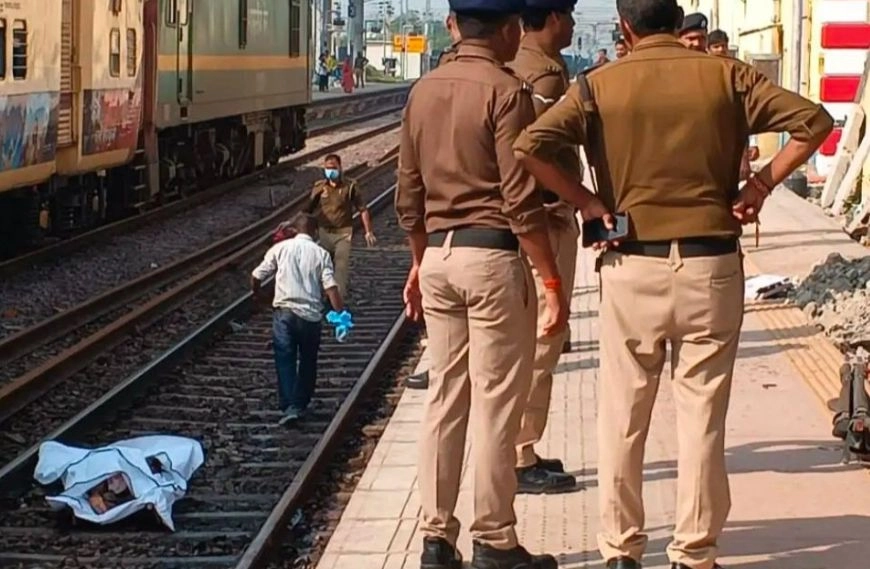
A tragic evening at Chunar railway station in Uttar Pradesh turned fatal when six devotees were run over by a speeding train. The shocking incident has once again raised serious questions about passenger safety, train scheduling, and awareness on India’s vast railway network.
The victims were reportedly returning from a pilgrimage when the tragedy struck. After their train stopped at Chunar, many passengers got down from the wrong side of the platform, trying to exit quickly instead of using the foot overbridge. In their haste to reach home, they were unaware of the danger coming from the adjacent track.
As they began to cross the tracks, another express train sped through the station on the neighbouring line, giving them no time to move to safety. Within seconds, six people were dead and several others were injured. Eyewitnesses described the scene as chaotic and horrifying. People screamed warnings, but the noise of the trains drowned everything out. Railway and district officials arrived soon after the accident, and relief operations began immediately.
The Chunar accident has once again highlighted the risks associated with India’s busy and tightly scheduled railway operations. Trains often pass through smaller stations at high speed to maintain punctuality, even while other trains arrive or depart on nearby platforms. This high-speed scheduling leaves little margin for error, especially when passengers get off from the wrong side or attempt to cross the tracks.
Experts have pointed out that although Indian Railways imposes speed restrictions near stations, enforcement and public awareness remain weak. The constant push to keep trains on time sometimes results in limited time gaps between crossings, increasing risks for passengers at smaller or semi-urban stations like Chunar.
Railway officials have repeatedly urged passengers to use foot overbridges or subways. Yet, many continue to take shortcuts because of crowding, confusion, or inadequate signage. In several rural stations, announcements about approaching trains are either unclear or made too late to be useful. Signboards, too, are often faded or poorly positioned, leaving first-time travellers unsure of which side is safe to disembark.
Most of the victims in Chunar were devotees travelling in groups, carrying bags, utensils, and small children. Their luggage and fatigue from a long journey slowed them down. By the time they realised that a train was approaching at full speed on the next track, there was no time to react.
The state government responded swiftly. Chief Minister Yogi Adityanath expressed deep grief over the incident and ordered a detailed investigation into its cause. He also announced financial compensation for the families of the victims and those injured. Railway authorities said that a probe would examine whether proper announcements were made and if staff at the station followed safety protocols.
The Chunar tragedy is not an isolated case. Over the past few years, several similar accidents have taken place across India. In 2018, dozens of people were killed in Amritsar when a crowd watching fireworks near a railway line was run over by a passing train. More recently, near Bihar and Maharashtra, people crossing tracks or getting off from the wrong side have met with similar fates. Each time, the causes are a mix of human error, poor awareness, and systemic gaps.
Despite ongoing safety campaigns, unsafe passenger behaviour continues to challenge railway safety. Overcrowded stations, insufficient infrastructure, and a lack of consistent monitoring add to the danger. With more than 13,000 passenger trains running daily, Indian Railways faces the difficult task of balancing speed, efficiency, and safety.
Experts suggest that solutions lie in both infrastructure improvement and stricter enforcement. Installing automatic platform barriers, fencing between tracks, and louder automated announcements could prevent people from stepping onto dangerous areas. CCTV-based monitoring and penalties for track-crossing can also help deter risky behaviour.
Equally important is the need for education and behavioural change. Awareness drives through digital boards, public campaigns, and school outreach can help passengers understand the real danger of crossing tracks. Local authorities and railway staff can also play a greater role by guiding passengers, especially during peak hours and religious travel seasons.
In a country where millions depend on trains every day, safety must be treated as a shared responsibility. Railways can strengthen systems, but passengers too must follow rules that are meant for their protection. The Chunar railway station tragedy serves as a painful reminder that a few minutes saved can sometimes cost a life.
India’s railways are among the busiest in the world, connecting cities, villages, and countless families. But incidents like this show that technology and infrastructure must be matched with awareness and discipline. Every platform should not only be a point of departure but also a space where people feel safe and informed.
The Chunar tragedy is more than just an accident; it is a wake-up call to re-examine how we travel, plan, and prioritise safety on the railways. In the race to keep trains on time, no timetable should come before a human life. Every journey should end at home, not in tragedy.
Subscribe Deshwale on YouTube


